UK sex survey: one in three young Britons never had sex
The UK sex survey finds one in three 16 to 24-year-olds have never had sex, as adults under 45 now average sex twice a month, down from weekly.
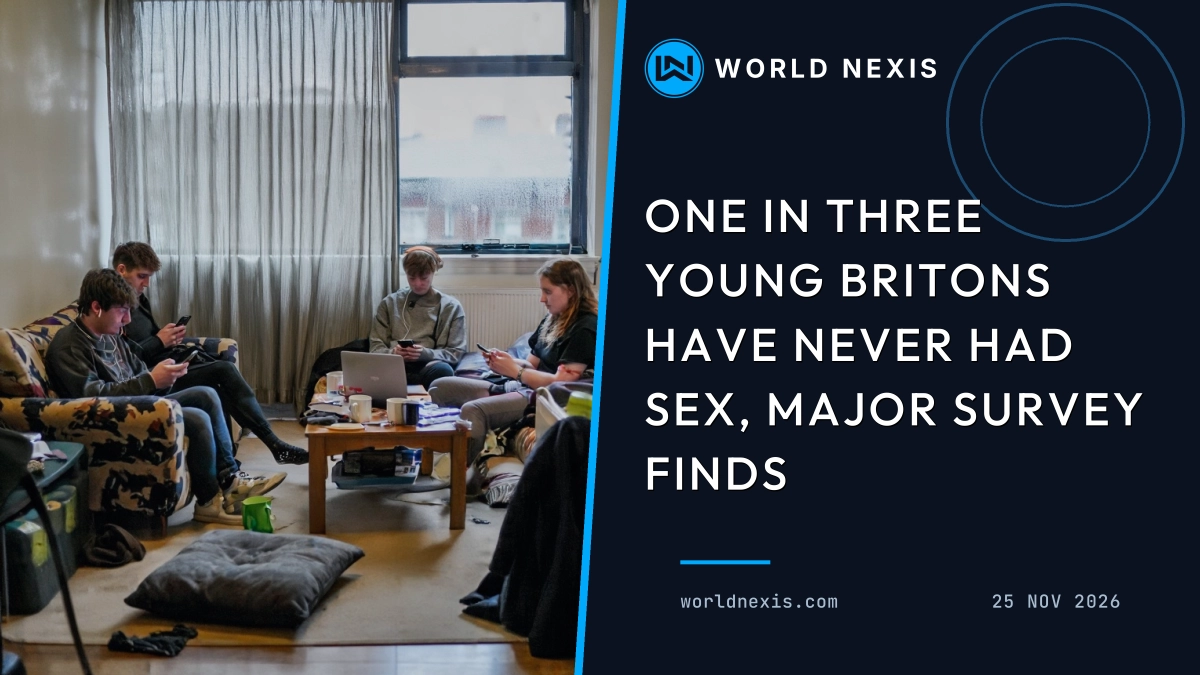
The UK sex survey has found that one in three people aged 16 to 24 in Britain have never had sex, up from around one in five in 2010. The results come from Natsal, the National Survey of Sexual Attitudes and Lifestyles, and were published in The Lancet. Researchers interviewed 6,700 people aged 16 to 59 across Britain, selected at random, between 2022 and 2024.
The UK sex survey shows adults under 45 now have sex twice a month on average, compared with four times a month in 1990-91 and three times in 2010-12. Overall, 77% of people aged 16 to 59 had sex at least once in the past year. Women reported sex once a month on average and men twice a month.
Key points
- One in three 16 to 24-year-olds have never had sex, up from around one in five in surveys between 1990 and 2010.
- Adults under 45 average sex twice a month, down from four times a month in 1990-91.
- 77% of people aged 16 to 59 had sex at least once in the past year.
- Half of young women and almost nine in 10 young men watched pornography in the past year.
What the UK sex survey found
The UK sex survey is the first Natsal round to ask about online behaviour. It found widespread engagement with pornography and sexting across age groups and genders, in line with evidence from other countries. Half of young women and almost nine in 10 young men said they had watched pornography in the past year, while among all adults aged 16 to 59 the figures were 37% of women and 81% of men.
Around half of people aged 16 to 24 have sent or received a sexual image on their phone in the past year. The authors wrote that, combined with declines in in-person sex, this “might signal a shift away from partnered physical intimacy, towards more solo and online sexual behaviour”.
They cautioned that online activity does not appear to be simply replacing sex. Pornography use and masturbation were less common among people who had never had sex, which the team said means more research is needed.
Adults under 45 are having less sex too, with the youngest groups driving much of the change. Previous rounds of the study in 1990, 2000 and 2010 put the share of 16 to 24-year-olds who had never had sex at about one in five.
Why young people are having less sex
Dr Wendy Macdowall, an associate professor at the London School of Hygiene and Tropical Medicine, said it may be tempting to blame screen time for the decline. She argued that many other factors are likely involved, “especially for young people”.
Those factors include rising rates of mental health conditions, falling alcohol use, more time spent online and a greater proportion of young adults living at home with their parents. The authors also suggested that more open discussion of consent may mean young people feel better able to decide whether and when to have sex.
Soazig Clifton, an honorary senior research fellow at University College London, said similar declines are being seen in other countries where researchers have examined links with digital technology. She pointed to housing and economic pressures, changes in how people socialise and higher rates of mental health problems. “We all want to reach for one factor, but it’s likely to be a mixture of those factors,” she said.
Figures from the UK sex survey also show a shift in attitudes to parenthood. Twice as many women said they definitely do not want children compared with more than a decade ago, rising from 8% to 17% among those aged 16 to 44. Among women aged 25 to 34 the share quadrupled, from 4% to 17%.
Dr Laura Oakley, a researcher at the London School of Hygiene and Tropical Medicine, said understanding what is driving the change should be a priority for future research and policy, “as it has real implications for planning health, care and family services”.
Why it matters
For readers, the UK sex survey is less about bedroom habits than about how public services are planned. Sexual health clinics, contraception providers and relationship education all depend on knowing how many people are sexually active, at what age and how often.
A third of young adults never having had sex changes the assumptions behind those services. So does the rise in women who say they definitely do not want children, which affects demand for contraception, maternity care and childcare places.
The findings also bear on how consent and relationships are taught. If young people delay sex while consuming more pornography, schools and parents face a harder question about what useful preparation looks like.
Analysis
Having covered public health data for World Nexis News, I look first at what a survey like this can and cannot tell us. Natsal is one of the most rigorous instruments we have for sexual behaviour, but it is a snapshot of self-reports, and its authors say plainly that it cannot explain the trend it has measured.
That is why I side with Macdowall’s multi-factor reading over the single-cause version that has shaped much of the reaction. Blaming phones is tidy, and the online shift is real, but it struggles to explain why pornography use and masturbation are less common among people who have never had sex.
The strongest counter-argument is that digital life has reshaped socialising so thoroughly that it deserves to be called the main driver. Even so, with housing costs, mental health and later parenthood all moving at once, a strategy built on one cause would fail. The UK sex survey is a measure of behaviour, not of wellbeing, and the 17% of women who say they definitely do not want children should matter more to ministers planning maternity and childcare capacity than the novelty framing suggests.
What happens next
The UK sex survey team is already considering what to add in future rounds. Clifton said the questions asked during the 2022-24 fieldwork about artificial intelligence and romantic chatbots still seemed “a little bit sci-fi” at the time. Later surveys may examine AI companions and their effect on relationships.
What we don’t know yet
The survey cannot say whether online sexual behaviour is replacing sex with a partner or simply adding to it. Nor can it isolate which explanation matters most. Further rounds of interviews will be needed before either question can be answered.
Related coverage
- Pope Francis diary: three devil visions and a power crisis
- Victims commissioner warns of crisis in 6,000-victim survey
- Vape spiking: one in eight school vapes held illicit drugs
Further reading
- One in three 16 to 24-year-olds in Britain have never had sex
- Britons having less sex than they used to, major study finds
About the author: Sofia Alvarez is the Health & Medicine Reporter at World Nexis News (WNN), covering health & medicine. The analysis section reflects the writer’s view.

Sofia Alvarez
Sofia Alvarez is Health & Medicine Reporter at World Nexis News, covering public health, clinical research, mental health and the policy decisions that shape care. Based in Manchester, she prioritises evidence over anecdote, checks claims against peer-reviewed research and official guidance, and explains uncertainty plainly…