Ambulance response times face urgent change after baby death
Ambulance response times are under scrutiny after 19-day-old Ezrah Pollard died, with a coroner warning that avoidable delays could cost more lives.
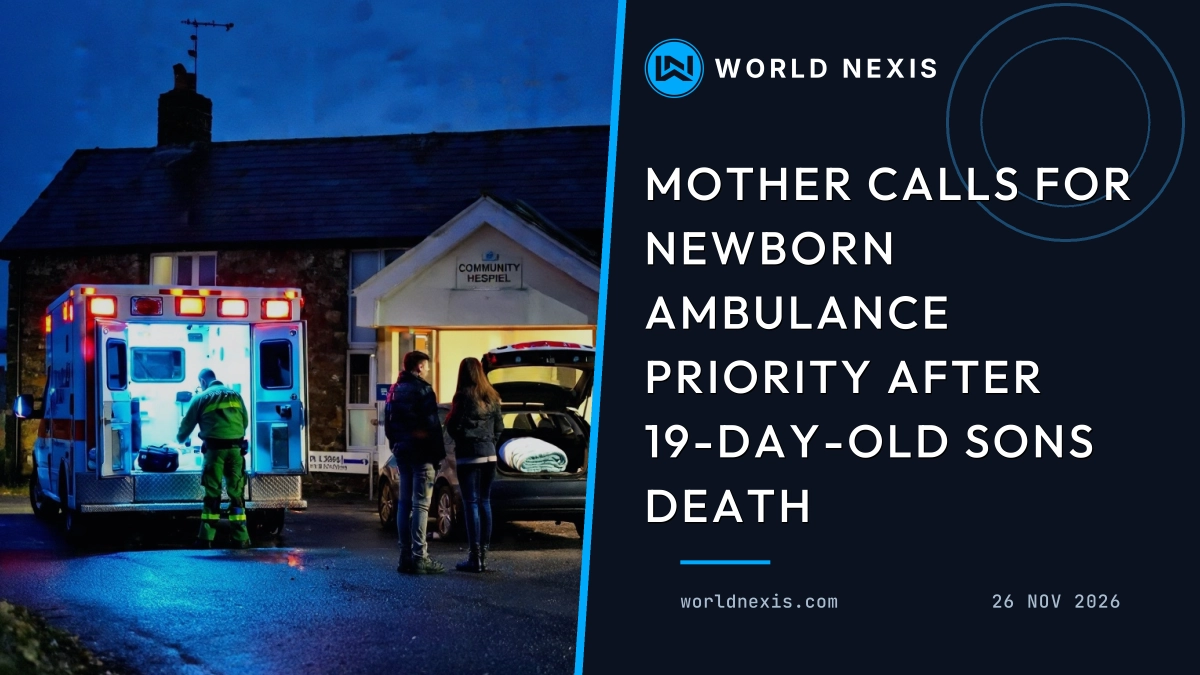
Ambulance response times for newborn babies are facing fresh scrutiny after a 19-day-old boy died of an infection his parents believe should have been treated far sooner. Sarah Doolin, 39, wants babies under three months to be graded as a higher priority after her son Ezrah Pollard died in 2022 from brain injuries caused by group B streptococcus. A coroner has now warned that an avoidable delay in getting him antibiotics may allow further deaths.
Key points
- Ezrah Pollard was 19 days old when he began showing red flag signs of infection at home in Cornwall in March 2022.
- His NHS 111 call was graded category two, the second-highest priority, and that night category two waits ran to four hours.
- Coroner Andrew Cox found an avoidable delay in reaching Ezrah and giving him antibiotics.
- There is no pathway for babies up to three months old to receive a category one response, which averages seven minutes.
- His mother is calling for ambulance response times to change so that babies under three months are prioritised.
How a suspected cold became an emergency
Ezrah was seen by a senior midwife the day before he fell ill in March 2022, and Ms Doolin said the midwife was “thrilled with his progress”. His mother first thought he had a cold, but he became less interested in feeding as the day went on. By early evening his breathing had changed into a grunt, which she later learned is a sign of infection.
His parents rang NHS 111 at roughly 8.30pm and were transferred to the South West Ambulance Service. They were told a paramedic would assess Ezrah at the family home in St Martin, Cornwall, and to wait for that visit. The call was classed category two, which usually has an average response time of 18 minutes.
When the couple chased the ambulance an hour later, it had still not been dispatched. The coroner’s prevention of future deaths report records that this was “owing to significant operational pressures”. That night, the wait for category two calls reached four hours.
With no crew on the way, the family drove Ezrah about 20 miles to the Royal Cornwall Hospital, where staff could see immediately that he was seriously ill. He was transferred to a hospital in Bristol, where a CT scan revealed devastating brain injuries. He died from late onset group B streptococcus, a bacterium carried harmlessly by between 20% and 40% of people but which can pass to a baby during birth and cause serious illness.
Coroner raises concerns over ambulance response times
Mr Cox’s report says there was an avoidable delay in getting Ezrah antibiotics, and it raises concerns that future deaths may follow if nothing is done. It also found that neither NHS 111 nor the South West Ambulance Service could give his parents a reason for the delay.
An inquest heard there is currently no pathway for babies up to three months old to receive a category one response, which averages seven minutes. Ezrah was classed category two despite showing what the report calls red flag markers of infection. These included fever, grunting, breathlessness, a “deathly colour” and drowsiness.
How the call categories work
NHS England guidance lists the situations that trigger a category one response: unconsciousness, fitting, choking on solids, cardiac arrest or major blood loss. That list sits at the centre of the argument over ambulance response times for the youngest patients.
“I would love to see that change. I don’t understand why a baby is not considered category one,” Ms Doolin said. “Newborn babies aren’t ever category one unless they’ve stopped breathing. In which case, by that point, it’s too late.”
Why it matters
For parents, this case turns on a judgement nobody trains them to make. Working out whether a grunt or a missed feed signals serious infection is hard. So the system depends on call handlers and clinicians spotting the pattern within minutes, and families are left to act alone when that fails.
If the grading rules stay as they are, the youngest patients will keep relying on ambulance response times that average 18 minutes for category two but can stretch to hours under pressure. A change would give newborns a protected place in the queue, while also altering how quickly other patients are reached.
Analysis
Having covered patient safety for World Nexis News, I look first at whether a triage category was built to catch the symptoms in front of it. In my view, the evidence here supports Ms Doolin’s campaign rather than the current rules. Ezrah had documented red flag markers of infection and still sat in a queue that had collapsed to four hours.
The strongest counter-argument is capacity. Ambulance services are measured on how fast they reach the sickest patients. Reclassifying every unwell newborn risks pulling crews away from adults in cardiac arrest. I accept that trade-off is real, but it does not answer the specific failure in this case: a pathway that escalates a baby only once breathing has stopped, when treatment is already too late to prevent injury.
What I would watch for is a written change to the newborn element of ambulance response times, not a general assurance about operational pressure. Words about demand management will not tell another parent what to do at 9.30pm when a 19-day-old is grunting in their arms.
What happens next
The prevention of future deaths report places the coroner’s concerns formally on record, and the organisations named in it now face questions about what they will change. Ms Doolin is continuing to press for babies under three months to be treated as category one.
What we don’t know yet
The material published so far does not say whether NHS England or the South West Ambulance Service accepts the coroner’s findings, or how quickly any review of ambulance response times would report back. Nor is it clear how many other newborns have been graded category two while showing similar red flag signs.
Related coverage
- Macy’s parade balloons face wind warning at 100th event
- Chloe Mitchell murder trial: jury sworn in over 2023 death
- Lambhill shooting: £20,000 reward in urgent appeal
Further reading
- Woman calls for change in ambulance responses after death of newborn son
- Woman calls for change in ambulance responses after death of newborn son
About the author: Sofia Alvarez is the Health & Medicine Reporter at World Nexis News (WNN), covering health & medicine. The analysis section reflects the writer’s view.

Sofia Alvarez
Sofia Alvarez is Health & Medicine Reporter at World Nexis News, covering public health, clinical research, mental health and the policy decisions that shape care. Based in Manchester, she prioritises evidence over anecdote, checks claims against peer-reviewed research and official guidance, and explains uncertainty plainly…