Iran Starlink use alleged in classified US war update
Iran Starlink use: a classified war update described Tehran using Elon Musk's satellites for drone attacks, but the Pentagon says it is unaware.
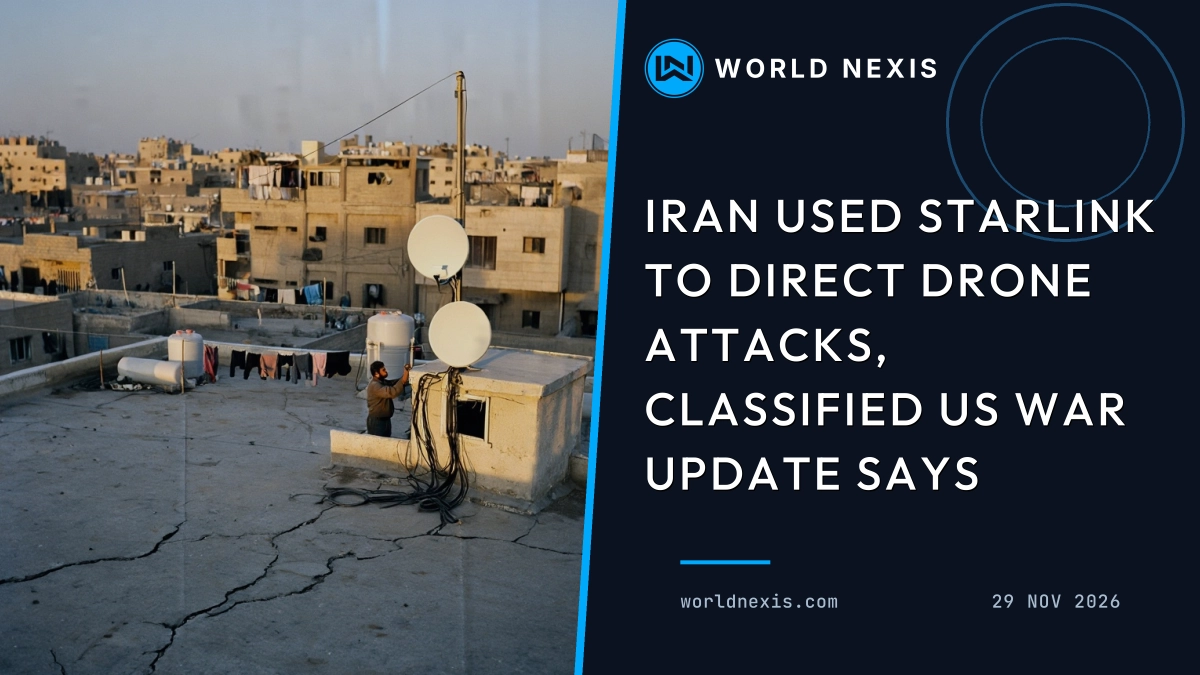
Iran Starlink use helped Tehran coordinate attacks on US forces in the opening weeks of the war, according to a published account that the Pentagon says it has no record of. The findings rest on four people familiar with the operations. They describe Iranian commanders relying on Elon Musk’s satellite internet service in early March, after the United States and Israel began striking Iran and Tehran retaliated with missiles and drones against American bases across the region.
The disclosure puts a civilian network at the center of a shooting war, and raises hard questions about who can switch it off. It also exposes an awkward overlap: US forces were using the military version of the same system at the same time.
Key points
- Iran Starlink use covered command and control and the oversight of one-way attack drone operations, according to the account.
- A classified war update delivered to Defense Secretary Pete Hegseth over the summer briefly described the Iranian use.
- The Pentagon says it is not aware of a Central Command report to the defense secretary’s office on the subject.
- Musk was angered by both Iran’s use of the service and the US military’s use of Starshield, its militarized version.
What the Iran Starlink report says
Starlink appears to have given Tehran an alternative communications channel just as US forces were working to degrade Iran’s traditional military networks. Operators used it to pass commands and to watch over one-way attack drones in the first phase of the campaign. The Iranian use had not previously been disclosed.
The classified war update reached Hegseth’s office over the summer, according to a person familiar with the document. It is that document the Pentagon now says it cannot trace. Spokeswoman Kingsley Wilson said the department was not aware of the existence of a Central Command report to the secretary’s office on the subject. She declined to comment on whether Iran had used the service in military operations.
The Starshield complication
Musk was told at the same time that the US military had flown one-way drones on Starshield, the militarized network sold to government users, while paying for a cheaper tier intended for ground operations. Two people familiar with internal company discussions said he was furious at both discoveries. SpaceX and the Defense Department did not immediately respond to requests for comment.
Pentagon pushback and the wider Iran Starlink questions
The Iran Starlink claims are disputed in part by the Pentagon itself. The Defense Department said it was not aware of the report to the office of the defense secretary on this subject, and Central Command declined to answer detailed questions. An Iranian drone strike killed six US soldiers at a military facility at Kuwait’s Port Shuaiba on March 1, but the account did not establish whether Starlink played any part, and the Pentagon has not made its investigation public.
Starlink is not licensed to operate in Iran, although Musk has previously said the service is active there. That gap between licensing and reality sits at the heart of the problem, because terminals sold through resellers are hard to trace once they leave the warehouse. Satellite industry executives have said that once hardware reaches the public, keeping it out of an adversary’s hands becomes close to impossible.
Cari Stinebower, a former US Treasury Department lawyer, pointed to Iran’s long experience of sanctions evasion. “The Iranians are really good at this,” she said, adding that front companies working through third countries could have fooled legitimate exporters. “It’s just really hard to police it.”
Why it matters
For the families of US service members in the region, the immediate question is whether a consumer service with a civilian price list helped an adversary target American bases, and why so little has been said publicly. No findings from the investigation into the Port Shuaiba strike have been released.
For Iranians, the trade-off is brutal. Switching Starlink off nationwide could silence dissidents who depend on it during state-imposed blackouts. Leaving it on keeps the door open for the Islamic Revolutionary Guard Corps. That is the Iran Starlink question in its sharpest form: a life-or-death call made by a private company and, in effect, by Washington.
Analysis
Having covered sanctions and conflict for World Nexis News, I look first at the plumbing of a story like this: who sold what, to whom, and under which plan. On that reading, the Iran Starlink disclosures are less a story about Iranian ingenuity than a story about commercial controls that were never designed for wartime. Tehran did not break the network. It bought or borrowed its way onto a system whose reseller chain is extremely difficult to police, exactly as sanctions specialists have warned for years.
I also think the Pentagon’s denial is narrower than it sounds. Saying you are not aware of the existence of a Central Command report is a statement about paperwork, not about whether Iranian drones ran on satellite links. A classified update that reached the secretary’s office and cannot now be traced is a records problem worth its own scrutiny. The strongest counter-argument is that anonymous wartime sourcing from a single account is a thin foundation for firm conclusions, and I accept that caution.
Where I come down: the evidence better supports the view that this is a dual-use export-control failure rather than a Pentagon plot. Musk’s own anger, the reseller loophole and Iran’s record of procurement trickery all point the same way. What would change my mind is proof that US commanders knew about Iranian Starlink traffic and stayed quiet. Nothing in the public record yet shows that.
What happens next
The Iran Starlink account remains unconfirmed in its operational detail, and SpaceX has not responded publicly to it. The Defense Department has given no timetable for releasing anything about the Port Shuaiba investigation, and Central Command has declined to answer detailed questions. No hearing, deadline or formal review has been announced in the reporting so far.
What we don’t know yet
- Whether Starlink played any role in the March 1 strike on the facility at Port Shuaiba.
- Which terminals, bought through which resellers, reached Iranian military units.
- Whether the classified war update sent to the defense secretary’s office still exists in retrievable form.
Related coverage
- Iran war: AI video’s warning to Microsoft and SpaceX
- Strait of Hormuz: Iran claims control amid US blockade
- Iran naval blockade: US disables 15th ship in Gulf of Oman
Further reading
- Iran used Starlink in attacks on US, Washington Post
- Iran reportedly used Musk’s Starlink to support attacks on US forces | The Jerusalem Post
About the author: Marcus Ellington is the International Correspondent at World Nexis News (WNN), covering world affairs. The analysis section reflects the writer’s view.

Marcus Ellington
Marcus Ellington is International Correspondent at World Nexis News, reporting on diplomacy, conflict and the political forces reshaping Europe, the Middle East, Asia and the Americas. Based in London, he focuses on explaining why events unfold as they do, using official statements, diplomatic documents and…