Iran naval blockade: US disables 15th ship in Gulf of Oman
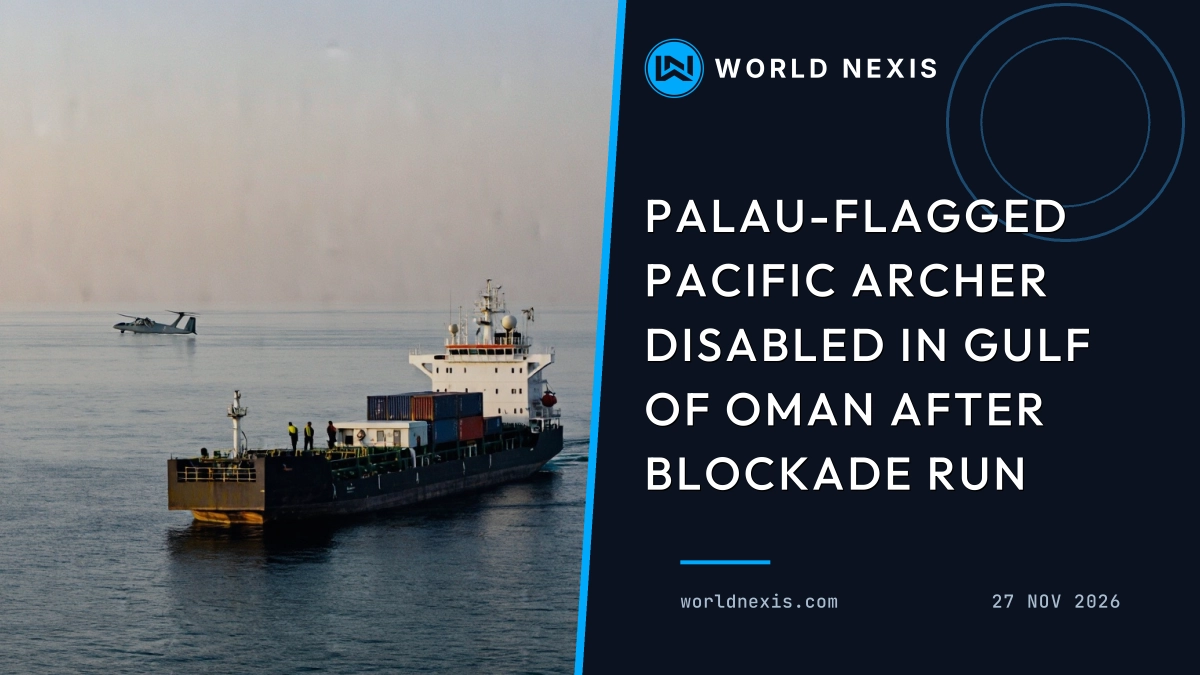
US forces fired precision munitions at the Palau-flagged Pacific Archer in the Gulf of Oman, the 15th ship stopped under the Iran naval blockade.
Updated 28 Nov 2026, 06:51 (UK time): Iran’s senior leadership publicly vowed to break the Iran naval blockade and its navy commander claimed escorted convoys are still running, while Washington announced a new task force to police Iran’s land borders and the Caspian Sea.
Iran’s leadership has answered the latest disabling of a ship with a public pledge to break the Iran naval blockade. Mohammad Mokhber, an adviser to Supreme Leader Ayatollah Mojtaba Khamenei, said in remarks carried by state media that “neither will the Strait of Hormuz be reopened, nor will we allow the blockade to remain in place,” without setting out how Tehran would act.
Iranian navy commander Shahram Irani told state television that “breaking through the enemy blockade is underway and our ports are active today,” adding that maritime escorts are taking place and that the campaign to cut off Iran’s economic lifeline has so far failed. Foreign ministry spokesman Esmaeil Baqaei said on Monday that Tehran would use every means at its disposal against the blockade. Iranian officials have also said Hormuz could reopen within two days if Washington lifts the blockade and meets its other demands.
The US military, for its part, has announced Task Force Iron Gate, intended to restrict the movement of weapons and sanctioned materials across Iran’s land borders and the Caspian Sea, pushing enforcement beyond the waterway. Central Command says six ships have been disabled and 158 redirected since enforcement resumed.
The pledges from Tehran are declarations of intent, not a breach: no escorted convoy has been publicly confirmed reaching a port. But the contest is now openly framed by both capitals as a test of will, which makes a single successful run far more dangerous than another disabled hull.
The US military has disabled a merchant ship in the Gulf of Oman after it tried to run the Iran naval blockade, firing “precision munitions” at the vessel’s stern, US Central Command said on Friday. The Palau-flagged M/V Pacific Archer was struck by a military aircraft on Thursday, and its civilian crew was unharmed. It is at least the 15th vessel publicly confirmed as disabled since the blockade of Iranian ports began in the spring.
Key points
- Central Command said a military aircraft fired precision munitions at the stern of the Pacific Archer on Thursday.
- The ship left Iran’s Bandar Abbas port before attempting to run the blockade; tracking sites list Singapore as its destination.
- It is at least the 15th disclosed vessel disabled since the Iran naval blockade began, and the sixth since the operation resumed in July.
- Iran’s Revolutionary Guard said two tankers used an “unauthorized” route through the Strait of Hormuz, and that one hit a naval mine.
How the strike on the Pacific Archer unfolded
According to Central Command, the Pacific Archer left Bandar Abbas, Iran’s main container port, before turning toward the blockade line in the Gulf of Oman. Ship tracking websites list the vessel’s destination as Singapore. A military aircraft then fired precision munitions at the ship’s stern.
“The ship’s propulsion was ultimately disabled and the civilian crew was unharmed,” the command said in its statement. Central Command added that the crew tried to breach the blockade despite multiple warnings. The command has consistently said its forces issue several warnings to merchant ships before firing on them.
Thursday’s operation fits a pattern. The Pacific Archer is at least the 15th disclosed vessel disabled since the Iran naval blockade began in the spring, and the sixth since it resumed this summer. The previous ship was disabled on Nov. 7.
Why the Iran naval blockade keeps producing confrontations
The Iran naval blockade has been in force, with one pause, since April. Enforcement was lifted during the summer while talks with Tehran were under way, then restarted in July. Since the restart, the US military says it has redirected 158 merchant ships and disabled those that refuse to comply.
That enforcement sits inside a wider war that began at the end of February and has settled into a quiet stalemate in recent months. President Donald Trump has alternated between threatening further large-scale strikes on Iran and insisting the war “militarily is effectively over.” The US has kept a large naval force in the region, including a constant presence of two aircraft carriers.
Diplomacy has not stopped. Government and security officials from Gulf countries, as well as Pakistan and Turkey, have run a campaign of phone calls with senior US officials aimed at heading off a renewed war.
The Iran naval blockade has also produced deaths. In June, three Indian sailors were killed when American forces struck the tanker M/T Settebello as it tried to evade the blockade, officials in India said at the time. The head of the International Maritime Organization, a United Nations agency, condemned that strike.
Tehran’s own warning to shipping
Iran does not accept Washington’s authority over the waterway. The Revolutionary Guard said on Friday that two tankers had tried to transit the Strait of Hormuz through an “unauthorized” route. In a statement carried by Iran’s state broadcaster, the Guard said one tanker struck a naval mine and the other was forced to turn back.
The Guard added that the number of oil tankers using unauthorized routes in the strait had fallen sharply in recent days. Iran continues to warn ships not to pass through the strategic lane without approval from Tehran.
Why it matters
For shipowners, insurers and crews, the Gulf of Oman and the Strait of Hormuz remain a live hazard rather than a settled trade route. Every disabled ship adds cost and delay to oil and container traffic through the world’s most important energy chokepoint. Households eventually pay for that through fuel and freight prices.
For Washington, each interception is a test of whether a stalemate can be managed. One misjudged shot, or a crew that leaves a warning too late, could turn the Iran naval blockade into the incident that forces a wider war.
Analysis
Having covered sanctions and maritime enforcement for World Nexis News, I look first at the arithmetic rather than the rhetoric. Fifteen disclosed vessels, 158 ships turned back, six interceptions since July: the Iran naval blockade is no longer an emergency measure. It is a standing operation that has outlived the diplomatic moment that might have ended it.
In my view, the record supports the critics more than the defenders. A blockade is only as precise as the crew receiving the final warning, and the June deaths on the Settebello showed what happens when that assumption fails. Describing a strike on a ship’s stern as precise tells you about the weapon, not the consequence.
The strongest counter-argument is that dropping enforcement would make the Iran naval blockade meaningless and invite Tehran to test every lane, which is a fair point. But a tool used 15 times without any public legal accounting stops being leverage and becomes a habit, and habits are how unwanted wars begin.
What happens next
The Iran naval blockade will continue while the Trump administration weighs its options, and enforcement is likely to keep producing the same kind of encounter. Tehran shows no sign of accepting the restrictions, and the Revolutionary Guard’s latest statement restates its demand that ships seek approval before entering the strait.
The diplomatic track involving Gulf states, Pakistan and Turkey is the main brake on a return to large-scale fighting. Whether it holds depends on decisions in Washington that have not yet been announced.
What we don’t know yet
- What will happen to the Pacific Archer, its cargo and its crew, and whether the ship will be towed to a port.
- Whether Washington will authorise further large-scale strikes on Iran.
- What evidence Tehran holds for its claim that a tanker struck a naval mine in the Strait of Hormuz.
Related coverage
- Iran naval blockade vow as MP warns over Hormuz control
- National Dog Show: Rocker clinches 15th Best in Show title
- Zelensky interview: Putin a ‘killer’, Ukraine warns US
Further reading
- US military says it disabled another ship that tried to breach naval blockade on Iranian ports
- US military says it disabled another ship that tried to breach naval blockade on Iranian ports
About the author: Marcus Ellington is the International Correspondent at World Nexis News (WNN), covering world affairs. The analysis section reflects the writer’s view.

Marcus Ellington
Marcus Ellington is International Correspondent at World Nexis News, reporting on diplomacy, conflict and the political forces reshaping Europe, the Middle East, Asia and the Americas. Based in London, he focuses on explaining why events unfold as they do, using official statements, diplomatic documents and…



