Iran naval blockade vow as MP warns over Hormuz control
Iran naval blockade: an Iranian MP says Tehran will break it and controls the Strait of Hormuz, as Trump says victory is 'at hand' and offers a deal.
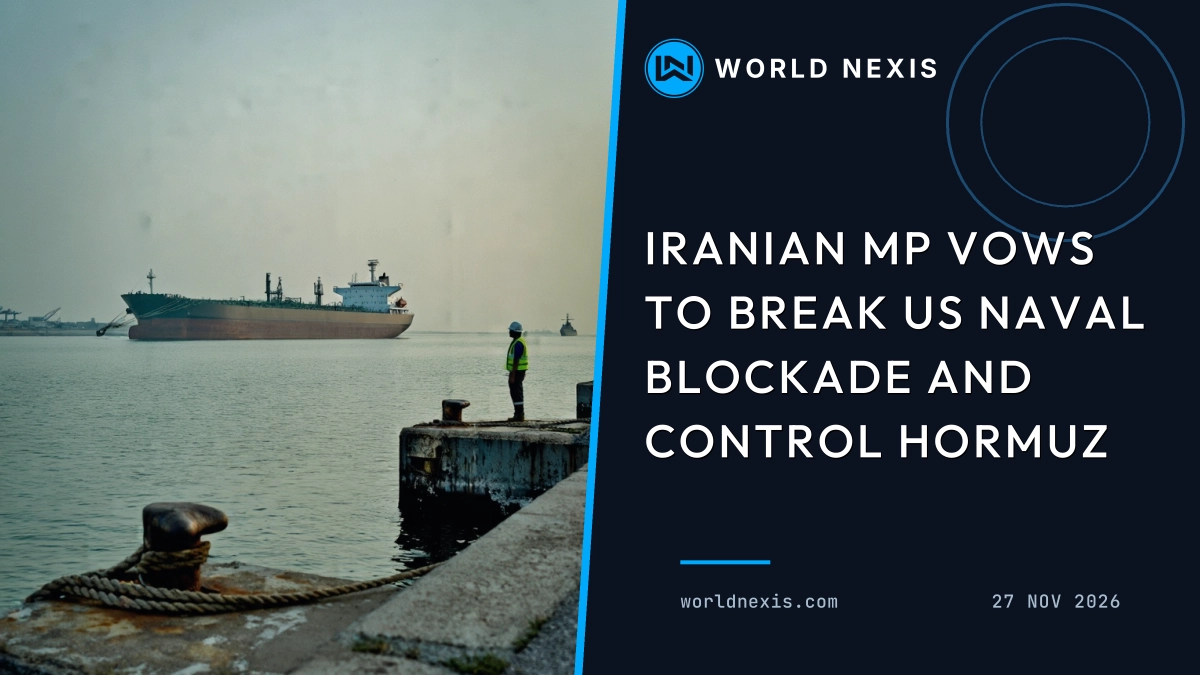
The Iranian government’s promise to break the Iran naval blockade has turned into an open challenge to Washington, after a senior lawmaker in Tehran claimed the country holds “full control” of the Strait of Hormuz. Esmaeil Kowsari, a member of the National Security and Foreign Policy Commission of the Iranian Parliament, made the remarks on state broadcaster IRIB on November 27.
He said Iran’s armed forces had been preparing to secure the waterway since 1987. He also warned neighboring states against allowing their territory or military infrastructure to be used for operations against Iran.
Key points
- Iranian MP Esmaeil Kowsari said the US naval blockade will be broken by Iran’s armed forces.
- He claimed Tehran has full control of the Strait of Hormuz and will decide when to respond to “enemy actions.”
- President Donald Trump said victory is “at hand” and that Tehran is getting “every chance to make a deal.”
- Foreign Minister Seyed Abbas Araghchi said Tehran’s priority is economic resilience, with Qatar and Pakistan still mediating.
What Kowsari said about the Iran naval blockade
Speaking on state television, Kowsari framed the Iran naval blockade as a test of military strength rather than a diplomatic problem. He said Iranian missile and drone capabilities had changed American calculations in the region. He also credited those capabilities for the withdrawal of US warships, a claim Washington has not echoed.
“The US naval blockade will be broken by the strategies and capabilities of Iran’s armed forces, and the timing and method of responding to enemy actions are at the discretion of the armed forces of the Islamic Republic of Iran,” he said.
Kowsari then aimed a warning at Iran’s neighbors and at Europe. Any country that hands Washington its territory or military capacity for action against Iran, he said, will carry responsibility for what follows.
“Any country that provides its capabilities and territory to the United States for action against Iran will be responsible for the consequences, and the use of European airspace to attack Iran will not go unanswered by the Islamic Republic,” he said.
He added that disruption to commercial shipping through the strait would impose high economic costs on countries across the region. At the same time, he said Tehran is not seeking to start a war or to stretch out the current conflict.
The Revolutionary Guard said separately that its air defenses fired warning shots at a US F-16 that it said was providing air cover for vessels violating the blockade. That account has not been independently confirmed.
Trump says victory is ‘at hand’ as the Iran naval blockade holds
President Donald Trump used a Thanksgiving call with US military personnel from his Mar-a-Lago residence in Florida to say that victory over Iran is within reach. He said the timing would be his decision, and that Washington is offering Tehran a route to an agreement.
“We have victory at hand. It will happen whenever I want it to happen. We are trying to be nice. We are giving them every chance to make a deal and save a lot of lives, but I am not sure if they are going to take advantage of that,” Trump said.
Iran’s foreign minister answered with economics rather than escalation. Seyed Abbas Araghchi said the immediate priority is hardening Iran against external pressure while keeping trade and essential supplies moving without interruption.
He said diplomatic channels are still working, with Qatar and Pakistan carrying proposals between the parties. Araghchi accused Israel of trying to create the conditions for a renewed military confrontation and to pull Washington into another conflict. Iran, he said, will defend itself but will keep negotiating if its demands are respected.
Why the Iran naval blockade matters beyond the Gulf
The Strait of Hormuz is the region’s main export channel for oil and gas, and Kowsari’s own warning about shipping costs shows how fast a naval standoff travels. Interruption reaches ordinary households through fuel prices, freight rates and insurance premiums long before any warship fires.
For Washington, the Iran naval blockade is now a test of whether military pressure produces concessions or a harder Iranian stance. For Tehran, the costs are already visible in disrupted trade, which is why Araghchi put supply lines ahead of rhetoric this week.
Analysis
Having covered Middle East security and sanctions for World Nexis News, I look first at who a statement is built for. Kowsari spoke on domestic state television, in the language of capability and retaliation, at the very moment Washington says it is holding out a deal. That combination points to a government managing its own public rather than preparing a first strike.
In my view, the evidence supports the reading that Tehran is bargaining from a weaker position than its rhetoric suggests. Kowsari’s insistence that the “timing and method” of response rest with Iran’s armed forces is a claim about future choices, not a report of action, and his emphasis on the economic pain felt by neighbors reads as an attempt to split the coalition behind the blockade. The strongest counter-argument is genuine, though: Iran’s missile and drone programs give it real capacity to make the strait dangerous, and one misread warning shot could escalate faster than either capital intends.
What I would watch next is whether Iranian officials begin naming shipping companies, insurers or specific vessels instead of speaking in general terms. Concrete targets signal enforcement; broad vows signal negotiation.
What happens next
Mediation through Qatar and Pakistan is expected to continue, with proposals moving between Washington and Tehran. Trump has set no deadline, saying only that the timing of any victory depends on his decision. Kowsari said Iran’s armed forces will choose when and how to answer any further action against the country.
What we don’t know yet
- Whether Washington will tighten the blockade or ease it to encourage talks.
- Whether the Guard’s account of warning shots near a US aircraft will be confirmed.
- Whether Tehran’s public position shifts if traffic through Hormuz falls further.
Related coverage
- Democratic majorities vow major corruption crackdown
- Mitchells & Butlers warns of £95m extra costs next year
- EasyJet profits: boss warns fares will rise after 96% slump
Further reading
About the author: Marcus Ellington is the International Correspondent at World Nexis News (WNN), covering world affairs. The analysis section reflects the writer’s view.

Marcus Ellington
Marcus Ellington is International Correspondent at World Nexis News, reporting on diplomacy, conflict and the political forces reshaping Europe, the Middle East, Asia and the Americas. Based in London, he focuses on explaining why events unfold as they do, using official statements, diplomatic documents and…