College Board cyberattack exposes data, shuts aid tool
The College Board cyberattack has left new account registration and the CSS Profile aid form offline, with hackers exposed basic user data late on Friday.
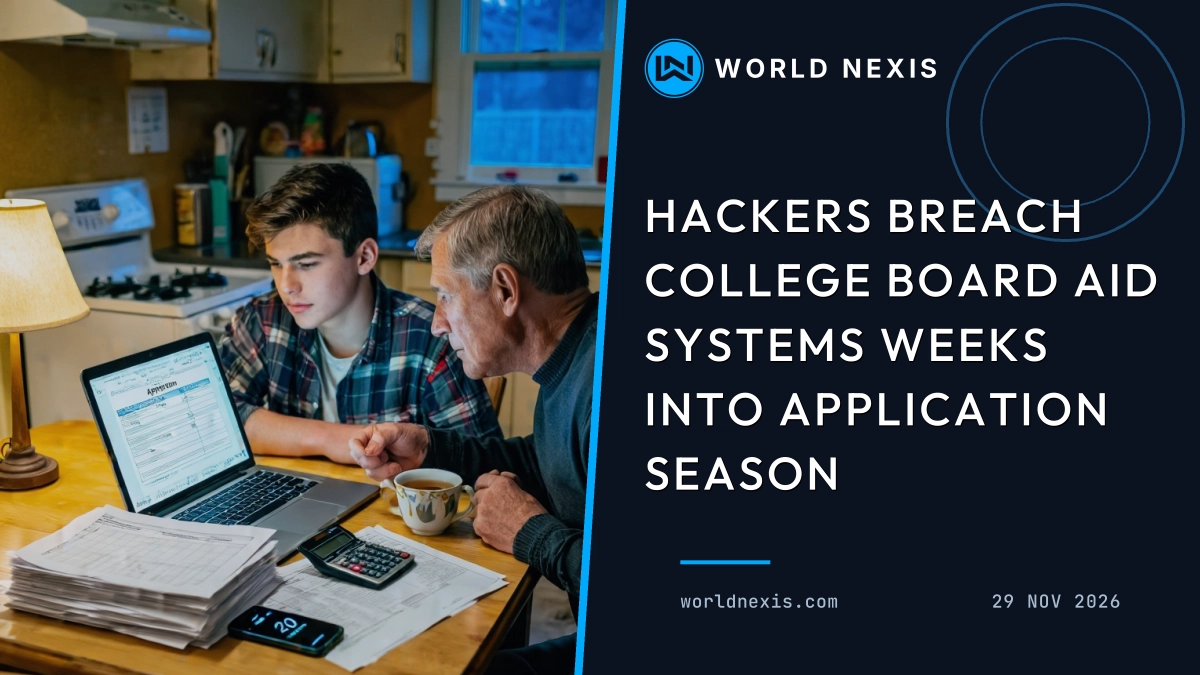
The College Board cyberattack has closed two of the busiest gateways into American higher education: new account registration is suspended and the CSS Profile financial aid application is offline. The New York-based nonprofit, which runs the SAT, said late on Friday that intruders reached the systems students use to open accounts and submit aid applications.
Basic account information for some users was exposed, and attackers were able to start password resets in certain cases. Both services remain unavailable. Spokesperson Massie Ritsch said investigators are still assessing the effect on people who use the CSS Profile, the form colleges and scholarship programs use to award non-federal institutional aid.
Those applications routinely carry family income and tax details, which makes the open questions about that system more sensitive than the account data itself. Millions of students use the College Board’s programs each year to seek admission, earn academic credit and apply for financial aid.
Key points
- New College Board accounts cannot be created and the CSS Profile is temporarily unavailable while a forensic investigation continues.
- Early findings point to a “small subset” of the organization’s millions of accounts, with names and email addresses exposed.
- The College Board says it has found no evidence of improper access to its repository of test scores and content.
- Preliminary findings suggest the intruders used ARTEX, an open-source artificial intelligence tool the FBI warned about last week.
The College Board cyberattack: what has been confirmed
The organization’s own account of the incident is narrow. Hackers reached the systems used to create new College Board accounts and to submit CSS Profile applications. The data taken was basic, with names and email addresses among the exposed fields, and Ritsch has described the affected group as a small subset of the millions of user accounts the nonprofit holds.
What the College Board has ruled out, on current evidence, is the worst-case version of the story. It says there is no sign of “improper access to our repository of test scores and content”. That distinction matters to students who have spent years building an academic record through the SAT and Advanced Placement programs.
In response, new account creation was suspended and the CSS Profile was taken offline for the duration. “We will let users know when these services can be safely restored,” the organization said, without offering a timetable.
Artificial intelligence moves to the center of the case
The preliminary assessment points at AI rather than a conventional intrusion. In a statement on Friday, the College Board said it believed “this activity involved sophisticated AI tools that have recently been leveraged to gain access to the systems of other major institutions worldwide”.
Ritsch went further. The spokesperson said early findings suggest the attackers used ARTEX, an open-source AI tool that the FBI warned last week had been deployed since August in cyberattacks on companies and government agencies.
That warning now covers a widening list of targets. The incident follows an intrusion into the US Air Force’s flagship cloud computing platform and a cyberattack on FIFA, soccer’s global governing body. Governments and insurers have warned publicly that AI has increased the risk of cyberattacks, and the wave is no longer confined to one sector.
For the College Board, the harder problem is verification. The organization cannot yet say how far the intruders went inside the CSS Profile system, and it has not published a number for affected accounts.
Why it matters
For a family in the middle of the cycle, the College Board cyberattack is not really a data story. It is a closed form at the moment students finalize where they can afford to apply, and aid paperwork is often the last thing standing between an offer and a place. A suspended application tool can move a deadline that families planned around for months.
The College Board data breach also exposes a structural weakness. The login a student creates for a test sits beside income statements, tax returns and institutional aid decisions, so a small slice of account data is a useful map for anyone who wants more. When a password reset is issued by an intruder rather than the user, the account is being tested, not merely listed.
None of this touches the exam calendar or the security of scores, which the organization says are intact. The exposure is administrative rather than academic, and that is where families should aim their attention.
Analysis
I think the “small subset” framing is honest and still misses the point. The number of accounts matters less than what sits behind them: an aid form holding income and tax detail, and a login that most students reuse elsewhere. A password reset started by an attacker is not a data loss on its own, but it is the exact lever that turns one email address into a run at other accounts.
The counter-argument deserves room. Nothing suggests test scores were read, the exposed fields are basic, and early breach estimates routinely grow or shrink as forensics proceed. If the College Board is right that a handful of accounts were touched and nothing sensitive was taken, this ends as a short spell of inconvenience for a few thousand families.
I still side with the FBI’s warning over the company’s calm. Having covered cybercrime and AI policy for World Nexis News, I look first at the tooling: an open-source tool reported to have been in circulation since August and used against companies and government agencies, now named in an attack on the administrator of the SAT.
When one instrument keeps turning up across very different targets, defensive spending is lagging. That is a policy question rather than a communications one, and it will outlast this particular breach.
What happens next
The forensic investigation is the binding constraint. The College Board has promised to tell users when account creation and the CSS Profile can be restored safely, and it has given no date. Ritsch said the effect on CSS Profile users is still being assessed, so the first firm figures on who was affected should follow that work rather than precede it.
For applicants, the CSS Profile outage is the one to watch. Restoring account creation without the aid form returns only half the service, and the aid side is where the sensitive data sits. The FBI’s ARTEX warning is meanwhile in force, and the Air Force and FIFA incidents show the same tools being pointed at institutions far beyond education.
What we don’t know yet
- How many accounts were affected, beyond the organization’s “small subset” description.
- Whether financial aid data, including income and tax information, was read rather than merely present.
- Whether the password resets led to further access on or off College Board systems.
- When the two suspended services reopen.
Related coverage
- Cloud One breach: Air Force hack spared critical systems
- Cloud One hack: Cyber Command called in over major breach
- DWP cyber incident: department confirms attack as services stay offline
Further reading
- College Board financial aid profiles, student registration hit by cyberattack during college application season, company says
- Cyberattack on US College Board exposed user data
About the author: Priya Nair is the Technology Correspondent at World Nexis News (WNN), covering technology. The analysis section reflects the writer’s view.

Priya Nair
Priya Nair is Technology Correspondent at World Nexis News, covering artificial intelligence, cybersecurity, consumer devices and the companies building them. Based in London, she explains how new technology works, who it affects and what the evidence actually shows, with attention to privacy, competition and the…