Cloud One hack: Cyber Command called in over major breach
The Cloud One hack has halted software fixes on the US Air Force's flagship platform, with Cyber Command called in and 200+ sites relying on it.
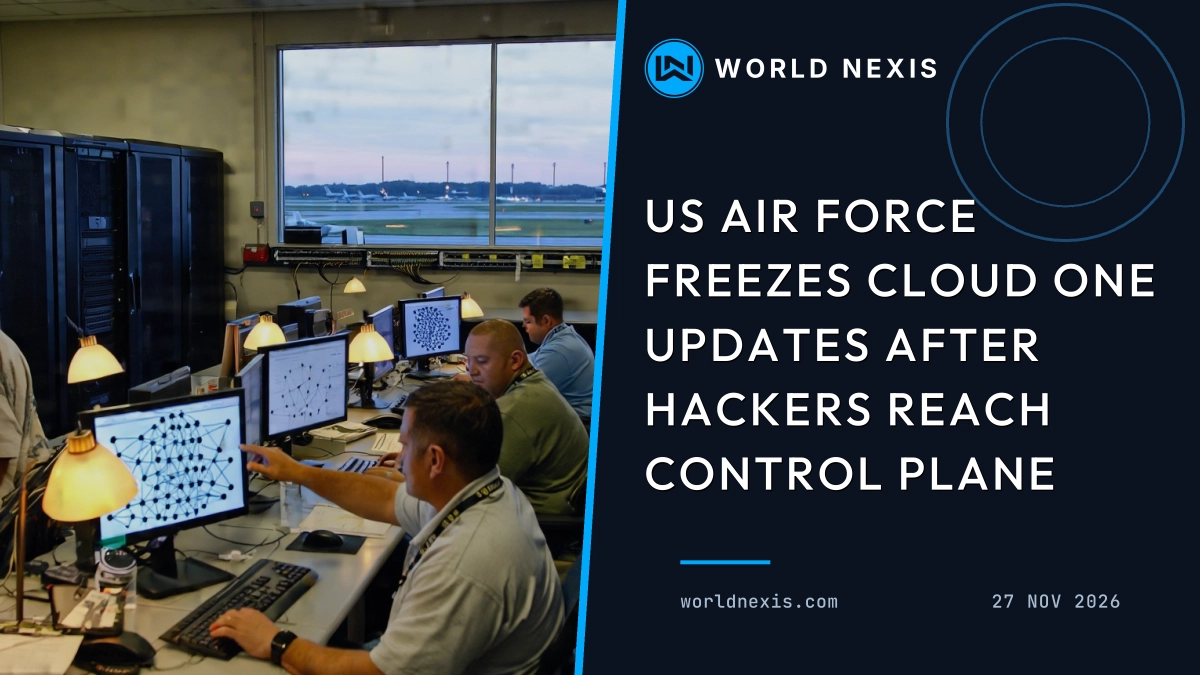
The Cloud One hack has left the US Air Force unable to install software fixes across its flagship cloud computing platform, with US Cyber Command brought in to assess the damage. The intrusion was discovered within roughly the past month while the system was being upgraded, and it has disrupted one of the largest cloud environments in the American military.
One person familiar with the matter said the intruders exploited a software vulnerability to reach the control plane, the layer that manages the whole platform. That person compared the access to a universal remote, which in theory could reveal the operational status of military aircraft or the movement of spare parts. It is unclear whether the hackers used it that way.
Key points
- Hackers breached Cloud One, the Air Force’s main cloud platform, and reached the control plane, according to people familiar with the matter.
- The Cloud One hack paused the migration of back-office applications and blocked updates to software already running there.
- US Cyber Command is assessing the damage, and the Air Force says it does not discuss the security of specific systems.
- Who was responsible, how far the intrusion reached and whether any data was stolen all remain unknown.
What the Cloud One hack has already stopped
Two people familiar with the matter, plus another person briefed on the work, said the migration of back-office applications onto Cloud One has been paused. That migration has been a long-standing military priority, so the pause delays a program the Air Force has pushed for years.
The immediate operational problem is patching. Updates to applications already running on Cloud One have been blocked, leaving personnel unable to apply fixes just as a new batch of serious software vulnerabilities has been disclosed across the technology industry.
Another person familiar with the matter said some users have had their administrator rights revoked, a step that restricts what anyone can change inside the environment while investigators work.
“A breach here is a big deal,” one of the people familiar with the matter said.
The Air Force said it does not comment on the security posture, vulnerabilities or operational status of specific networks and systems, and that it continuously takes prudent measures to protect Department of the Air Force information, systems and mission capabilities.
Inside the platform: pay records, logistics and radar feeds
Cloud One began in 2017 as a one-stop shop for the Air Force’s IT needs, combining the resources of Microsoft, Amazon, Oracle and Google. Scores of applications run on it, covering personnel data, pay, logistics and maintenance.
Two of those applications carry particular weight. Cloud-Based Command and Control collates air defense radar and other data feeds from across North America. The Theater Integrated Combat Munitions System tracks bombs and missiles at more than 200 US Air Force locations around the world.
SAIC was the prime contractor on the platform until 2025, when Leidos took over. Cloud One is among the biggest cloud platforms the US military runs, and its reach extends well beyond head office administration.
That breadth is what turns an intrusion into a problem of national scale. Because the same environment carries tactical, personnel and logistics data, the Air Force cloud platform breach does not stop at one system or one base.
A government already firefighting cyber incidents
The Cloud One hack lands in a difficult stretch for federal cybersecurity. At least six other recently disclosed incidents are already being worked: two at the FBI, an earlier hack of Pentagon data, a leak of Department of Homeland Security personnel information, a breach affecting at least two spy agencies, and an intrusion at the Treasury Department.
Cloud One’s own leadership once described the platform as close to impregnable. In a 2023 commentary, they claimed a “100% success rate” against what they called a “staggering” number of attempts to break in.
“There is no room for error when it comes to security,” Cloud One’s leadership wrote.
Why it matters
For most Americans the exposure is indirect but real. Cloud One holds personnel and pay records for service members, together with the logistics chains that keep aircraft flying and spare parts moving. When the platform is compromised, the people who feel it first are troops whose records sit on it and families whose income depends on those systems working.
The wider cost is confidence. Allies, contractors and commanders plan around the assumption that military data systems are defended to a higher standard than civilian ones, and the Cloud One hack tests that assumption at the worst moment. Investigators still cannot say what, if anything, was taken.
Analysis
Having covered cybercrime and digital rights for World Nexis News, I look first at which layer of a system an intruder reached, not at how much data they carried off. On that measure the Cloud One hack is about as serious as a cloud breach gets before theft is confirmed, because the control plane is the management layer: the place from which everything else is configured, monitored and inventoried.
I side with the people inside the investigation who call this a big deal, and I think the “100% success rate” framing was the wrong posture from the start. Military platforms should be built on the assumption of intrusion, with continuous monitoring, fast patching and tight segmentation so that a foothold in one application never becomes reach across the whole estate.
The strongest counter-argument is that nothing yet shows data was stolen, and military networks are compartmentalized by design, so control-plane access may have bought the intruders far less than headlines suggest. That is fair, but only a finished Cyber Command investigation can make it convincing. Until then, the patch freeze is doing damage of its own.
What happens next
The next milestone in the Cloud One hack is Cyber Command’s assessment. Investigators need to establish how the intruders got in, what they touched and whether they are still present, and that answer will decide whether the migration pause lifts quickly or drags on.
The Air Force and Leidos must also choose when to restart patching. Every day the freeze continues, the backlog of unapplied fixes grows against vulnerabilities that are already public.
What we don’t know yet
- Who carried out the intrusion, and whether a state or criminal group is responsible.
- Whether any data was stolen, and how far the access reached.
- Which specific software vulnerability was exploited.
- Whether the hackers checked aircraft status or parts movements through the control plane.
Related coverage
- DWP cyber incident takes major benefit services offline
- Trump tariffs rethink gives Democrats a major opening
- Hashtag United funding fuels major inclusive football push
Further reading
- Exclusive-Hackers breach US Air Force flagship Cloud One computing platform
- Hackers breached the US Air Force’s Cloud One platform, Reuters reports
About the author: Priya Nair is the Technology Correspondent at World Nexis News (WNN), covering technology. The analysis section reflects the writer’s view.

Priya Nair
Priya Nair is Technology Correspondent at World Nexis News, covering artificial intelligence, cybersecurity, consumer devices and the companies building them. Based in London, she explains how new technology works, who it affects and what the evidence actually shows, with attention to privacy, competition and the…