Trump tariffs rethink gives Democrats a major opening
Trump tariffs face a Republican rethink after election losses, with senators open to a case-by-case review as Democrats target Canada duties first.
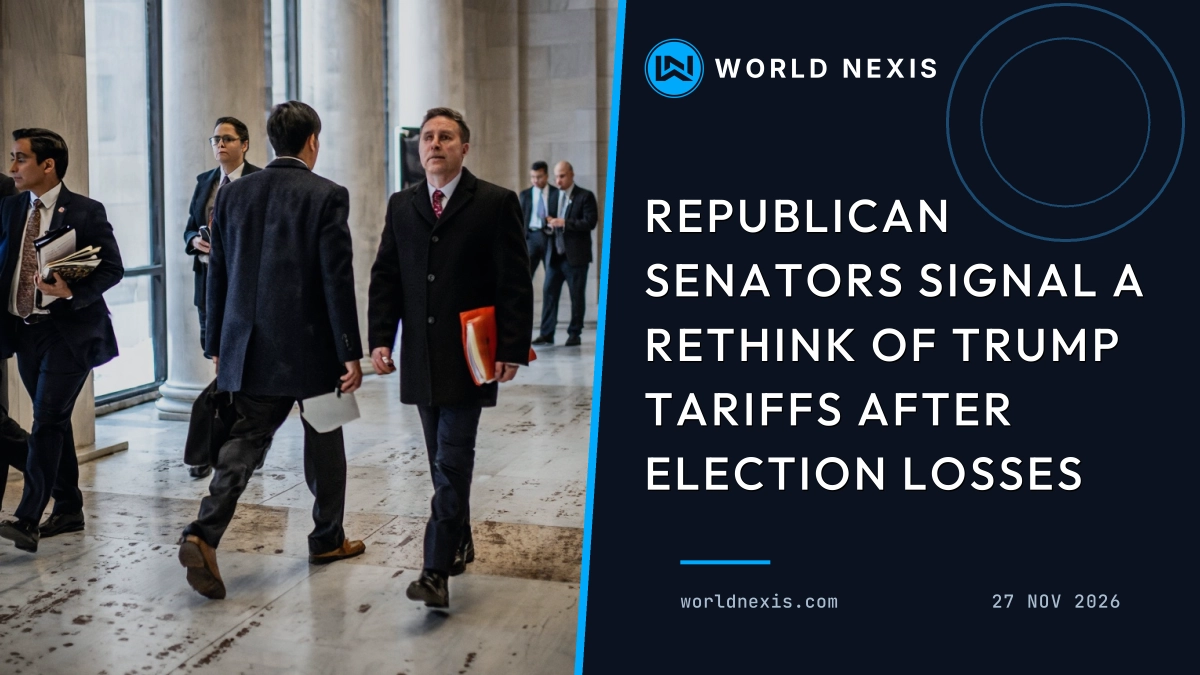
Trump tariffs are facing their most serious challenge from inside the president’s own party, after more than half a dozen Republican lawmakers said they would consider revisiting some of the levies and Democrats prepared to turn that opening into early bipartisan wins when they take control of Congress. The administration this week proposed new duties on 14 trading partners, including China, the European Union, Japan, South Korea and Taiwan. Republicans say they want predictability, and several argue Congress should reclaim its constitutional authority over trade.
Key points
- More than half a dozen congressional Republicans say they are open to reviewing Trump tariffs, at least on a case-by-case basis, after election losses centered on the cost of living.
- The administration proposed new duties this week on 14 major trading partners, among them China, the EU, Japan, South Korea and Taiwan.
- Democrats, led by incoming Senate Finance Committee chairman Ron Wyden, have made tariffs on Canada a priority target.
- Most Republicans remain unwilling to curb the president’s tariff powers broadly and accept that he could veto any repeal.
Why Republicans are rethinking Trump tariffs
The rethink of Trump tariffs follows a bruising election in which rising prices dominated the campaign and cost the president’s party its hold on Congress. Lawmakers returning to Washington have been blunt about what they heard from voters. Many now describe the tariff structure as too broad and too unpredictable for the factories, farms and small businesses that buy imported parts and sell into foreign markets.
Trump has made the levies the defining feature of his second term, calling himself “Mr. Tariff” as he placed duties on allies and adversaries alike. He argues they will revive American manufacturing and strengthen the economy. The approach reversed decades of Republican free-trade orthodoxy.
Young: “A rethink is indeed in order”
Senator Todd Young of Indiana, who faces reelection in 2028, has been the most explicit. “A rethink is indeed in order,” he said, promising to be “a bipartisan voice for making sure we have the most consumer friendly tariff approaches.” In posts after the election he said voters were “rightly focused on the cost of living” and called the tariff structure “overly broad.” He wants duties that are predictable and aimed at reshoring strategic goods or pressing trading partners to open their own markets.
Representative Michael Guest of Mississippi struck a similar note, saying “there may be some areas that I would agree with the Democrats.” He drew a line at a blanket limit on presidential power, saying he would “be willing to look at it on a case-by-case basis based on what the Democrats may bring forward.”
Canada becomes the first test of the Trump tariffs rethink
Not every Republican wants to retreat. Several draw a distinction between duties aimed at China and those aimed at Canada, and they are prepared to defend the former. Senator John Kennedy of Louisiana, also on the 2028 ballot, backs levies on China but said: “Tariffs with respect to Canada don’t make sense to me.”
Democrats have already picked their ground. Ron Wyden of Oregon, the incoming chairman of the Senate Finance Committee, has named Canada as a top target. Earlier repeal efforts drew support from a handful of Republicans, and Canadian retaliation has given more lawmakers a reason to sign on.
The obstacle is less the Senate floor than the White House. Republicans concede that Trump could veto any repeal reaching his desk, and most will not vote to dismantle Trump tariffs wholesale.
Why it matters
Tariffs are charged on imports, and the cost tends to surface later in prices on shop shelves, in factory budgets and on farm balance sheets. A genuine congressional review of Trump tariffs could mean steadier costs for households and clearer planning for importers. It could also mean less leverage in negotiations with trading partners.
For readers, the more durable change is constitutional. If Congress reasserts control over trade, future presidents of either party would need lawmakers behind them before imposing broad duties. That shift would outlast any single tariff rate.
Analysis
Having covered accountability and constitutional law for World Nexis News, I start with a simple question: who actually voted for this? Congress has lent the White House its tariff authority in pieces over many years, and no voter has ever been asked to approve the structure that resulted. The election gave Republicans a blunt answer on the cost of living, and I think the facts support the case Young and Guest are making: a case-by-case review, not a wholesale surrender of presidential power.
The strongest counter-argument is that a blanket restriction would handcuff a president in a fast-moving confrontation with China, and that Trump’s veto makes any repeal largely symbolic. That is fair, and it is exactly why the narrow route is the credible one. A Congress that cannot pass even a Canada repeal has reasserted nothing at all.
What I will watch is whether a vote happens. Talk of a rethink is cheap. A recorded tariff repeal vote on Canadian duties, with the administration’s response known in advance, is the only evidence that counts.
What happens next
The next round of Trump tariffs covers 14 trading partners, among them China, the EU, Japan, South Korea and Taiwan, and now sits with the administration. Once Democrats take control of Congress, Wyden is expected to press a repeal of the Canada levies as an early test of Republican appetite. Republicans acknowledge Trump could veto any repeal that reaches him.
What we don’t know yet
It is unclear how many Republicans would vote against duties once the choice is recorded rather than described. Nor is it known whether the White House will offer concessions to wavering lawmakers, or whether Democrats would settle for a narrow Canada bill instead of a broader challenge.
Related coverage
- Trump tariffs: major duties hit 14 US trading partners
- Trump Putin talks: he urges major pull-back in Europe
- Trump tariffs: India rejects excess-capacity claim as rates firm up
Further reading
- Trump’s accounts traded Nvidia shares 44 times this year, records show
- Republicans rethink tariffs, giving Democrats an opening to challenge Trump
About the author: Ayesha Rahman is the Senior Political Correspondent & Columnist at World Nexis News (WNN), covering politics & opinion. The analysis section reflects the writer’s view.

Ayesha Rahman
Ayesha Rahman covers politics and opinion for World Nexis News from London, focusing on elections, legislatures and the policy choices that shape everyday life in the US and UK. She writes analysis and columns that separate what is confirmed from what is claimed, working from…



