Trump tariffs: India rejects excess-capacity claim as rates firm up
The Trump tariffs hit 14 trading partners including China, the EU and India, adding 20% on Chinese goods despite midterm backlash over inflation.
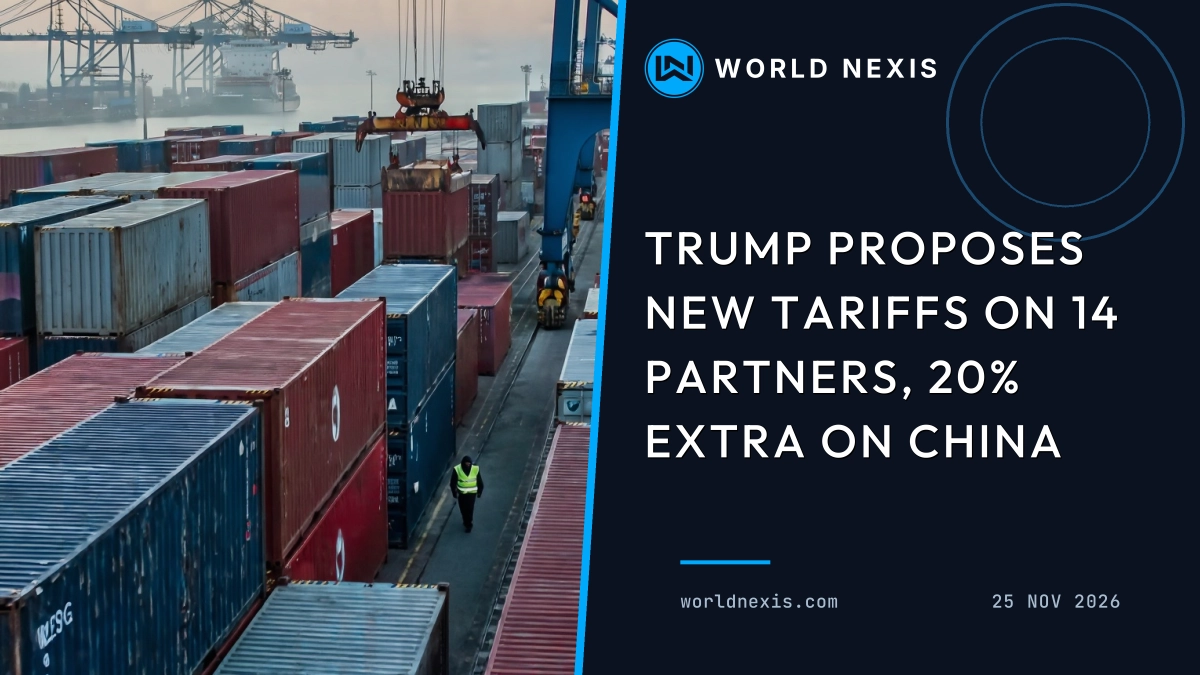
Updated 25 Nov 2026, 20:06 (UK time): India formally rejected Washington’s “excess manufacturing capacity” finding behind the proposed Trump tariffs and said it would fast-track a trade deal, while firmer rate details surfaced, including an extra 20% on China and new sugar and aircraft levies on Brazil.
India has pushed back on the case underpinning the new Trump tariffs, saying there is no “structural excess capacity” in any of its sectors and that trade talks with Washington will be fast-tracked rather than suspended. New Delhi’s response lands as the proposal puts partners including India in line for duties of up to 25%.
The shape of the package is also firmer than it was on announcement night. China remains the hardest hit, carrying an additional 20% on top of existing duties with the highest rates in the round, while Brazil faces higher levies on raw and refined sugar and a new 10% duty on aircraft. Officials have still given no implementation timeline, and the duties are not expected to bite until next year.
What this changes is the terms of the argument. The question is no longer whether the proposal exists but how each capital answers it, and the first serious answer from a targeted government was to negotiate, not retaliate.
I have covered enough of these rounds to read a fast-tracked trade deal as the tell: the threat is already doing its work before a single duty is collected. That may suit the administration, but it makes the published reasoning and the missing cost estimates more important, not less, because bargaining chips of this kind get spent quickly.
President Donald Trump’s administration has proposed a sweeping new round of Trump tariffs on 14 trading partners, including an extra 20% on Chinese goods, in an announcement that landed the day before Thanksgiving despite Republican losses in this month’s midterm elections.
Officials briefed reporters late on Tuesday and the proposals were published early on Wednesday. The targets are China, the European Union, Japan, South Korea, Taiwan, India, Vietnam, Thailand, Singapore, Switzerland, Indonesia, Malaysia, Cambodia and Bangladesh, with Brazil also facing new or higher duties on selected goods.
Key points
- Chinese imports would carry an additional 20% levy on top of duties already in force.
- Thirteen other partners plus the 27-member EU face new product-specific tariffs.
- The plans follow Section 301 investigations into foreign trade practices.
- They remain proposals, and no start date has been set.
Trump tariffs hit 14 partners as China takes the heaviest hit
China sits at the centre of the package. Its goods will face an additional 20% on top of existing duties, with the overall rate varying from product to product. Other partners face new levies on selected categories rather than blanket increases.
The investigations covered 12 countries, the 27-member EU and Taiwan. A senior administration official, briefing reporters on condition of anonymity, said the duties are aimed at specific products and would not be stacked on top of existing measures.
The case from the trade office
US Trade Representative Jamieson Greer said the inquiries had found a pattern of state support across the targeted economies that disadvantages American manufacturers.
“For decades, many of our trading partners have adopted industrial strategies built on targeting manufacturing, wage and labor suppression, financial and other support, non-market economy inputs, and other market-distorting practices that tilt the trade balance in their favor while eroding America’s manufacturing base.”
Greer’s office opened the inquiries after the Supreme Court struck down earlier tariffs. The proposals also aim to replace revenue lost when that ruling took effect.
A legal detour after a Supreme Court defeat
The new Trump tariffs rest on Section 301 of the Trade Act of 1974, which allows the US trade representative to investigate trading practices that harm American industry. The administration turned to it after the Supreme Court ruled in February that the president could not rely on a national emergency declaration to impose across-the-board tariffs under the International Emergency Economic Powers Act.
That ruling dismantled a central plank of the president’s economic programme and forced refunds to thousands of businesses. Officials have since leaned on other parts of trade law, including Section 232, which covers imports deemed a national security risk.
The average statutory US tariff rate now stands at 11.2%, according to the Yale Budget Lab. Tariffs are taxes on imported goods, paid by the businesses that bring them into the country.
Backlash over costs deepens after midterm defeats
Democrats won majorities in both the House and the Senate in this month’s elections. Roughly two-thirds of voters said Trump’s policies had made the economy worse, according to the AP Voter Poll, and post-election polling put 66% saying the Trump tariffs had hurt the national economy.
Small business advocates warned that the timing, the day before Thanksgiving and the start of the holiday shopping rush, could hardly be worse.
Dan Anthony, executive director of the We Pay the Tariffs coalition, said the vote had already settled the argument.
“Three weeks ago, voters unambiguously rejected tariffs that have worsened the affordability crisis and devastated small businesses.”
The European Commission rejected the plan and said it would examine Washington’s reasoning, pointing to a previously agreed 15% ceiling on duties covering the bloc.
Why it matters
Tariffs are ultimately a tax, and importers rarely absorb them in full. For American households, the practical test comes in the new year, when shoppers find out whether clothing, electronics, car parts and imported food staples cost more at the till.
Because the duties target selected products rather than whole economies, the pain will be uneven. Retailers and manufacturers that depend on components from the named countries will feel it first, while firms with domestic alternatives may gain ground.
For governments in Asia and Europe, the message is that access to the US market now carries a price that can be revised at short notice, which is exactly the uncertainty that makes long-term investment decisions harder.
Analysis
I think the political arithmetic here is brutal. Voters who handed both chambers of Congress to the Democrats did so largely over the cost of living, and the clearest lesson in the polling is that tariffs are now tied in their minds to higher prices rather than revived factories. Launching a fresh round on Thanksgiving eve looks less like a strategy than a gesture aimed at the president’s base while the wider electorate has moved on.
Having covered constitutional fights for World Nexis News, I look first at the legal scaffolding, and it is thin. The strongest counter-argument is not frivolous, though: Greer’s complaint about subsidised overcapacity and suppressed wages describes a genuine grievance US manufacturers have raised for years, Section 301 offers a lawful route, and tariffs are real bargaining chips that no administration gives up lightly.
Where the evidence leaves me is with the small businesses and economists warning about prices. A policy built around a court defeat, with no fresh authorisation from Congress, is fragile by design, because the next ruling can undo it. What I will watch is whether the administration publishes its own cost estimates alongside the proposal, since the silence on that point is the most telling feature of this week’s rollout.
What happens next
The measures remain proposals rather than law. Officials said they are at the proposal stage, declined to give a strict implementation timeline, and the duties are not expected to take effect until next year. Publication of the full investigation reports by the trade representative’s office is the next formal step.
What we don’t know yet
Three questions remain open. First, whether the rates survive contact with the courts, given that the legal foundation has already been struck down once. Second, how Beijing and Brussels respond, with the world’s two largest economies still locked in a tariff dispute. Third, whether Congress moves to reclaim authority over tariffs, as some Democratic lawmakers have demanded.
Related coverage
- Giuliani Medal of Freedom: Trump presents honor to Rudy Giuliani
- Shoot Trump stickers: ICE arrest took 5 weeks to surface
- Turkey pardon 2026: Trump to spare Freedom and Feather
Further reading
- US announces new tariffs on host of countries including China
- Trump administration to introduce new tariffs on China, EU and 12 other major trading partners
About the author: Ayesha Rahman is the Senior Political Correspondent & Columnist at World Nexis News (WNN), covering politics & opinion. The analysis section reflects the writer’s view.

Ayesha Rahman
Ayesha Rahman covers politics and opinion for World Nexis News from London, focusing on elections, legislatures and the policy choices that shape everyday life in the US and UK. She writes analysis and columns that separate what is confirmed from what is claimed, working from…



