USS Doris Miller: historic carrier keel laid next week
Construction of the USS Doris Miller, named for the Pearl Harbor hero who fired at Japanese planes in 1941, begins next week with a keel ceremony.
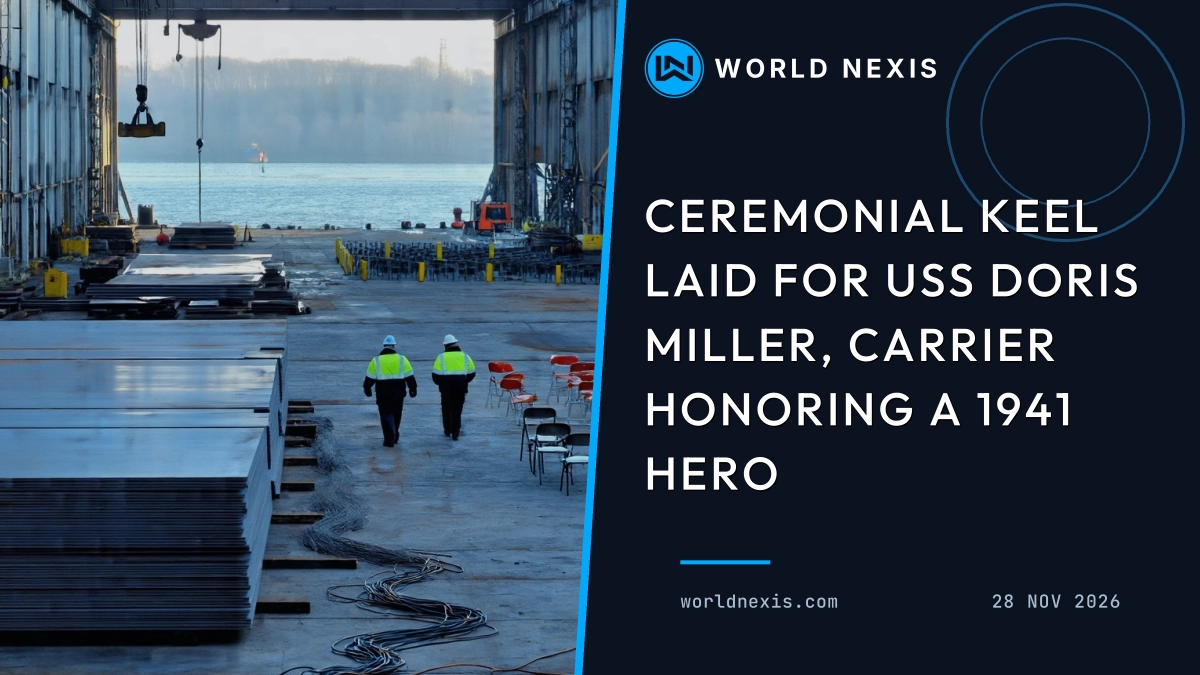
The USS Doris Miller, the aircraft carrier named for the 22-year-old sailor who fought back during the Japanese attack on Pearl Harbor, reaches a construction milestone next week when its ceremonial keel is laid. More than 2,400 Americans died on December 7, 1941, and 106 of them were aboard Miller’s ship, the USS West Virginia. The ceremony turns a long-planned name into steel.
The moment is about more than shipbuilding. Miller served a segregated Navy that kept Black sailors in the kitchen and the laundry. Putting his name on a carrier is meant to memorialize his heroism, and it places that record at the center of a ship that will carry it for decades.
Key points
- The ceremonial keel for the aircraft carrier USS Doris Miller will be laid next week, the traditional marker that construction has formally begun.
- Miller, known to his shipmates as Dorie, was a cook and mess attendant aboard the USS West Virginia when Japanese forces attacked on December 7, 1941.
- He moved wounded men through fire and smoke, then fired a .50-calibre anti-aircraft gun although Black crew members had not been trained for combat duty.
- He received the Navy Cross in May 1942 and was killed two years later when the USS Liscome Bay sank. His body was never recovered.
A laundry room, a burning deck and a gun
Doris Miller was 22 when Japanese aircraft attacked the US Pacific Fleet at Pearl Harbor on that Sunday morning. He came from a sharecropping family in Waco, Texas, hours away from any coast. He enlisted because he wanted to see the world and send money home to his family.
The Navy of 1941 was segregated, like every branch of the armed forces. Black sailors were assigned to custodial roles, and Miller became a cook and mess attendant aboard the West Virginia. He was in the laundry when the bombs began to fall.
He went out into the smoke anyway. Miller leapt through flames to move wounded sailors to safer positions, including the ship’s badly wounded captain. Then he made his way to a .50-calibre anti-aircraft gun.
No Black crew member had been trained for combat duty. Miller fired at the attacking planes until he ran out of ammunition. He then pulled men to safety from the oily water until he was ordered to abandon ship.
More than 2,400 Americans died that morning, 106 of them on the West Virginia. Miller survived, and on May 27, 1942, Admiral Chester W. Nimitz, commander-in-chief of the Pacific Fleet, pinned the Navy Cross on him at a ceremony aboard a US Navy warship at Pearl Harbor.
The Doris Miller Navy Cross citation is short and specific.
“For distinguished devotion to duty, extraordinary courage, and disregard for his own personal safety…”
He did not live to see the peace. Two years later Miller was killed in the fiery sinking of the USS Liscome Bay, and his body was never recovered.
The USS Doris Miller and the Navy’s own record
A keel-laying ceremony is the point at which a ship stops being a set of drawings and becomes a hull. For the USS Doris Miller, that step comes next week. From then on the name appears in every document, order and deployment the ship generates.
That makes the name a public statement about who the Navy says it honors. Miller was not an officer and not a pilot. He was a 22-year-old in a laundry room who decided, without orders, to act, and the carrier’s name is intended to memorialize that heroism rather than the rank he held when he showed it.
The record the name carries is uncomfortable as well as proud. The same service that decorated the Pearl Harbor hero had barred him from the training that would have made his gunfire routine. Miller served a segregated Navy in a segregated America, and the citation he received was written by an institution that had expected nothing of him.
Why it matters
For most readers, the practical effect is small: a keel laying changes no tax bill and no deployment schedule. The symbolic effect is larger. The name will appear in Navy ceremonies, briefings and public accounts of the fleet for decades, and it will be the version of the Pearl Harbor story that many people meet first.
That puts weight on accuracy. Miller’s courage is easy to celebrate. The reason he was in the laundry, and not on a gun crew, is harder to say out loud. A carrier named after him invites both halves of the record into the same sentence.
Analysis
I have spent five years at World Nexis News covering accountability inside American institutions, and I read ceremonies like next week’s as a promise rather than a plaque. A name on a hull is worth exactly what the institution is willing to say about why the man who carried it had to be extraordinary in the first place.
In my view the case for the USS Doris Miller is the stronger one, and the facts support it. Miller’s conduct was not a gesture. It was sustained, dangerous work carried out without training, without orders and without any expectation of reward, and naming a carrier for him writes that into the fleet’s permanent vocabulary.
The best counter-argument is that symbolism is cheap: a ship’s name costs the Navy nothing, while the inequalities that put Miller in the laundry are fixed by budgets, promotion boards and discipline, not by christening speeches. I accept the point but not the conclusion. A memorial that states plainly what the service once was is harder to sustain, and therefore more useful, than one that only praises.
What happens next
The ceremonial keel for the USS Doris Miller will be laid next week, opening the construction phase. After that, the name moves into the long, unglamorous stretch of shipbuilding, where a carrier is measured in steel, schedules and years rather than in ceremony.
The next public moment comes when the ship is launched and christened. No date for that has been set out, and large shipbuilding programs are rarely finished on the first schedule they are given.
What we don’t know yet
- The exact date and location of the keel-laying ceremony, and who will attend it.
- How long construction will take, and when the ship will be launched.
- Whether the Navy will use the moment to address the segregated service Miller served in, or only his courage.
Related coverage
- Democratic attorneys general flip five states in major shift
- Port Orange flooding: Thanksgiving dinner survives 8 inches
- NBC anti-Israel ad pulled as $400 Gaza spot sparks backlash
Further reading
About the author: Ayesha Rahman is the Senior Political Correspondent & Columnist at World Nexis News (WNN), covering politics & opinion. The analysis section reflects the writer’s view.

Ayesha Rahman
Ayesha Rahman covers politics and opinion for World Nexis News from London, focusing on elections, legislatures and the policy choices that shape everyday life in the US and UK. She writes analysis and columns that separate what is confirmed from what is claimed, working from…



