Trump tariffs: major duties hit 14 US trading partners
Trump tariffs proposed on 14 trading partners, including China and the EU, must clear months of consultation before duties bite; China faces up to 40%.
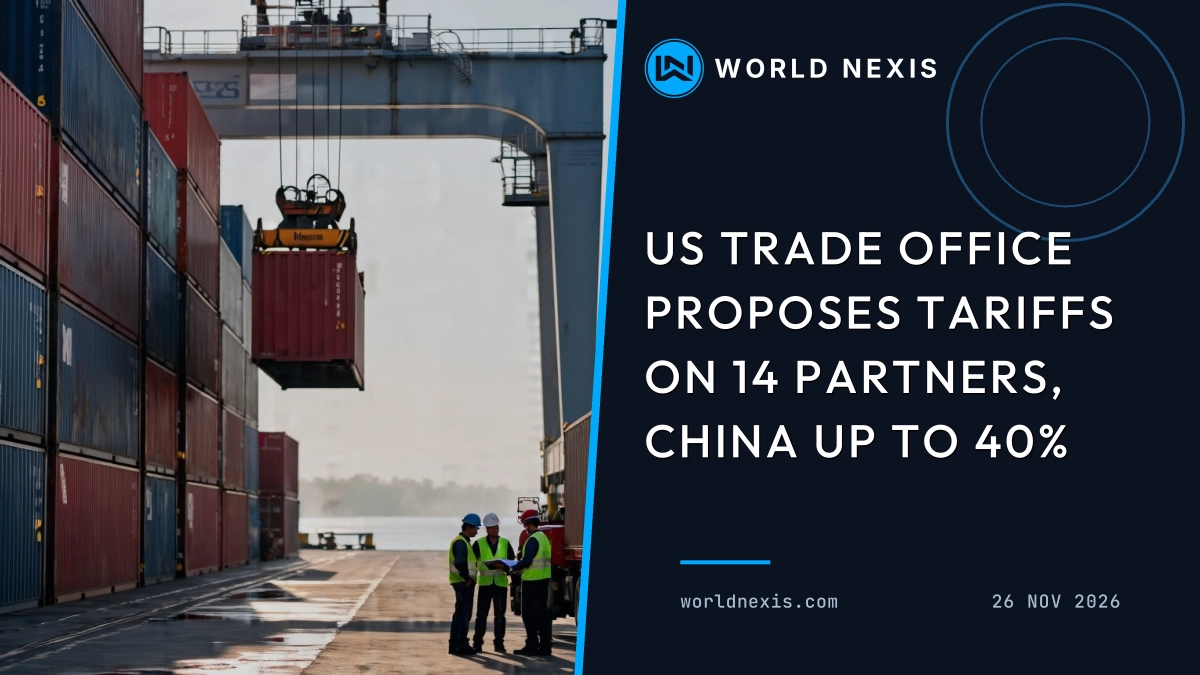
The latest round of Trump tariffs, proposed against 14 trading partners including China and the European Union, will not reach American ports or price tags until next year at the earliest. The Office of the U.S. Trade Representative must first run a public comment period and, potentially, formal hearings before any duty is collected. China faces the steepest proposed rate, up to 40%.
The proposal opens a second act for the president’s signature trade policy, aimed this time at a targeted list of economies rather than at the world at once.
Key points
- The Trump tariffs cover goods from China, the European Union, Japan, South Korea, Taiwan, India, Vietnam, Thailand, Malaysia, Indonesia, Singapore, Switzerland, Cambodia and Bangladesh.
- China would face up to 40%, Vietnam up to 35%, and the remaining economies either 20% or 25%.
- The duties are aimed at specific goods rather than imposed as blanket tariffs, and will not stack on top of existing duties except for China, a senior administration official said.
- Nothing is payable yet: consultation comes first, with January the earliest target for clearing those requirements.
What the Trump tariffs cover, and what they replace
The legal basis is Section 301 of the Trade Act of 1974, which lets Washington retaliate when it judges foreign trade practices to be unfair. The USTR said its investigations found that the acts, policies and practices of 14 economies on structural excess capacity and manufacturing production “are unreasonable and burden or restrict U.S. commerce”.
Those duties would replace the sweeping “Liberation Day” tariffs the Supreme Court struck down earlier this year. The White House began fresh investigations in March, after that ruling, and now leans on trade law instead of emergency presidential powers.
Jamieson Greer, the U.S. Trade Representative, said the measures would “level the playing field for American workers and chart a new, more sustainable course for the world economy”. He argued that many partners had for decades run industrial strategies built on “targeting manufacturing, wage and labor suppression” and other practices that tilt trade in their favor.
Not every economy under scrutiny is covered. Investigations into Norway and Mexico are still running.
China and Brazil push back
Beijing rejected the move. Foreign ministry spokesperson Guo Jiakun said: “Tariff wars and trade wars serve no one’s interests. Relevant issues should be resolved through consultation on the basis of equality, mutual respect and mutual benefit.”
Brazil’s government called the tariff threat unacceptable. In India, which is also on the list, former diplomat Ashok Sajjanhar said uncertainty and unpredictability had become “the second name” of the US administration, adding that the existence or absence of a trade agreement “makes little difference”.
The administration said every affected government had been told in advance and that it does not expect retaliatory action. Greer framed the plan as two tracks at once: “targeted tariffs that apply to a subset of goods”, alongside negotiations. “We expect to have a broad, even a plurilateral negotiation to talk about excess capacity and how to resolve it,” he said.
Others see legal trouble ahead. Chang Pao-Li, an economics lecturer at Singapore Management University, said the Section 301 route rests on a stronger footing than the emergency powers used before, but that the levies are still likely to face challenges in court.
Why it matters
For American households, the Trump tariffs are not a 2026 story. Because the comment period runs into January, and because some goods are excluded, shoppers are unlikely to see shelf prices move this side of the new year. The exposure comes later, when importers decide whether to absorb the cost or pass it on.
Economists have long warned that US import duties can feed inflation when firms pass costs along, and can slow global trade. Stephen Brown of Capital Economics called the announcement “not as alarming as it looks”, because the new duties “essentially replace” tariffs announced in the summer. He said the rise in the effective tariff rate looks set to be a touch lower than his firm had assumed, though the measures “will still provide a marginal boost to prices”.
The Trump tariffs also sit inside a wider push to narrow the US trade deficit and rebuild manufacturing, which is why the fight is as much political as economic.
Analysis
Having covered market structure and consumer prices for World Nexis News for five years, I read every round of Trump tariffs in the same order: the calendar first, then the scope, then the loopholes. On that reading, the facts support the inflation alarm less than the headlines suggest, and support Greer’s level-playing-field framing only on the narrow question of design.
I side with Stephen Brown’s verdict that this is “not as alarming as it looks”. The duties swap out levies importers had already priced in, they hit a subset of goods, and the effective rate may land slightly below forecasters’ assumptions. The strongest counter-argument, and one I take seriously, is that discretion is itself a cost: China’s rate can double at the stroke of a pen, and firms budget for uncertainty, not just for tariffs.
What worries me more than the price arithmetic is the politics. Republicans came out of the midterms with a poor result, and the president has pressed on regardless. That tells me the policy is now judged on credibility and leverage rather than on the deficit number, and credibility is the one variable no comment period can settle.
What happens next
The next milestone for the Trump tariffs is procedural. The USTR publishes the proposed rates, opens the comment period and may hold hearings, with the administration eyeing January as the earliest date to finish those steps. Duties would therefore land later in 2027 at the earliest.
Talks run in parallel, including the plurilateral negotiation Greer described on excess industrial capacity. The USTR is separately still investigating Norway and Mexico, so more economies could be added to the list.
On China, a senior administration official said the additional rate would start at 20% and be doubled to 40% if Beijing does not honor the agreed trade truce. Section 301 duties have survived court tests before, remaining in force from the first Trump term into Joe Biden’s presidency, but Chang expects fresh litigation.
What we don’t know yet
Whether China settles at 20% or 40%. Whether any of the 14 governments retaliates, which the administration says it does not expect. And whether these duties survive the courts, which will decide how much of this ever reaches a till receipt.
Related coverage
- Trump tariffs: China rate hits 45% as Wall Street slides
- Trump tariffs: India rejects excess-capacity claim as rates firm up
- New US tariffs: Section 301 named as China rate could double to 40%
Further reading
- US announces new tariffs on host of countries including China
- Trump admin proposes new tariffs on China, EU and 12 other trading partners
About the author: Daniel Whitmore is the Business & Markets Editor at World Nexis News (WNN), covering business & markets. The analysis section reflects the writer’s view.

Daniel Whitmore
Daniel Whitmore is Business & Markets Editor at World Nexis News, based in New York. He leads coverage of companies, economies, markets and the forces that move them, from central bank decisions to corporate earnings and the cost-of-living pressures facing households on both sides of…



