Facebook Marketplace food sales outpace Illinois law
Facebook Marketplace food sellers in Chicago are openly advertising meat and dairy dishes that Illinois' Cottage Food Law bans, with little enforcement.
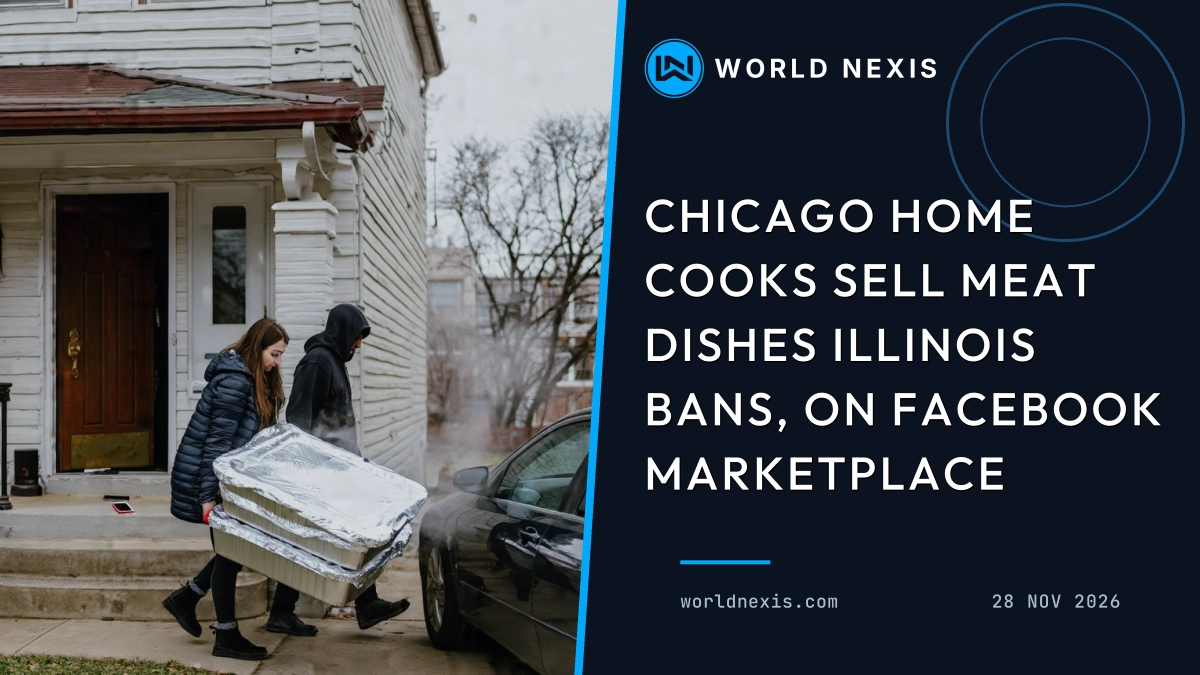
Facebook Marketplace food sales have quietly outgrown the Illinois law written to police them. Hundreds of home cooks across Chicago now advertise seafood boils, oxtail, lamb samosas and slow-cooked pork. The state’s Cottage Food Law bars them from selling it, and experts say enforcement rarely goes further than a strongly worded letter.
This Thanksgiving week, one family was running its seventh annual holiday delivery of steaming trays of shrimp and sausage across the city. The operation belongs to Silvia Pena, a 46-year-old Mexican immigrant. Her 26-year-old daughter Alondra and her brother ferry the orders. “It’s nerve-wracking, but really exciting,” Alondra said. “We’re just happy to see people and for them to try the food.”
Key points
- Home-cooked meat and dairy dishes have become a fixture of Facebook Marketplace food listings in Chicago, even though the state bars home cooks from selling them.
- Experts say enforcement of those rules rarely goes beyond a warning letter.
- Meta says food listings must comply with local law and can be pulled by automated detection or user reports, but has not explained why some have stayed up for years.
- Sellers say the legal alternatives, cookies and jars of jam, cannot earn a living wage.
How Facebook Marketplace food sales outgrew Illinois rules
The statute itself is narrow. Illinois’ Cottage Food Law lets home cooks sell a limited list of items, such as cookies and jars of jam, provided they register properly. Meat and dairy are excluded, which puts the seafood trays and samosas now on the platform on the wrong side of the law.
Meta’s policy sits alongside those state rules rather than above them. The company says on its website that users may sell food on Marketplace as long as it complies with local law. It adds that listings breaking its policies can be removed through automated detection or user reports. Asked why some listings have stayed visible for years, Meta did not respond. In practice, Facebook Marketplace food listings appear to stay up until someone objects.
The turning point for Chicago home cooks, according to experts and sellers alike, was the COVID-19 pandemic. People who lost their livelihood suddenly had time to experiment in their kitchens, while customers shut out of restaurants looked for other ways to eat. Marketplace, one of the country’s largest social commerce platforms, became the meeting point.
“It’s absolutely the classic story of entrepreneurship,” said Elizabeth Kregor, a Chicago attorney who specializes in small-business regulation and campaigns for street vendors. “It’s probably changed some people’s attitudes about what’s possible and what’s fun and where to go to get a good meal.”
The incentive to bend the rules is straightforward. Sellers say cooking the permitted goods is unlikely to earn a living wage, let alone enough to fund a restaurant or a food truck.
What the Facebook Marketplace food economy pays
Jay Estrella, 35, has sold through Facebook Marketplace food listings since 2021 and now earns twice what she did in 15 years as a medical assistant. Her cooking draws on her Mexican and Puerto Rican roots, and on weekdays she sells roughly a hundred individual lunch plates. Customers in New York City and Los Angeles now call to ask whether she will ship.
“It’s just me,” Estrella said. “I’m the one who does the advertising, the menus, the prepping, the cooking. And then in between, I have three children.”
She has weighed moving into a commercial kitchen, which would demand more research and planning than she has time for. Her hesitation captures the dilemma for a sector built on home stoves.
Kregor, who has spent decades watching informal food businesses take root across Illinois, is not surprised to find tender oxtail advertised beside free couches. “There are businesses that put children through college, but they’ve been illegal, by and large, for many, many decades,” she said. “Facebook Marketplace is the continuation of that kind of scrappy, ad hoc way of making things work.”
Why it matters
For buyers, the trade-off is price and choice against paperwork. A tray of oxtail bought through Facebook Marketplace food listings arrives without the inspection record a licensed restaurant or grocery counter leaves behind. With enforcement this thin, the risk lands on the customer.
For the cooks, Facebook Marketplace food sales are one of the few on-ramps left that cost almost nothing to enter. A family recipe becomes income within weeks, with no lease, licence or loan. It also stays informal, which caps how far the business can grow.
Analysis
Having covered small-business economics and platform commerce for World Nexis News, I look first at who actually sets the rule. Here it is Meta’s moderation queue, not the state, and a complaint-driven system is a weak substitute for inspection. That is why these listings survive.
On balance I side with Kregor’s reading: this is entrepreneurship, not fraud. The sellers here have repeat customers, a seven-year holiday trade and a hundred plates a week of demand, which are the marks of a functioning business. The strongest counter-argument is food safety, and it deserves respect. A bad batch from an unlicensed kitchen leaves no inspection trail and no recall mechanism, so a customer who falls ill has no route back to the source.
My view is that the present arrangement gives readers the worst of both worlds: real economic activity without the protections, and a rulebook almost nobody enforces. What most coverage misses is that cracking down on Facebook Marketplace food sellers would strip income from the households least able to replace it. I expect serious change to come from the platform’s own enforcement rather than from state legislators, because the platform is the only party that can see every listing.
What happens next
No enforcement action, hearing or rule change has been announced on either side. Meta’s stated tools remain automated detection and user reports. The company has not said whether it will tighten its approach to Facebook Marketplace food listings in Illinois.
Sellers face a decision of their own: stay home, where costs are low and rules are loose, or move into a licensed kitchen and carry the planning burden Estrella says she cannot yet take on. Holiday demand will test both paths within days, as this year’s Thanksgiving orders are filled.
What we don’t know yet
- Whether Meta will remove food listings that breach Illinois rules, or keep relying on user reports.
- How a formal complaint would be handled, given that enforcement rarely exceeds a letter.
- The exact scale of the trade: hundreds of home cooks are described as selling this way, but no count is public.
Related coverage
- UK house sales fall 8% as mortgage rate rise hits buyers
- Black Friday deals: record-low AirPods and 100+ sales
- Online safety law: Australia defies US with 5% revenue fines
Further reading
- Who needs turkey? Facebook Marketplace brimming with seafood boils and slow-cooked meats.
- Who needs turkey? Facebook Marketplace brimming with seafood boils and slow-cooked meats.
About the author: Daniel Whitmore is the Business & Markets Editor at World Nexis News (WNN), covering business & markets. The analysis section reflects the writer’s view.

Daniel Whitmore
Daniel Whitmore is Business & Markets Editor at World Nexis News, based in New York. He leads coverage of companies, economies, markets and the forces that move them, from central bank decisions to corporate earnings and the cost-of-living pressures facing households on both sides of…