Online safety law: Australia defies US with 5% revenue fines
Australia's online safety law clears a Senate deal, with fines of up to 5% of global revenue for tech giants despite US objections from Trump's team.
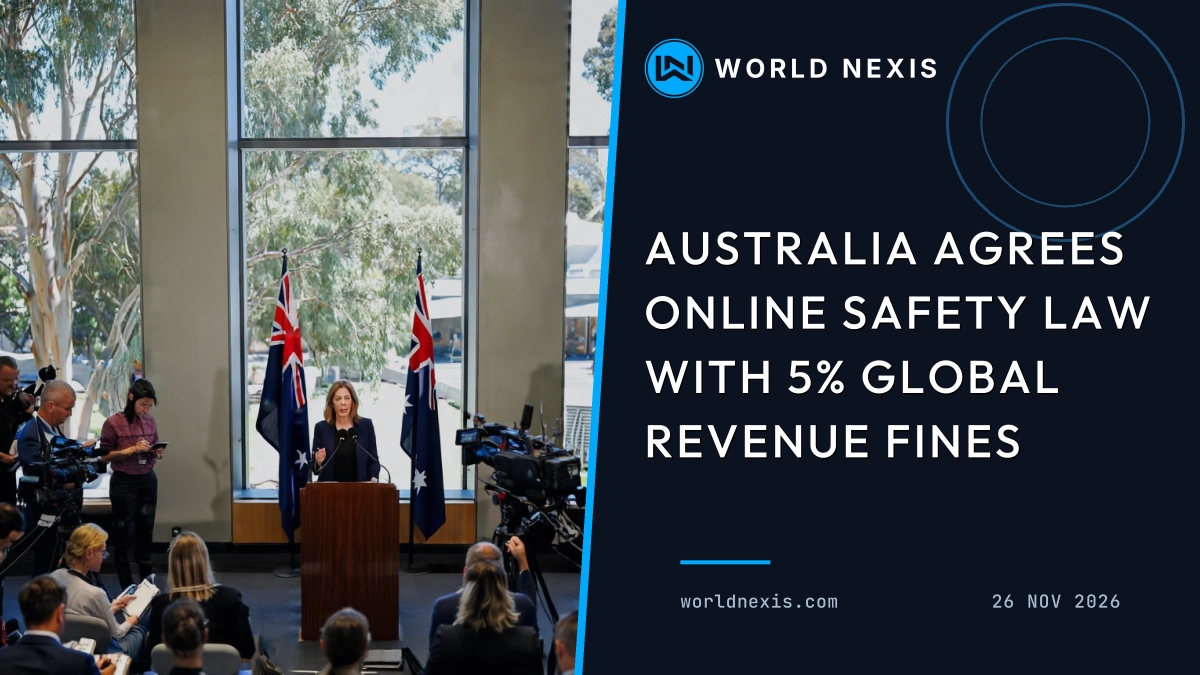
Australia’s online safety law has cleared its final political hurdle, after the Labor government agreed a deal with the Greens that lifts maximum penalties on tech companies to 5% of their global revenue, despite objections from the United States. The amended Digital Duty of Care Bill was expected to pass the Senate on 25 November. The House of Representatives, where the government holds a majority, was then due to send it into law before Parliament rises for the year on 26 November.
Key points
- Labor agreed the deal with the Greens on 24 November to secure the Senate numbers for its Digital Duty of Care Bill.
- Maximum fines for breaches rose from A$109 million, about US$72 million, to 5% of a tech company’s worldwide revenue.
- Washington says vaguely defined harms will push platforms to censor lawful speech; the opposition Liberal Party makes a similar case.
- The online safety law sets minimum standards for apps, games and AI chatbots, and lets users switch off recommendation algorithms.
How the online safety law was agreed
The Digital Duty of Care Bill requires tech companies to cut the risk of serious harm before it happens, rather than react after users are hurt. It sets minimum safety standards for online services including games, apps and artificial intelligence chatbots. Ministers say platforms must protect Australians from seriously harmful material and conduct.
Communications Minister Anika Wells announced that Labor had accepted amendments drafted by the minor Greens party to get the legislation through the Senate. The most consequential change is to the penalty regime. The previous ceiling of A$109 million, about US$72 million, has been replaced by a maximum of 5% of a company’s worldwide turnover.
“We can’t cure the internet, but this is providing some basic safety standards and saying if you build it, you are responsible for its risks,” Wells told reporters at Parliament House in Canberra.
Greens leader David Shoebridge confirmed his party would support the amended bill and framed the vote as a transfer of power. “Today we are taking power back from a handful of billionaire-owned, largely U.S. corporations and giving it back to Australians who have been paying too high a price for their profits,” he said.
Closer to Brussels than to Washington
The architecture will look familiar to European and British regulators. Australia’s model follows the European Union’s Digital Services Act, passed in 2022, and the United Kingdom’s Online Safety Act, passed a year later. All three place the burden of anticipating harm on the platform rather than on the user.
US objections to the online safety law
President Donald Trump’s administration lodged “serious concerns” with a parliamentary committee examining the draft in September. Its submission questioned how Australia would designate what counts as a foreseeable harm.
US ambassador to Australia David Brat said he had put his government’s objections to Wells directly on 24 November. “Vaguely defined ‘harms,’ backed by penalties of up to five percent of global revenue, will push platforms to censor lawful speech,” he posted on social media. He added that as Australia’s largest foreign investor, the US was concerned about compliance burdens that fall on American companies more heavily than on their competitors.
Wells played down the rift, saying the two sides were still talking. “There are points of difference, and we’re ironing them out,” she said.
The conservative opposition Liberal Party shares Washington’s reading. Its senators argue the bill hands ministers and the national online safety watchdog too much power to decide what is harmful. “This bill undermines both the online safety of Australians and our freedom of expression,” senior opposition senator Sarah Henderson told reporters.
What the Greens’ amendments add
The deal does more than lift the ceiling on fines under the online safety law. People would gain a legal right to sue social media companies in Australian courts for harms suffered online. Users would also be able to opt out of the algorithmic feeds that recommend content to them.
Separately, the online safety watchdog would be empowered to remove apps and websites that fabricate naked images from genuine photographs of people. The bill also requires protections for children against material that promotes eating disorders, hostile ideas about women, pornography, crime or dangerous stunts, or that causes serious mental health distress.
Why it matters
Fines tied to global revenue change the arithmetic for platform bosses, and the prospect of 5% global revenue fines is already the most contested line in the bill. A penalty measured against Australian advertising income alone barely registers on a global balance sheet; 5% of worldwide turnover does. For ordinary users, the practical gains are a route to court, an off switch for algorithmic feeds and a firmer baseline for what children should not see.
The online safety law also sets a precedent outside Europe. Australia would become the first major Asia-Pacific economy to legislate a broad duty of care for online services, giving other governments a working template for compliance costs and court challenges.
Analysis
Having covered AI policy and digital rights for World Nexis News, I look first at where the leverage actually sits. A fine measured in local revenue is a rounding error to a company of this size. The Greens’ switch to 5% of global turnover is therefore the only clause in this bill that will reach a boardroom, and on the penalties the government has the stronger argument.
The counter-argument from ambassador Brat is not frivolous. Harm is a slippery category, and a regulator who defines it badly can chill legitimate speech. What reassures me is that the online safety law pairs its duty of care with rights that sit with the user: a statutory route to sue, and the power to switch off the recommendation engines that amplify the worst material. That is a freer settlement than the status quo, not a more censorious one.
My reservation is about capacity rather than principle. A duty to anticipate harm demands a regulator with engineers, lawyers and money, and the 5% headline will mean little if the watchdog cannot staff the work. I would rather see that commitment written down than another record penalty announced.
What happens next
The Senate was expected to vote on 25 November, with the House of Representatives following before Parliament rises on 26 November. Once the online safety law is in force, the regulator begins the slower work of writing standards and designating foreseeable harms.
What we don’t know yet
Three questions remain open. How the watchdog will define foreseeable harm in practice, how a 5% global-revenue penalty will be calculated and collected, and whether Washington moves beyond public objections once the law takes effect.
Related coverage
- Australia US alliance: Wong warns against abandoning ties
- Jensen Huang faces Congress as Nvidia shares slide 6%
- Nvidia investigation: Huang faces 3 days of hearings
Further reading
About the author: Priya Nair is the Technology Correspondent at World Nexis News (WNN), covering technology. The analysis section reflects the writer’s view.

Priya Nair
Priya Nair is Technology Correspondent at World Nexis News, covering artificial intelligence, cybersecurity, consumer devices and the companies building them. Based in London, she explains how new technology works, who it affects and what the evidence actually shows, with attention to privacy, competition and the…