Australia US alliance: Wong warns against abandoning ties
Penny Wong has defended the Australia US alliance in a Senate speech, warning that a retreat would leave the country more vulnerable, with fewer options.
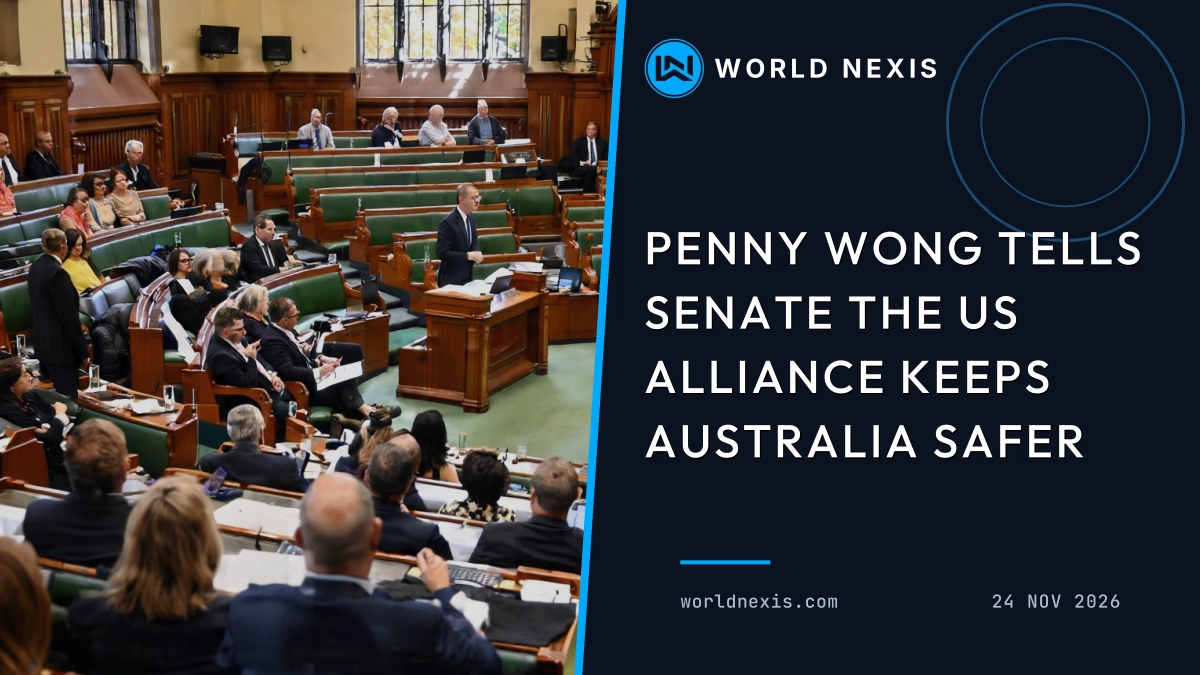
The Australia US alliance is still a central source of Australian strategic weight, Foreign Minister Penny Wong told the Senate on Tuesday, warning that abandoning Washington would leave the country “more vulnerable” as the major powers rewrite the global order.
In a major foreign policy speech, Senator Wong rejected the argument that uncertainty about American policy under President Donald Trump should push Canberra to forge its own path. She said the Australia US alliance remained significant even as the United States and China reshape the international system.
Key points
- Foreign Minister Penny Wong defended the Australia US alliance in a Senate speech on Tuesday.
- She argued that retreating from the alliance would surrender “a central source of Australian strategic weight”.
- Greens leader David Shoebridge said the Albanese government was still “clinging to the past”.
- Coalition senator Michaelia Cash said Labor has still not produced a national security strategy after more than four years in government.
Wong makes the case for the Australia US alliance
Senator Wong told the chamber that critics of the relationship were presenting a false choice between dependence and autonomy. In her view, the partnership gives Australia leverage it could not generate alone, particularly across the Indo-Pacific.
“There are those that say uncertainty about American policy means Australia should abandon America … they present a retreat from the alliance as a road to autonomy,” she said.
“What they would do is give us fewer choices and leave us more vulnerable, reducing our capacity to contribute to a regional balance in which our sovereignty can be protected.”
The minister said the America-first turn in US foreign policy had not altered Washington’s military role in building a stable region. She also pointed to the midterm election results, which she described as a repudiation of Mr Trump’s approach, including the war with Iran and the resulting spike in fuel prices.
“As we have seen in recent weeks, the US is a vigorous democracy with the ability to remake and re-imagine itself,” she said. “The direction of its foreign policy is still being contested at home in ways that will affect the entire world.”
Middle powers and the United Nations
Senator Wong argued that a more fragmented order makes partnerships with like-minded middle powers more valuable, not less. Reform of institutions such as the United Nations would matter, she said, but governments cannot walk away from multilateral forums while they wait for change.
“What is changing today is the great powers’ willingness to exercise power, without accepting the constraints that make international order possible,” she said.
“Middle powers would not help themselves by walking away from multilateralism because it’s imperfect. It would leave a vacuum, and vacuums are rarely filled by peace.”
She said Australia must work to build alignment with partners who share its interests, describing an emerging world in which trust in global institutions has declined.
Critics press from both flanks
Greens leader David Shoebridge said the government was out of step with public opinion and called for a broader rethink of the country’s foreign and defence posture.
“The Albanese government is still clinging to the past and failing to recognise the growing public discontent … with our relationship with the United States,” he said.
“If the world is changing, our foreign policy should change. Our defence policy should change. Our relationship with the world should change.”
From the Coalition, senator Michaelia Cash attacked the government’s follow-through rather than the Australia US alliance itself, saying the country lags others because it has no comprehensive national security strategy in place.
“Minister Wong, in her speech, told Australians how dangerous the world has become. Yet again, after more than four years in government, Labor still hasn’t produced the comprehensive strategy needed to respond to it,” she told parliament.
“Labor has yet again delivered just another speech, rather than the strategic framework Australia needs to confront the challenges of tomorrow.”
Why it matters
The Penny Wong Senate speech matters well beyond the chamber because it fixes the government’s public position on the Australia US alliance, the question that shapes almost every other decision in Australian defence and trade policy. That question is now how closely to align with a partner whose politics are volatile, and what to demand in return.
For households, the stake is indirect but real. Choices about the alliance determine what the country spends on Australia defence policy, which partners it can count on in a crisis, and how much room it has to disagree with Washington on trade and fuel prices.
Analysis
Having covered foreign policy and alliance management for World Nexis News, I look first at what a minister is trying to lock in before the ground shifts again. Senator Wong is not merely defending the Australia US alliance; she is trying to close down the US alliance debate inside her own government’s supporter base about whether distance from Washington is now a virtue.
On the evidence in her speech, I think her side of the argument is the stronger one. The alliance is a source of leverage Australia cannot manufacture alone, and what the Greens offer is a direction of travel rather than a policy with costs attached. The counter-argument still deserves respect: a partner whose foreign policy is contested at every election cycle carries genuine risk, and “the alternative is worse” is a thin answer to the unease David Shoebridge is pointing at.
Where I part company with the government is on the second half of the case. Senator Wong says middle powers must invest in multilateralism and reform the United Nations, but Senator Cash’s complaint lands: more than four years in, there is still no published national security strategy turning that rhetoric into priorities, budgets and trade-offs. Without it, the alliance argument is defensible in the abstract and impossible to test in practice.
What happens next
Senator Wong’s defence of the Australia US alliance settles the government’s position but does not end the argument. The Coalition will keep pressing for the national security strategy it says is missing, and the Greens will keep arguing that the relationship should be renegotiated in public rather than defended in the abstract.
What we don’t know yet
The speech set out no timetable for publishing that strategy, and no detail on what Australia would ask of Washington in return for its continued alignment. Nor is it clear how the government intends to answer the public discontent the Greens say they are hearing, beyond insisting that the alternative would leave the country weaker.
Related coverage
- Economic revolution needed, Badenoch warns CBI chiefs
- Center Parcs costs hit tipping point, boss warns of red tape
- Next cyber attack: retailer warns over supplier data breach
Further reading
- Australia warned against abandoning US ties under Trump
- Australia warned against abandoning US ties under Trump
About the author: Marcus Ellington is the International Correspondent at World Nexis News (WNN), covering world affairs. The analysis section reflects the writer’s view.

Marcus Ellington
Marcus Ellington is International Correspondent at World Nexis News, reporting on diplomacy, conflict and the political forces reshaping Europe, the Middle East, Asia and the Americas. Based in London, he focuses on explaining why events unfold as they do, using official statements, diplomatic documents and…



