Francesca Albanese leaves Costa Rica after 50-hour standoff
Francesca Albanese spent more than 50 hours stuck at Costa Rica's airport after being denied entry, then flew to Mexico as the entry ban stayed in place.
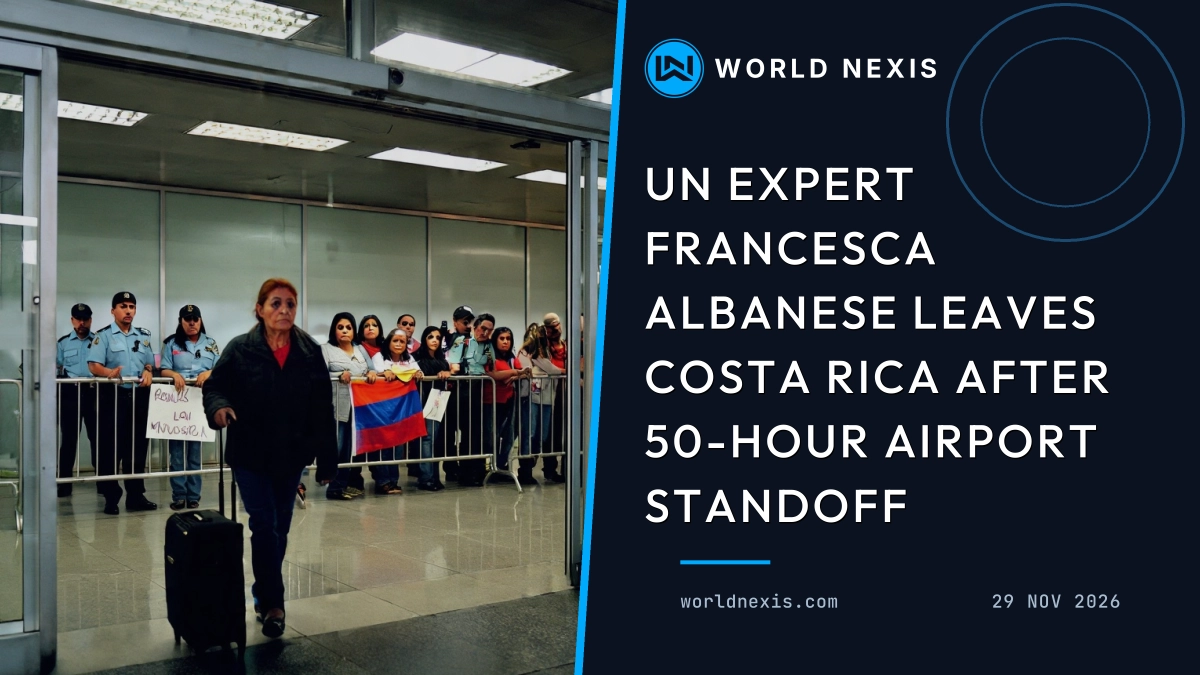
Francesca Albanese, the United Nations special rapporteur on the Israel-occupied Palestinian territories, left Costa Rica on Saturday after the country refused her entry and kept her inside an airport for more than 50 hours. The Italian lawyer flew in from Paris on Thursday to collect an honorary degree; she was stopped at immigration and eventually travelled on to Mexico.
Key points
- Francesca Albanese was denied entry on Thursday and held airside for more than 50 hours.
- Officers cited an international alert over alleged terrorism ties, but named no issuer and offered no evidence.
- Rulings from the Costa Rica Constitutional Court blocked her deportation, then let her stay in a hotel while the entry ban remained in force.
- She collected an honorary doctorate from the University of Costa Rica by video call from the terminal.
How the Francesca Albanese Costa Rica standoff unfolded
Albanese was appointed by the UN to investigate abuses against Palestinians. She is one of Israel’s loudest critics and accuses the Israeli government of genocide in Gaza, a charge Israel rejects. Her reporting has also made her a target in Washington, which sanctioned her last year.
Immigration officers stopped Francesca Albanese on arrival and said she was the subject of an international alert over alleged ties to terrorism and posed a national security risk. They did not identify who issued the alert and produced no evidence for it. “Defending human rights is not terrorism,” Albanese wrote on X on Friday.
She called for an investigation into whether the ban was tied to the US sanctions, which bar her from entering the United States and from using US banks. The Trump administration imposed them over accusations that she was working with the International Criminal Court to pursue cases against Israeli and American citizens.
Court order, video call and a defiant departure
As officials moved to put her back on a flight to Paris, the Costa Rica Constitutional Court ordered a stay of her deportation while it reviewed a legal challenge filed on her behalf. Still unable to leave the terminal, she accepted her honorary doctorate by video call. She later thanked Costa Ricans, the university, the Italian embassy and the judges who blocked her removal.
Late on Friday the court cleared Francesca Albanese to leave the airport and rest at a hotel, although the entry ban stayed in place. She departed on her own terms rather than under escort. “Goodbye, for now. I will return, I promise, when Costa Rica is free again,” she wrote on X.
UN alarm, Israeli approval and a domestic row
The UN’s human rights chief, Volker Turk, was “deeply concerned” by the decision, his office said, describing it as “difficult to reconcile with Costa Rica’s longstanding commitment to human rights”. Israel’s ambassador to the UN, Danny Danon, welcomed the move and suggested on X that Albanese was paying the price for using her mandate to spread “vile propaganda” about Israel.
At home, the case set the judiciary against a right-wing government closely aligned with US President Donald Trump and Israeli Prime Minister Benjamin Netanyahu. Rodrigo Chaves, a former president now serving in the cabinet of his successor, President Laura Fernández, called the court’s intervention “yet another usurpation by an increasingly arbitrary judiciary”. The country’s ombudsman’s office said holding her at the airport showed officials’ “ignorance” of her immunity from detention.
Why it matters
UN special rapporteurs hold no police powers and cannot enforce anything. Their authority depends on states letting them travel, so a refusal at the border can quietly close down a mandate. The Costa Rica entry ban therefore matters far beyond one honorary degree: it tests whether a sanctions listing in Washington can shape who is allowed into a country thousands of miles away.
For Francesca Albanese the airport became the argument. She has suggested Washington leaned on Costa Rica to shut her out, and she wants an inquiry into whether the sanctions drove the decision. No government has confirmed that link.
Whether she returns is a personal matter; whether any rapporteur can be held this way is not.
Analysis
Having covered UN mandates and sanctions for World Nexis News, I look first at the gap between an alert and its source. An international alert that no state will own, used to hold a mandate holder for more than two days, is exactly the kind of opaque action the special rapporteur system was built to survive. On the facts as they stand, the court had the stronger argument: Costa Rica could keep its border shut, but it could not park an accredited expert in a terminal indefinitely without evidence or an identified issuer.
I side with the court and with the ombudsman’s office on the central point: Francesca Albanese was a UN expert on official business, and the executive treated an anonymous alert as a verdict. The government’s best counter-argument deserves space, because states do control their own borders and ministers say the judiciary overstepped by intervening in an immigration decision. That is a genuine constitutional question, yet it is not a licence to hold someone without explanation.
What I find most revealing is how fast this became a story about alliances rather than law. A small, normally stable democracy spent a weekend explaining itself, while the sanctions regime it may have deferred to stayed invisible. That is the pattern to watch, because the next refusal will almost certainly be quieter.
What happens next
Francesca Albanese has travelled to Mexico, where she is expected to speak on Palestinian rights at the invitation of the Palestinian embassy. Her legal challenge remains before Costa Rica’s Constitutional Court, and the entry ban has not been lifted. Nobody has publicly taken responsibility for the travel alert that triggered her detention.
What we don’t know yet
Who issued the alert, and on what evidence. Whether the court’s review will reach the entry ban itself rather than only her deportation. And whether other governments will treat a US sanctions listing as grounds to refuse entry to UN mandate holders.
Related coverage
- NAZA documentary: 24 IDF testimonies stir fury in US cinemas
- Tirana clashes: tear gas at 114th independence day protest
- Afghanistan school explosion kills 10 and injures 110
Further reading
- UN expert Albanese leaves Costa Rica after being denied entry, stuck at airport
- UN rapporteur leaves Costa Rica after entry denied
About the author: Marcus Ellington is the International Correspondent at World Nexis News (WNN), covering world affairs. The analysis section reflects the writer’s view.

Marcus Ellington
Marcus Ellington is International Correspondent at World Nexis News, reporting on diplomacy, conflict and the political forces reshaping Europe, the Middle East, Asia and the Americas. Based in London, he focuses on explaining why events unfold as they do, using official statements, diplomatic documents and…