NAZA documentary: 24 IDF testimonies stir fury in US cinemas
NAZA documentary, built on testimony from 24 IDF soldiers, reaches US cinemas as Israeli ministers demand the directors lose their citizenship.
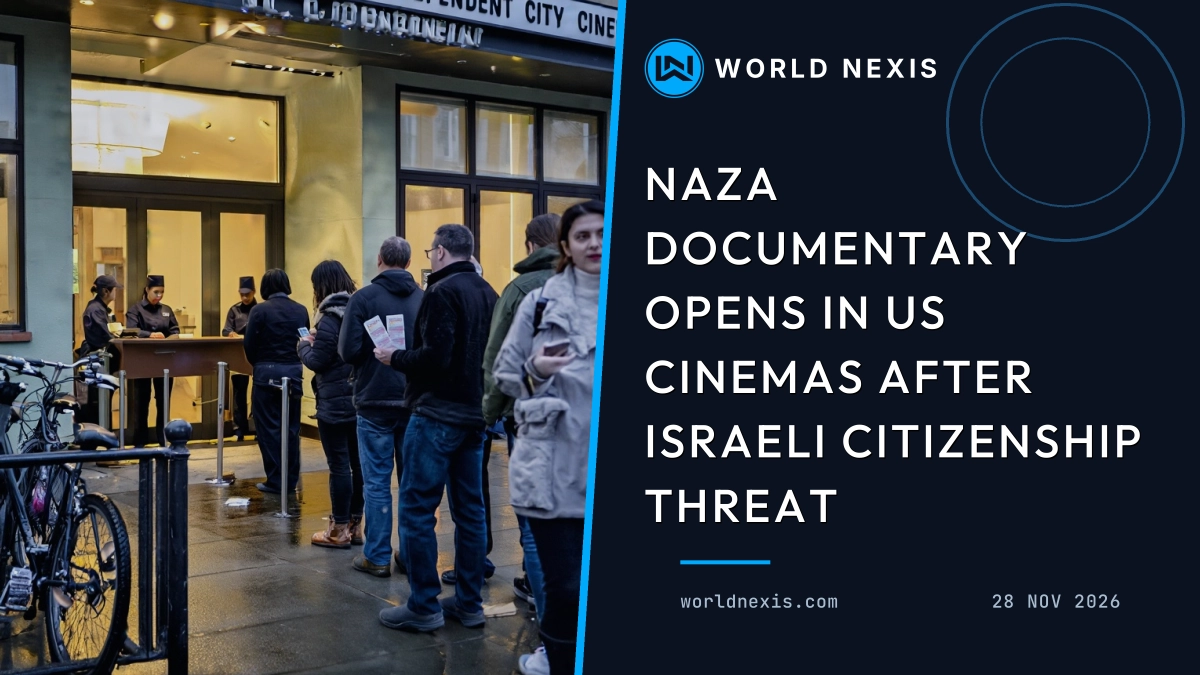
The NAZA documentary, built on testimony from 24 Israeli soldiers, has reached cinemas in the United States after a season of official hostility in Israel, where senior ministers have called for its two directors to be stripped of their citizenship. The film was directed by the Israeli investigative journalists Yuval Abraham and Rachel Szor, won the special jury prize at the Venice International Film Festival in September and was produced by Guardian News and Media. Its title is a Hebrew military acronym that translates as “collateral damage”.
Key points
- The NAZA documentary is now screening in US theatres, months after its Venice premiere.
- Abraham interviewed 24 Israel Defense Forces soldiers, whose faces were blurred and voices altered.
- Culture and Sports Minister Miki Zohar has called for the directors’ citizenship to be revoked.
- The IDF says it never approved a strike in which 500 civilians were expected to die.
Why the NAZA documentary has angered Israel’s government
The film has been widely criticised by the Israeli government since its premiere. Zohar called for the citizenship of Szor and Abraham to be revoked. Prime Minister Benjamin Netanyahu said citizenship would be withdrawn from anyone who defamed Israel Defense Forces soldiers, and promised to “hit them hard in the pocket”.
Guardian News and Media said it was disturbed by what it described as an “authoritarian” response to the film.
“Yuval Abraham and Rachel Szor are brave journalists and filmmakers,” a spokesperson said. “The attacks against them come from people who have not yet seen the film.”
The spokesperson said the film rested on more than three years of investigative journalism and that its testimonies came from confidential journalistic sources. “We will robustly defend NAZA – and the team behind it – from any attacks or attempts at censorship,” the spokesperson said.
What the soldiers describe
In the NAZA documentary, Abraham interviews 24 soldiers on rooftops in Tel Aviv. One said that without anonymity, Israel would put him in jail for what he was going to expose.
Their IDF soldiers testimony returns repeatedly to civilian deaths. “Some strikes killed 20, 30, even 300 people,” one soldier said in Hebrew, in a film subtitled in English.
Asked for the highest toll he could remember from a single airstrike, another soldier said the results were never assessed.
“But there was approval once to kill 500 for one human target.”
A third described a military that holds so much data on private homes in Gaza that every house carries a serial number, and a mechanism called “Where’s Daddy?” that alerts forces when an operative returns home.
An IDF spokesperson said the claims were untrue and denied the most serious of them in a statement released on 1 October. “The IDF has never planned, approved or carried out a strike in Gaza in which 500 civilians, or anything close to that number, were expected to be killed,” the spokesperson said.
The genocide accusation behind the NAZA documentary
The International Association of Genocide Scholars, which has about 500 members in different countries, including Holocaust experts, has concluded that Israel has committed genocide. “Israel’s policies and actions in Gaza meet the legal definition of genocide,” its resolution states. It was backed by 86% of those who voted.
The Israeli government has repeatedly denied the Gaza genocide accusation and argues that its campaign is legal and fought in self-defence against Hamas. Hamas killed about 1,200 people in its attack on Israel on 7 October 2023. Ajith Sunghay, head of UN human rights in the occupied Palestinian territory, says 72,769 Palestinians have been killed since then.
Why it matters
For readers in Britain and the United States, this is a test of what a democracy does with uncomfortable testimony from its own soldiers. If citizenship can be threatened over a film, the same pressure can be aimed at any journalist examining military conduct, and the chilling effect travels far beyond Israel’s borders.
A NAZA documentary that arrives with a festival prize and a ministerial threat attached will draw viewers who might otherwise have skipped it. The argument over its accuracy now runs in public, in front of audiences who can weigh the testimonies and the denials for themselves.
Analysis
Having spent four years covering conflict and foreign policy for World Nexis News, I look first at how a state answers testimony: with evidence, or with punishment. Israel’s response here has leaned heavily on the second. Threatening the citizenship of two journalists whose film is showing in American cinemas does not rebut a single testimony; it tells viewers that the argument is being settled by pressure rather than by facts.
I side with Guardian News and Media, whose spokesperson called the reaction authoritarian. The filmmakers spent three years gathering interviews from people who risk prosecution to speak, and the government’s first instinct was to target the messengers. The strongest counter-argument is that the film rests on anonymous testimony and the IDF has flatly denied its most explosive claim, so audiences should treat the NAZA documentary as evidence to be tested rather than a verdict to be accepted. That is a fair point about the film. It is not an answer to the citizenship threats.
The genocide question will not be settled by a documentary or by an association’s vote, however large its majority, because only a court can make that legal finding. But a professional body of 500 scholars reaching 86% agreement removes the comfort of calling the accusation fringe. My concern is that the Israeli government has made its own denials harder to hear on the substance, and critics’ claims of censorship easier to believe.
What happens next
The NAZA documentary is now screening in US theatres, and the dispute moves to audiences, critics and, potentially, lawyers. Ministers’ statements so far are political rather than legal, and the filmmakers have said they will defend the film against censorship.
What we don’t know yet
It is not clear whether Israel will pursue the citizenship of Szor and Abraham, or on what legal basis. Nor has the claim about a strike approved to kill 500 people been independently verified: the IDF denies it, and the soldiers who described it remain anonymous.
Related coverage
- Huw Edwards documentary: Channel 4 defiant over backlash
- Princess Kate documentary shows tears, mountains and a new cancer role
- Kate cancer documentary reveals 30-minute film on diagnosis
Further reading
- IDF soldiers call military action in Gaza a genocide in documentary
- IDF soldiers call military action in Gaza a genocide in documentary
About the author: Marcus Ellington is the International Correspondent at World Nexis News (WNN), covering world affairs. The analysis section reflects the writer’s view.

Marcus Ellington
Marcus Ellington is International Correspondent at World Nexis News, reporting on diplomacy, conflict and the political forces reshaping Europe, the Middle East, Asia and the Americas. Based in London, he focuses on explaining why events unfold as they do, using official statements, diplomatic documents and…