Kate cancer documentary reveals 30-minute film on diagnosis
Kate cancer documentary Heal: Princess of Wales says her cancer story is more a collective than solitary experience in a 30-minute film screened on Sunday.
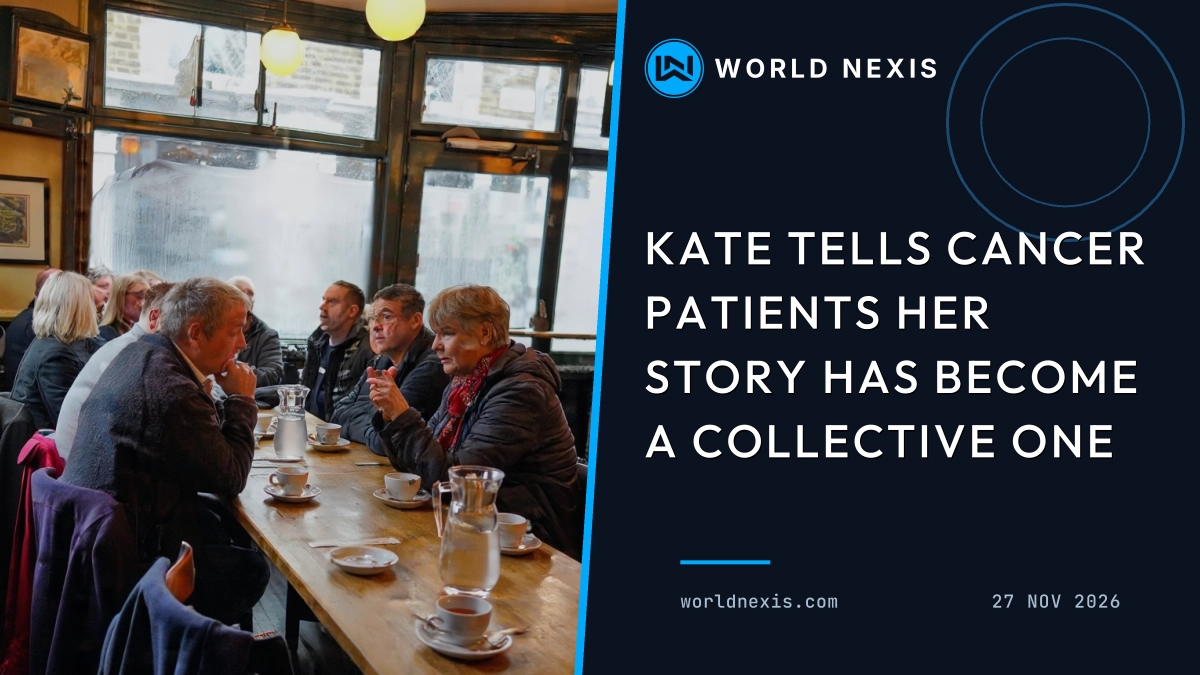
Kate cancer documentary Heal will be screened on Sunday, and a clip released ahead of it shows the Princess of Wales describing her illness as “so much more than a personal or solitary experience but really a collective one”. The 30-minute film, made with Detail Films and Kensington Palace, explores life beyond a cancer diagnosis. In the new footage she sits around a table with patients and survivors from the charity Shine Cancer Support at a pub in Richmond upon Thames, south-west London.
Key points
- A new clip from the Kate cancer documentary Heal has been released ahead of a screening on Sunday.
- Kate says navigating cancer or any long-term illness “is a lonely road”, but that people are “not meant to carry life’s challenges alone”.
- She tells the Shine Cancer Support group that her illness has become “a collective one” rather than a solitary experience.
- The princess, in remission since the start of last year after chemotherapy, is making a gradual return to full-time royal duties.
What the Kate cancer documentary clip shows
The Kate cancer documentary opens with the princess narrating over footage shot from inside a car travelling at night past road signs in western Scotland. “Navigating cancer or any long-term illness is a lonely road,” she says. “But it’s clear we’re not meant to carry life’s challenges alone.”
She goes on to link her own treatment to the wider community of patients. “You know, my illness has brought me alongside so many others navigating their own journeys too,” she says. “This has become so much more than a personal or solitary experience but really a collective one.”
The film then cuts to the pub in Richmond upon Thames, where the princess arrived last June to join the Shine group. “Genuinely meeting you all here today really means a lot to me because it’s just lovely to be able to share my personal experience, but also hear your stories and be able to connect with others who’ve gone through something similar,” she tells them.
In a more unguarded passage, she admits the conversation took her somewhere new. “I haven’t really explored this outside my family walls, really. So thank you for allowing me the time to do that and the open space to explore that. I really appreciate it, so thank you.”
It is the second extract from the Heal documentary released this week. In earlier footage, Kate says: “Once you experience something like that, it’s very hard to go back to the person you were before.”
Kensington Palace introduced the project on social media as a deeply personal film about “the many ways people find comfort, strength and hope in the face of serious illness”, adding that the princess hopes it will help others navigate their own experiences.
From abdominal surgery to remission
The Kate cancer documentary returns to a period the princess has discussed only in fragments. She revealed at the start of last year that she was in remission after receiving chemotherapy for an undisclosed form of cancer.
Her treatment followed abdominal surgery in January 2024. At the time her condition was thought to be non-cancerous, but tests after the operation found cancer, and she was treated at the Royal Marsden Hospital in London.
Since then she has been working her way back to a full diary of royal duties at home and overseas. Earlier this month she travelled with Prince William to India for his Earthshot Prize environmental awards.
At the table with Shine Cancer Support
The strength of the clip lies less in the princess’s narration than in the voices around the table. Ceinwen Giles, co-founder of Shine Cancer Support and a cancer survivor, punctured the solemnity of the occasion. “I remember someone saying to me, ‘Oh, you can’t take cancer patients to the pub’,” she recalls. “And I was like, ‘No. That’s where they want to go’.”
Joss Serraillier described the upheaval that follows a diagnosis. “You’re going through so much in terms of turning over the earth in who you are and what your identity is,” Serraillier says. “You don’t get any help with that from doctors or the language that they use.”
Serraillier added that clinical settings offer no tools for that part of illness, leaving patients to find their own. “Finding language or finding other people, that community or art or something, these are the only tools we have, I think, to explain and exercise your uncertainty and become OK with it.”
Why it matters
For anyone living with cancer, or caring for someone who is, the Kate cancer documentary makes its case quietly and practically. The emotional work of illness, from identity to uncertainty to the sense of a former self slipping away, mostly happens outside the consulting room. Peer groups are often the only place it is said aloud.
It also matters who is speaking. A member of the royal family describing her own treatment in the language of community, rather than recovery alone, gives public permission to discuss the parts of cancer that clinics do not address.
Analysis
I cover public services for World Nexis News, and my instinct with any royal project is to ask what changes on the ground once the cameras leave. On that test, the Kate cancer documentary is stronger than most. Its most useful content is not the palace framing but the plainly stated gap between treatment and the rest of a patient’s life, the identity work that Shine Cancer Support’s members describe and that no scan measures.
I think the princess’s side of the argument holds up better than the sceptics allow. The admission that she had not explored her illness beyond her family walls is not the sort of sentence a communications team drafts. It is a quiet acknowledgment of isolation, and it will land with people who have said something similar to a stranger because they could not say it at home. The counter-argument is fair, though: a documentary is not a service, and warmth on camera does not pay for the groups doing the work.
So I would judge the Kate cancer documentary by what follows it, not by how it is framed now. If the film is a one-off, it belongs in a long list of royal awareness campaigns. If it leads to sustained work alongside cancer support groups, the case for it becomes far harder to dismiss.
What happens next
Heal is due to be screened on Sunday. The Kate cancer documentary, a 30-minute film made with Detail Films and Kensington Palace, puts a small charity’s approach, built on conversation, community and a pub table, in front of a national audience.
What we don’t know yet
It is not yet clear how widely the film will be available after Sunday’s screening. No timetable has been announced for further charitable work connected to the project.
Related coverage
- Princess of Wales patron: Kate’s new Christie cancer role
- Kate Middleton named patron of The Christie as Heal gets premiere date
- Beyond Paradise Christmas special reveals Santa Claus twist
Further reading
- My cancer story more a ‘collective one’ than solitary experience, says Kate
- My cancer story more a ‘collective one’ than solitary experience, says Kate
About the author: Liam O’Connor is the UK Politics Reporter at World Nexis News (WNN), covering uk politics. The analysis section reflects the writer’s view.

Liam O'Connor
Liam O'Connor is UK Politics Reporter at World Nexis News, covering Westminster, devolved politics and the issues that matter to voters across England, Scotland, Wales and Northern Ireland. Based in London, he reports from primary sources — Hansard, official statements, published data — and explains…



