DWP Christmas Bonus 2026: 25 benefits that qualify for £10
The DWP Christmas Bonus 2026 has been confirmed: 25 benefits qualify for the £10 payment, but pensions and Universal Credit portals remain down.
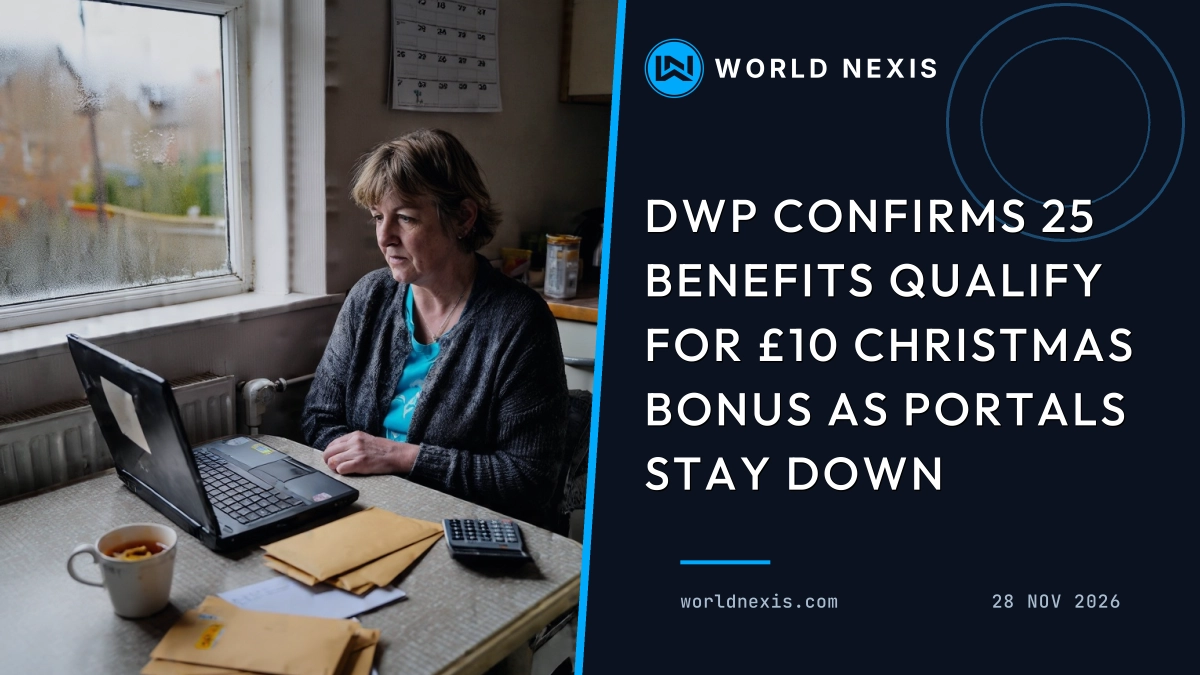
The DWP Christmas Bonus has been confirmed for 2026, with 25 benefits qualifying for the one-off £10 payment, but the announcement has landed while the department’s state pension, Universal Credit and PIP portals remain offline after a cyber incident. The Department for Work and Pensions says the tax-free payment will reach eligible claimants automatically before Christmas, with no claim required.
The confirmation came as ministers tried to reassure millions of claimants that regular benefits and pensions will keep being paid despite the outage, which began late on Thursday and was still disrupting online services on Saturday morning.
Key points
- Twenty-five benefits qualify for the £10 DWP Christmas Bonus, which is tax-free and paid automatically before Christmas.
- Claimants must receive one of those benefits during the qualifying week, normally the first full week of December.
- State pension, Universal Credit and PIP portals have been offline since Thursday after what the Work and Pensions Secretary called a “serious cyber incident”.
- The government says normal payments will continue and that reported delays are not thought to be linked to the outage.
£10 Christmas Bonus eligibility: who qualifies
Entitlement to the DWP Christmas Bonus turns on what someone is receiving during the qualifying week, which is normally the first full week of December. Claimants must be present or ordinarily resident in the UK, the Channel Islands, the Isle of Man or Gibraltar at that point, and must be receiving at least one of the 25 qualifying benefits.
The payment is tax-free, arrives in the same account that carries a benefit or pension, and does not reduce any other award. Anyone receiving more than one qualifying benefit still gets a single £10 payment rather than one per benefit.
Being on benefits in general is not enough, and the DWP Christmas Bonus is not available on request. Someone who has not claimed their State Pension, and receives no other qualifying payment, will not get it. There is no form to complete and no number to call: the money should appear without any contact with the department.
If it does not arrive, the department’s guidance is to contact the Jobcentre Plus office that handles a claimant’s payments, or the Pension Service.
Cyber incident leaves the DWP Christmas Bonus in the balance
The DWP cyber incident began late on Thursday, when the department took its systems offline. Almost all of its online services have been affected, including the portals used by pensioners and by people applying for Personal Independence Payment, and the disruption was continuing on Saturday.
Work and Pensions Secretary Pat McFadden has described the event as a “serious cyber incident”. The government has not confirmed that hackers were behind it, and has not ruled the possibility out. It is working with the National Cyber Security Centre, part of GCHQ, and Downing Street has said no other department was accessed by a “malicious actor”.
Ministers insist that benefits and pensions will still be paid. The department believes the delays reported by some claimants are not connected to the outage.
The outage has collided with the DWP Christmas Bonus timetable. The payment should not depend on anyone logging in, because it is paid automatically into the account that carries a benefit or pension. However, claimants who want to check an award or report a change before the qualifying week currently cannot.
Specialists have focused on the age of the government’s digital estate. David Knott, the UK’s former chief technology officer, said his “strong suspicion” was that the department had been targeted, adding that taking citizen-facing services down “implies to me that there’s some kind of attack could be mounted through the front door”. John Curry, a cyber security expert at Bath Spa University, said the department had “almost certainly” detected hacking activity, and that the “best thing to do is slam the front door shut”. Matthew Gould, the former Cabinet Office head of cyber security, warned that systems were relying on very old infrastructure and that “quite boring investment” was needed to keep them resilient.
Claimants have described the practical fallout. Benyamin Abdollahi, 19, a part-time university student and full-time carer for his mother in Birmingham, said his Carer’s Allowance had not landed and that he would have to borrow from friends. Jacob Dwight, 21, a design graduate from Stockport, said he could not reach his Universal Credit account to explain why he had missed a meeting.
Why it matters
For households on the lowest incomes the sum is not the story; the timing is. The qualifying week falls in early December, the same days claimants would normally sign in to check an award, report a change of circumstances or upload evidence.
Claimants have said they fear being penalised for missing deadlines they cannot meet while the portals are down. Even if the DWP Christmas Bonus arrives as promised, a decision taken on incomplete information would cost far more than the bonus is worth.
Analysis
Covering public services for World Nexis News, I look first at what a department tells people to do when something breaks. This week the answer was to wait and to trust that payments would arrive, which is the only honest answer available, but it is not a plan.
On the outage itself, I think the government’s argument is the stronger one. When an intrusion is suspected, cutting citizen-facing access is a responsible call rather than a sign of panic, and John Curry is right that the first instinct should be to shut the door. The fairest criticism is the one Matthew Gould makes: this is a story about old infrastructure and unglamorous maintenance, not about a single bad decision taken on Thursday. The counter-argument, that a department sitting underneath the incomes of the poorest households should never have been this exposed, is fair, but it describes years of underinvestment rather than anything ministers did this week.
Where I part company with ministers is over the DWP Christmas Bonus itself. A flat £10 spread across 25 qualifying benefits is a token, and presenting it as festive support sets expectations the sum cannot meet. I would rather the department said plainly that the bonus is symbolic, and that the reliability of the payment system is what actually protects households in December. That is not an argument for scrapping it; it is an argument for judging the department on whether the money clears.
What happens next
The qualifying week is normally the first full week of December, so the practical test arrives within days. The DWP Christmas Bonus should appear automatically in the account that carries a claimant’s benefit or pension, with no action needed.
The department has not said when online services will be restored, and it continues to work with the National Cyber Security Centre. Anyone who believes a bonus has been missed can approach the Jobcentre Plus office handling their payments, or the Pension Service, once systems return.
What we don’t know yet
The government has not confirmed whether hackers were responsible, what data if any was accessed, or how long the outage will last. It has also not set out how claimants who miss deadlines during the disruption will be treated.
Related coverage
- COP31 summit fails as fossil fuels split 2026 climate talks
- DWP cyber incident takes major benefit services offline
- Beyond Paradise Christmas special reveals Santa Claus twist
Further reading
- DWP pensions and benefits services still down after ‘cyber incident’
- The 25 benefits that qualify for DWP
About the author: Liam O’Connor is the UK Politics Reporter at World Nexis News (WNN), covering uk politics. The analysis section reflects the writer’s view.

Liam O'Connor
Liam O'Connor is UK Politics Reporter at World Nexis News, covering Westminster, devolved politics and the issues that matter to voters across England, Scotland, Wales and Northern Ireland. Based in London, he reports from primary sources — Hansard, official statements, published data — and explains…