COP31 summit fails as fossil fuels split 2026 climate talks
COP31 summit ends in Antalya without a cover decision, the first since 2009, as fossil fuel divisions split more than 30 nations over the final text.
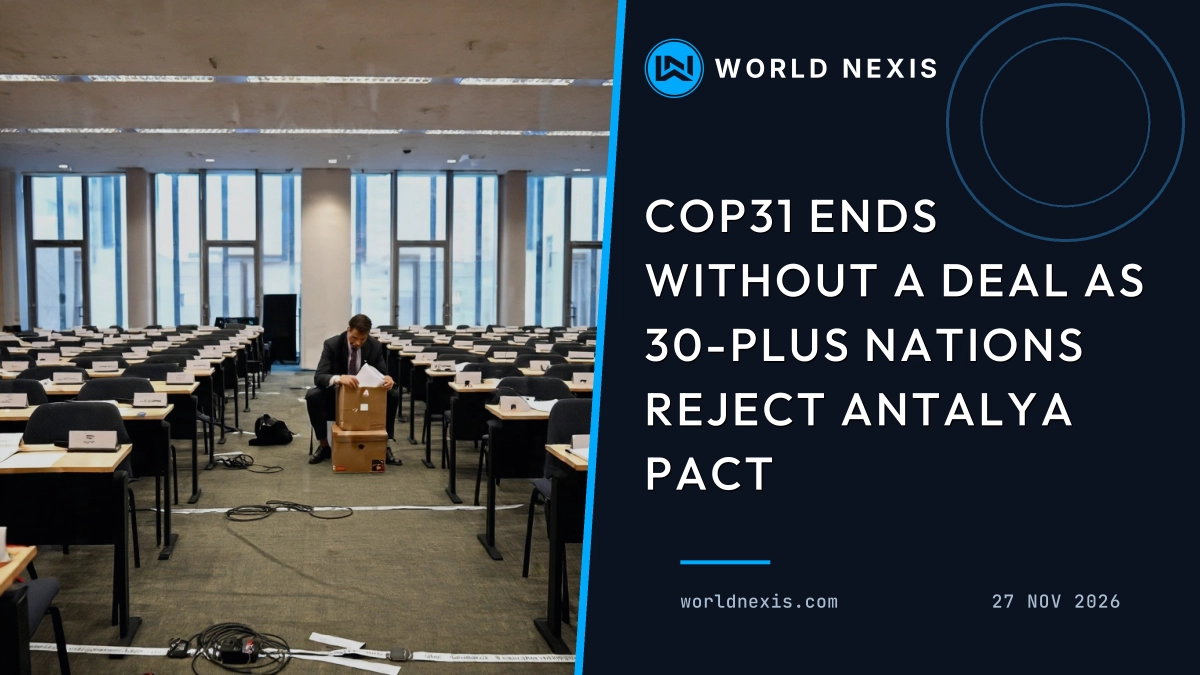
The COP31 summit in Antalya has ended without an overarching agreement, the first United Nations climate conference to close without a cover decision since 2009. Negotiations ran two days past Friday’s deadline, making this the longest UN climate summit to date, before the presidency conceded defeat on Sunday afternoon local time. More than 30 countries refused to endorse the final text, known as the Antalya Pact.
Key points
- The COP31 summit in Antalya, Turkey, closed without a cover decision, the first such failure since 2009.
- A draft of 144 provisions across 18 pages was halved, losing both multibillion-dollar climate finance targets and language on moving away from fossil fuels.
- More than 30 countries rejected the Antalya Pact, among them the UK, European Union members, Norway, Vanuatu and the Marshall Islands.
- Turkey’s environment minister, Murat Kurum, presided over the talks; Australia’s climate change minister, Chris Bowen, led negotiations.
How the COP31 summit lost its final text
The 2026 conference was unorthodox from the outset. A deal between Turkey and Australia made Turkish Environment Minister Murat Kurum the COP president and Australian Climate Change Minister Chris Bowen the president of negotiations.
In October, Bowen announced that the pair would seek a cover decision, the final statement intended to capture the world’s ambition on climate action. Early in the second week they released a comprehensive draft: 144 provisions over 18 pages, stretching from multibillion-dollar climate finance targets to a transition away from fossil fuels.
Within days a second draft had halved the page count and removed both provisions, drawing protests from environmental groups. A third draft then failed to win backing on Sunday afternoon Turkish time, and Kurum conceded defeat.
Consensus broke on three issues: climate finance, carbon capture and storage, and what participants came to call the “f-word” — fossil fuels.
The “f-word” that stalled the Antalya climate summit
The fault line ran between countries demanding an unambiguous commitment to a fossil fuel transition and those determined to block one. Matthew McDonald, professor of international relations at the University of Queensland, said the failure was not unexpected given increasingly polarised views on renewable energy, carbon capture and storage, and moves away from coal, oil and gas.
He pointed to the opening speeches. Neither Prime Minister Anthony Albanese nor Bowen mentioned a transition away from fossil fuels, which Professor McDonald said may have emboldened nations opposed to the measure. He added that the absence of the United States from the summit contributed to global divisions.
“Electrification was (Bowen’s) way of talking about decarbonisation by stealth,” he said. “That was his political move to try to get past using the f-word.”
Frank Jotzo, professor of climate change economics at the Australian National University, went further. He said the 2015 Paris Agreement, which committed nations to limit global warming, would be so politically polarising if proposed today that it would have little chance of success.
“If you tried to negotiate the Paris Agreement now, that would probably not be possible,” he said. “UN negotiations are so obviously stuck in unbridgeable divides between different countries.”
More than 30 countries refuse to sign the Antalya Pact
The final text did not fail for lack of opposition to it. More than 30 countries rejected the Antalya Pact, including European Union members, the UK, Vanuatu, Norway and the Marshall Islands.
Gavan McFadzean, advocacy head at the Australian Conservation Foundation, said that refusal showed how hard many governments are pushing for clearer action against global warming.
“The fact that weak language didn’t get up is a sign that a whole bunch of nations are really pushing for demonstrably stronger climate action around the world,” he said.
Bowen and Simon Stiell, the UN’s climate change executive secretary, both called the failure to reach agreement disappointing. Yet attention is already shifting to smaller coalitions. Like-minded countries are planning separate summits to pursue their goals, according to climate policy experts, a route that could challenge, change or even doom future COP meetings.
Why it matters
For households and businesses, the practical effect of a missing cover decision is an absent signal. There is no agreed text setting multibillion-dollar climate finance targets or pointing energy systems away from coal, oil and gas. Investors, utilities and developing-country governments are left reading national plans instead of a shared direction.
It also tests the consensus model itself. If the countries most exposed to warming conclude that a universal forum cannot deliver, they will turn to smaller groups — and the choices that shape energy prices, adaptation funding and industrial policy will be settled in rooms where fewer governments hold a veto.
Analysis
Having covered energy transition and climate finance for World Nexis News, I look first at what a missing cover decision does to the investment case, and on that measure the governments that walked away were right. A text that had already lost its finance targets and its fossil fuel language would have carried a UN badge without shifting a single capital allocation. The COP31 summit did not fail because roughly 30 governments refused to sign; it failed because the draft on the table had been hollowed out until signing meant accepting the status quo with extra paperwork.
I side with McFadzean’s reading rather than with those who call the collapse a wasted fortnight. Refusing weak language keeps the standard intact, and Jotzo’s point about Paris is the honest one: an agreement built on the same consensus rules today would probably not survive the room.
The strongest counter-argument is real, though. A thin cover decision would have kept every government inside one process and given poorer countries a hook for finance commitments they cannot win elsewhere, so fragmentation carries costs that fall hardest on those least able to pay them. In my view those costs are still smaller than the cost of a text that pretends a transition is under way while deleting the words that require one.
What happens next
The immediate question is whether a cover decision can be revived at the next COP. Groups of like-minded countries are meanwhile expected to pursue their priorities through separate summits, which could produce parallel standards on finance and on fossil fuels.
Both Bowen and Stiell have framed the Antalya outcome as a disappointment, leaving the negotiating bloc that rejected the pact as the main source of pressure for a stronger text.
What we don’t know yet
It is not yet clear which countries will join those alternative gatherings, or whether they will complement or compete with the UN process. Nor is it settled whether carbon capture and storage and climate finance can be separated from the fossil fuel question that sank this round.
Related coverage
- Rough gas storage: 100 jobs at risk as winter deal fails
- Nicole Scherzinger split confirmed as 7-year romance ends
- Mecca defense pact: Pakistan hosts talks after 279-119 vote
Further reading
- The ‘f-word’ threatening future global climate talks
- The ‘f-word’ threatening future global climate talks
About the author: Hannah Lindqvist is the Climate & Environment Reporter at World Nexis News (WNN), covering climate & environment. The analysis section reflects the writer’s view.

Hannah Lindqvist
Hannah Lindqvist is Climate & Environment Reporter at World Nexis News, based in London. She covers climate policy, extreme weather, the energy transition, conservation and climate finance, grounding stories in scientific research, official data and documented commitments rather than slogans. She is interested in how…