Power grid alert: Neso issues record fourth day of warnings
Neso issued a power grid alert for a record fourth day running, with two electricity margin notices as a cold snap and maintenance squeeze supply.
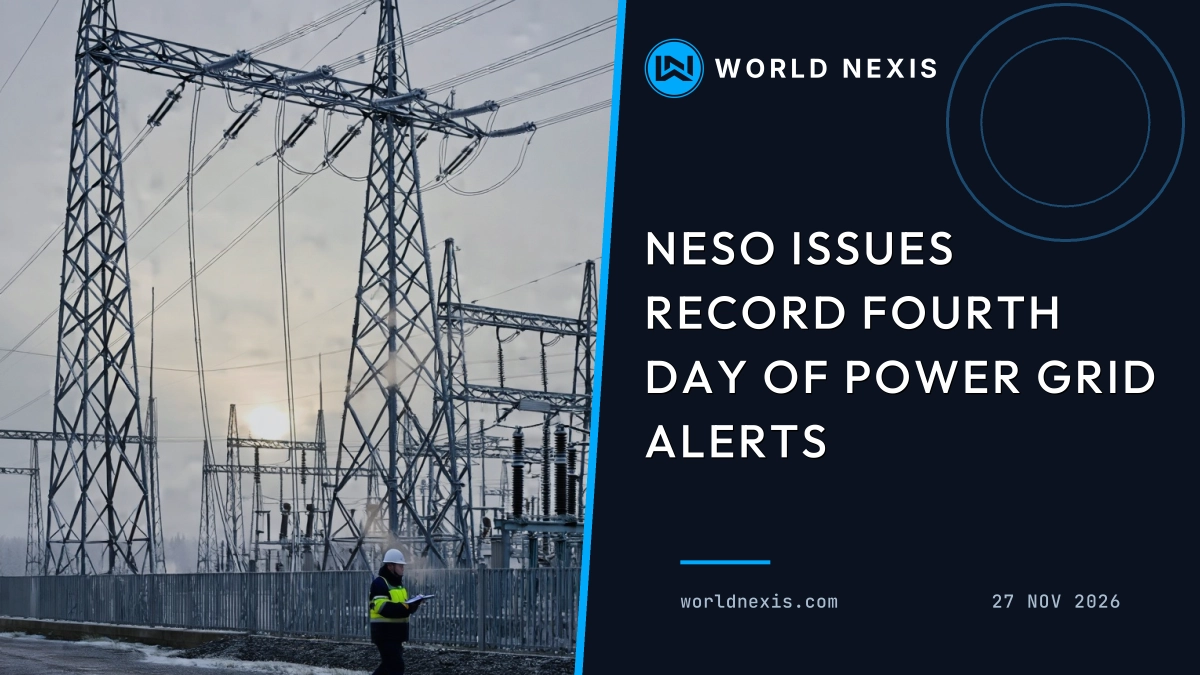
A power grid alert has been issued for a record fourth day running after the National Energy System Operator told the market to prepare extra generation for Friday. The operator, known as Neso, issued two electricity margin notices, following one on each day since Tuesday, as a cold snap across the UK coincided with heavy maintenance on the transmission network.
Key points
- Neso issued two electricity margin notices on Friday, extending an unbroken run of alerts since Tuesday that is being described as a record.
- Eleven margin notices have been issued so far this year, a total said to be higher than the previous five years combined.
- Friday’s expected system margin shortfalls were 2,500 megawatts between 7am and 10am, and 2,400 megawatts between 2pm and 8pm.
- Neso says there is no risk to customer supplies and households do not need to take any action.
What the power grid alert actually asks for
An electricity margin notice is not a blackout warning. It is a message to generators and suppliers that Neso would like a wider cushion between demand and available supply for a limited period, so it can call on plant that would otherwise sit idle.
For Friday, Neso flagged a reduced cushion of supply between 7am and 10am, when it expected a system margin shortfall of 2,500 megawatts. It also identified a shortfall of 2,400 megawatts between 2pm and 8pm. The operator described the power grid alert as a “routine and precautionary measure” taken to allow for “additional generation capacity”.
A Neso spokesman said:
“This is not a warning of power cuts, there is no risk to customer electricity supplies and customers do not need to take action.”
Why the power grid alert run is unusual
Eleven electricity margin notices have now been issued this year, including Friday’s two, a figure said to be more than the previous five years combined. Consecutive daily notices are rarer still, with the operator issuing at least one on every day since Tuesday.
That pattern points to a system running with less headroom than usual. Each notice reflects a forecast gap between what the country is expected to demand and what the market has committed to supply, and the gap has to be closed by plant that might otherwise not run at all.
Cold snap, maintenance and 6,000 megawatts held up
The reassurance is genuine, but the backdrop is tighter than the wording suggests. Temperatures have plunged across the UK this week, lifting demand for heating and electricity at precisely the moment when significant parts of the network are unavailable.
Network constraints linked to maintenance work are holding up around 6,000 megawatts of capacity, according to Neso. That is roughly the output of several large power stations sitting behind a bottleneck, rather than a shortage of fuel or of generating plant.
Industry reaction
Laura Fleming, UK and Ireland managing director at Hitachi Energy, said the week’s alerts were “an important reminder of the importance of strengthening the UK’s grid”, and argued that this “must be a national priority”.
She added: “As renewable generation expands and electricity demand rises, Britain’s energy security depends not just on how much power we generate, but on how effectively we move and manage it.” Fleming called for stronger transmission infrastructure, smarter networks and greater flexibility to balance supply and demand, and for faster investment alongside digital tools that unlock capacity from existing networks.
Why it matters
For most readers the practical position is straightforward. The notices are aimed at the wholesale market rather than at consumers, nobody is being asked to change their behaviour, and there is no expectation of controlled outages.
Yet the record run carries real consequences for the country’s bills and resilience. Paying generators to stand by, and moving power around a constrained network, is not free, and over time those costs feed into the investment decisions that determine how quickly the grid is reinforced. Reliability during a cold snap is becoming a political question as well as an engineering one.
Analysis
Having covered the energy transition for World Nexis News, I look first at what a run of notices says about the network, not at the weather. In my view the facts support Laura Fleming’s argument more than the “routine” framing does. A system that asks the market for help four days in a row, and has done so 11 times in a single year, is not simply unlucky with the temperature. It is being asked to carry more than its wires can comfortably move.
The strongest counter-argument is that maintenance has to happen somewhere in the calendar, cold snaps arrive without warning, and a margin notice is exactly the precautionary tool designed for that collision. Neso is right that a notice is not a warning of power cuts, and treating every alert as a near-blackout would be alarmist.
What tilts me towards the infrastructure view is the direction of travel. Demand is rising as heating and transport electrify, so the same constrained stretches of network will face the same squeeze every winter. Around 6,000 megawatts sitting behind maintenance looks like a capacity problem dressed up as a scheduling problem, and I would rather see this record run treated as an argument for building and digitising the grid faster.
What happens next
The two notices apply to defined windows on Friday, from 7am to 10am and from 2pm to 8pm. They are time-limited by design and expire at the end of the period they cover, with the market left to respond.
What we don’t know yet
Neso has not said when the maintenance work behind the constraints will be completed, or how much of the 6,000 megawatts of held-up capacity returns once it is. It is also unclear whether the run of notices will extend beyond Friday.
Related coverage
- Central Park rain record broken as 900,000 lose power
- Met Office snow warning: ice alert for 11 areas today
- Thanksgiving storm cuts power to hundreds of thousands in US
Further reading
- Electricity grid operator issues back-up power call for fourth day running
- Electricity grid operator issues back-up power call for fourth day running
About the author: Hannah Lindqvist is the Climate & Environment Reporter at World Nexis News (WNN), covering climate & environment. The analysis section reflects the writer’s view.

Hannah Lindqvist
Hannah Lindqvist is Climate & Environment Reporter at World Nexis News, based in London. She covers climate policy, extreme weather, the energy transition, conservation and climate finance, grounding stories in scientific research, official data and documented commitments rather than slogans. She is interested in how…