Mecca defense pact: Pakistan hosts talks after 279-119 vote
Pakistan opens the first Mecca defense pact talks with Saudi Arabia and Turkey in Islamabad as Erdogan ratifies, with Houthi attacks top of the agenda.
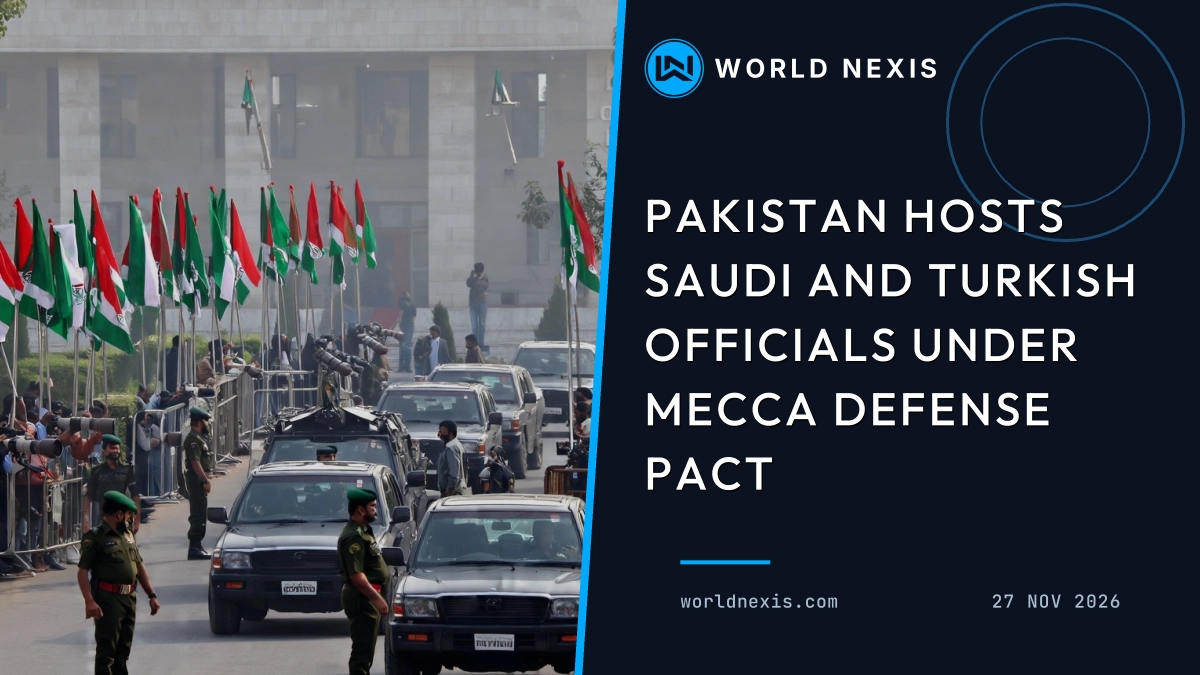
Pakistan is hosting the first Mecca defense pact talks in Islamabad on Friday, with senior diplomats, defense officials and military chiefs from Saudi Arabia and Turkey joining their Pakistani counterparts to test how far the three countries will go to defend one another while Houthi attacks on Saudi Arabia continue.
The meeting of the Strategic, Political and Defense Committee sits under the Joint Mecca Defense Agreement, signed in August in the Saudi holy city by Crown Prince Mohammed bin Salman, Turkish President Recep Tayyip Erdogan and Pakistani Prime Minister Shehbaz Sharif. The document treats an attack on any one of the three as an attack on all.
Two security officials said delegations from Ankara and Riyadh had begun arriving in the capital, and that flags of the three countries lined the route as convoys moved through the city under tight security. The officials spoke on condition of anonymity because they were not authorized to discuss the meeting publicly.
Key points
- Saudi Arabia, Turkey and Pakistan have opened Mecca defense pact talks in Islamabad, with Houthi attacks on Saudi Arabia at the top of the agenda.
- Turkey’s Recep Tayyip Erdogan formally approved the agreement on Friday, completing his country’s ratification after parliament backed it by 279 votes to 119.
- Pakistan’s Defense Minister Khawaja Muhammad Asif, Foreign Minister Ishaq Dar and army chief Field Marshal Asim Munir are attending.
- Authorities declared a local holiday in the capital and traffic police announced road diversions to limit movement around the venue.
What the Mecca defense pact actually commits
Officials say the committee will look at ways to deter threats, widen military cooperation, share intelligence and deepen defense industry ties. That is the substance behind the ceremony: not a joint command, but a framework the three capitals can scale up or play down as circumstances demand.
Pakistan has described the Mecca defense pact as purely defensive, saying it is not directed against any country, Iran included. Turkish officials have gone further, saying Ankara is considering military assistance to Saudi Arabia while insisting the agreement is defensive and that no Turkish troops would be deployed to fight in Yemen or attack the Houthis.
The pledge is broad, but the language around it is carefully bounded. Asif has said Pakistan will use “whatever means are available” to defend Saudi Arabia against Houthi attacks.
Turkey ratifies the Mecca defense pact as Houthi attacks continue
Erdogan’s formal approval, published in Turkey’s Official Gazette on Friday, completes Turkey’s ratification process. Legislators approved the agreement earlier this month by 279 votes to 119, after opposition parties argued it could drag Turkey into regional wars and put Turkish soldiers in harm’s way.
Turkish officials said Foreign Minister Hakan Fidan, Defense Minister Yasar Guler and military chief Gen. Selcuk Bayraktaroglu would take part in Islamabad. Fidan is expected to reaffirm Turkey’s commitment and full solidarity with Riyadh, to call Houthi attacks on civilians and civilian infrastructure unacceptable, and to press for a diplomatic resolution between the United States and Israel on one side and Iran on the other, including safe navigation through the Bab al-Mandeb Strait.
That channel runs alongside Pakistan’s own mediation. Islamabad has been working with Middle Eastern governments including Qatar to push Washington and Tehran back to the negotiating table, and it brokered an interim deal between the two sides in June.
Why it matters
For readers far beyond South Asia, the test is whether a collective defense promise becomes movement of forces. Turkey has put safe navigation through the Bab al-Mandeb Strait on the agenda, a sign that shipping risk now sits inside the conversation. Whether the Mecca defense pact hardens into deployments would set the price of any further strike on Saudi infrastructure; a pact that stays on paper changes very little.
There is a diplomatic cost too. The same three governments are urging Washington and Tehran to talk, and that mediation becomes harder if one member of the alliance is drawn into an exchange with Iran’s partners.
Analysis
Having covered alliance politics and conflict diplomacy for World Nexis News, I read the Mecca defense pact’s ratification-day summit by what it leaves out, and this one leaves out almost everything operational. Nothing in the confirmed agenda sets a force posture, a deployment timetable or a trigger that would automatically commit Turkish or Pakistani units. The 279-119 vote in Ankara shows how thin the domestic consensus behind the deal still is.
In my view, the Mecca defense pact is worth more as leverage than as a war plan. Pakistan wants Saudi security ties without rupturing its Iran channel, Turkey wants Gulf money and sway without Yemen, and Riyadh wants visible backing that lifts the price of the next Houthi attack. The strongest counter-argument is that ambiguity is exactly what early deterrence looks like, and that a public attack-on-one-is-attack-on-all line already shifts Houthi and Iranian calculations before a single soldier moves.
I side with the skeptics on capability and with the pact’s authors on diplomacy. The evidence points to a bargaining chip: Turkey’s insistence that no troops will go to Yemen and Pakistan’s continuing mediation with Iran both suggest the three want a bigger seat at a negotiating table, not a new front. What worries me is that vague guarantees are also easy to stumble into.
What happens next
Under the Mecca defense pact, the committee’s session is due to conclude on Friday, with attention on any joint language about intelligence sharing and defense industry cooperation rather than on deployment. Erdogan’s approval means Turkey’s side of the ratification is complete. Turkish and Pakistani officials will then carry the same message into their separate channels with Washington and Tehran, and Islamabad’s talks with Qatar on reviving U.S.-Iran negotiations are expected to continue.
What we don’t know yet
Three questions remain open. It is not clear what the committee will commit to in writing on intelligence sharing or procurement. Nor is it confirmed where Pakistan and Saudi Arabia stand in their own ratification procedures. And Ankara has given no timeline for the military assistance to Saudi Arabia that Turkish officials say is under consideration.
Related coverage
- Pentagon drone talks: GM and Ford face major conversion test
- Trump Putin talks: he urges major pull-back in Europe
- Iran naval blockade vow as MP warns over Hormuz control
Further reading
- Pakistan hosts defense talks with Saudi Arabia and Turkey under Mecca pact
- Pakistan set to host talks with Saudi Arabia and Turkey under trilateral defense pact
About the author: Marcus Ellington is the International Correspondent at World Nexis News (WNN), covering world affairs. The analysis section reflects the writer’s view.

Marcus Ellington
Marcus Ellington is International Correspondent at World Nexis News, reporting on diplomacy, conflict and the political forces reshaping Europe, the Middle East, Asia and the Americas. Based in London, he focuses on explaining why events unfold as they do, using official statements, diplomatic documents and…



