Pentagon drone talks: GM and Ford face major conversion test
Pentagon drone talks: the Defense Department confirms early discussions with GM and Ford on drone components, testing Detroit's idle plants and thin margins.
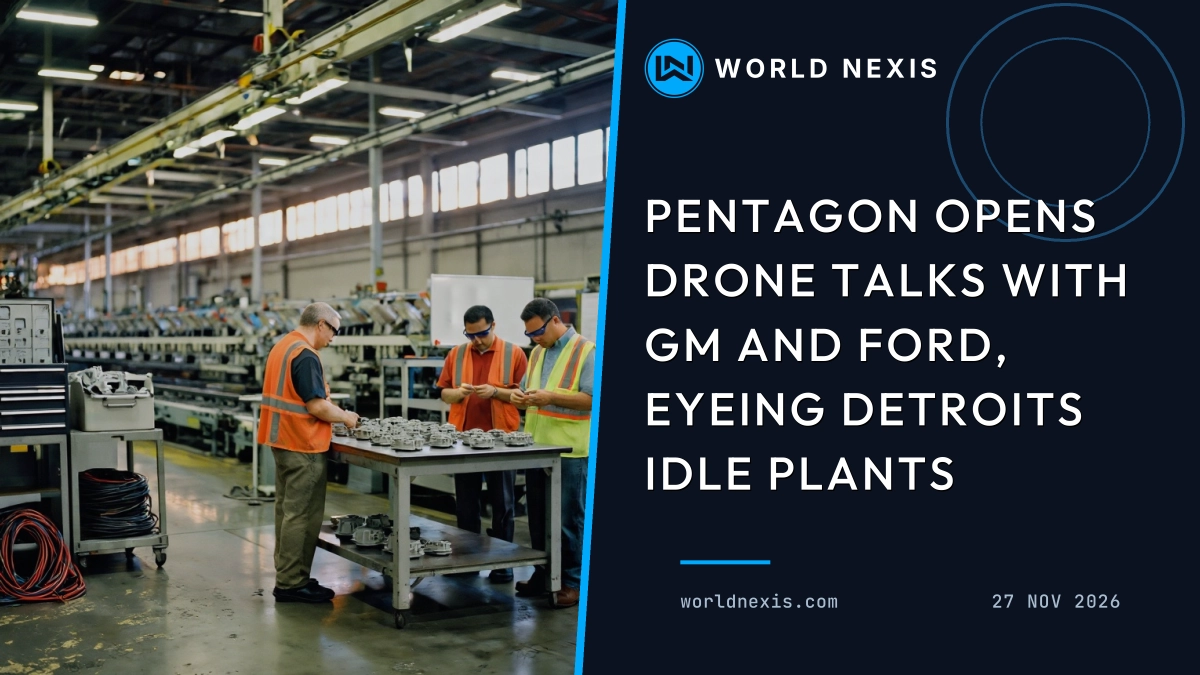
Preliminary Pentagon drone talks with General Motors and Ford cover components for military drones, the Defense Department has confirmed, as Washington pushes toward a new autonomous warfare command. Major suppliers are involved too, and officials are looking closely at Detroit’s idle factory capacity and its established supply chains.
The plants that once built tanks and bombers are being courted for a different mission. Drones have rewritten modern war, and the United States wants an industrial base that can keep up.
Key points
- The Pentagon drone talks are early and involve GM, Ford and major suppliers.
- They sit inside a wider push toward a new autonomous warfare command.
- Officials are eyeing Detroit’s idle capacity and supplier networks.
- Auto executives have questioned whether thin margins make the work sustainable.
What the Pentagon drone talks cover
These are conversations about parts, not orders for complete aircraft. A drone assembly line depends on motors, batteries, sensors and electronics, and each item sits inside a chain of vendors that has to hold up under pressure.
Detroit’s appeal is straightforward. The buildings, tooling and trained workers already exist, and the supplier networks behind them reach deep into the Midwest. Any push into Detroit drone production would rest on that base rather than on new factories built from scratch.
Louis Libin, a combat technology expert and strategic communications innovator, said carmakers bring strengths that matter here. He pointed to their record in “production engineering, quality control, and managing large supplier networks”.
“The auto industry can close important parts of the production gap, but full surge capacity requires more,” Libin said. “I would bring those companies in now, especially where existing manufacturing processes can produce proven components.”
For now the Pentagon drone talks centre on proven components rather than experimental airframes. Libin warned that one weak link can slow everything. “If one critical supplier cannot keep up, the entire production system slows down,” he said, adding that the chain needs testing for how fast it can expand and replace losses.
Detroit’s margin question hangs over the Pentagon drone talks
The business case is not settled. Auto executives have questioned whether thin margins on defense work make it a sustainable line of business, or one more wartime conversion experiment that fades once the emergency passes.
The two industries run on different rhythms. Car plants are built to run flat out on a handful of models, while defense work arrives in smaller batches with tighter specifications and longer approval chains.
The margin question will decide how far the Pentagon drone talks go. Libin argued the answer lies in how contracts are written. Small drones need frequent improvements, so manufacturers need enough order stability to justify investment while the military keeps the freedom to buy better technology.
“The cheapest drone on paper is no bargain if the company making it can’t afford to fill the next order,” he said.
History offers only a partial guide. American car plants switched to military production in World War II, a mobilization Libin called “extraordinary”, though he noted the ramp still took time. More recently, he said, GM delivered missile housing components in 22 days. “It doesn’t establish a timeline for an entirely new weapons system,” he added.
Speed as well as scale
Speed is the second test for the Pentagon drone talks. Libin said Ukraine has shown how quickly drone development can move when engineers and troops work closely together, and that Israel demonstrates the value of rapid feedback from the front line.
“A drone should never become obsolete while its purchase order is still moving through the Pentagon,” he said.
He added that a healthy industrial base needs room for smaller innovators as well as the large manufacturers, because each depends on the other.
Why it matters
For communities across the Midwest supplier belt, these Pentagon drone talks could mean a new stream of orders for machine shops, electronics firms and parts makers whose fortunes currently rise and fall with vehicle production cycles. Detroit drone production would spread that work across hundreds of smaller vendors.
For taxpayers, the risk runs the other way. Money spent standing up capacity that never scales is hard to recover. Drones that double as connected sensors and computers also raise supply-chain and security questions that car plants have never had to answer.
Analysis
Having covered corporate strategy and industrial policy for World Nexis News, I look first at the contract, not the factory floor. The automakers’ caution about margins is honest, but it is also a negotiating position, and it should not be read as a verdict on the work itself.
In my view the stronger argument is Libin’s. The binding constraint is contract design, not shop-floor capability. Payment terms that arrive reliably, plus upgrade clauses that let the military swap in better technology, would make thin-margin work bankable at volume.
The counter-argument deserves respect. Carmakers have chased defense work before and retreated when margins thinned, and specialist drone makers still iterate faster than any converted assembly line. Still, if the Pentagon drone talks end with vague assurances and no volume commitments, Detroit will be asked to hold capacity open on goodwill, and no board signs off on that for long.
What happens next
The discussions are preliminary, and the push toward an autonomous warfare command continues in parallel. The next stage of the Pentagon drone talks would move from components to numbers, but no production contract has been set out publicly and the companies have not committed to terms.
What we don’t know yet
- Which components each company would make, and at which plants.
- Whether volume or payment commitments would accompany the work.
- Whether the automakers conclude the margins justify the investment.
Related coverage
- Trump Putin talks: he urges major pull-back in Europe
- Nuclear test veterans win major truth panel by 2027
- Imperial Brands takeover: Altria weighs major all-cash bid
Further reading
- Pentagon confirms preliminary talks with GM, Ford on drone component production
- Pentagon confirms preliminary talks with GM, Ford on drone component production
About the author: Daniel Whitmore is the Business & Markets Editor at World Nexis News (WNN), covering business & markets. The analysis section reflects the writer’s view.

Daniel Whitmore
Daniel Whitmore is Business & Markets Editor at World Nexis News, based in New York. He leads coverage of companies, economies, markets and the forces that move them, from central bank decisions to corporate earnings and the cost-of-living pressures facing households on both sides of…



