El Niño snow forecast: Southwest snow to surge by a third
El Niño snow forecast points to a third more snow in the Southwest, with the Rockies split along I-70. It matters for passes, crowds and mountain towns.
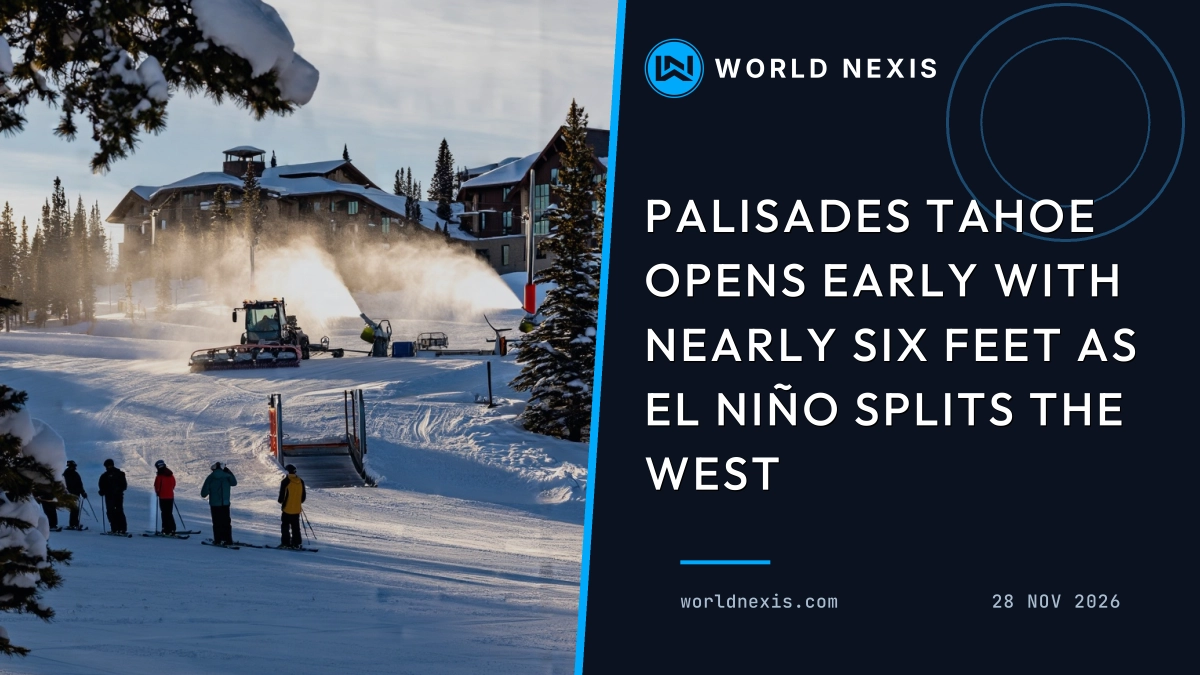
The first El Niño snow forecast of the season is already delivering in the Sierra Nevada, where Palisades Tahoe opened on November 21, four days early, with nearly six feet of snow on the mountain by Thanksgiving.
A year ago the same slopes were dry, and only one of the resort’s roughly 40 chairlifts was running on Christmas morning. Now operators across the American West are weighing a rare emotion, optimism, in a weather pattern that splits the map in half.
Key points
- Palisades Tahoe opened four days ahead of schedule with nearly six feet of snow, after a Christmas when a single lift turned.
- The El Niño snow forecast splits the West along Interstate 70, with below-average snow to the north and above-average snow to the south, according to National Weather Service meteorologist Brad Pugh.
- Southwest ski resorts have taken about a third more snow than normal across the past 10 El Niño winters, says OpenSnow meteorologist Sam Collentine.
- Americans logged 52.6 million ski days last winter, about 15% fewer than the season before, according to the National Ski Areas Association.
El Niño snow forecast splits the West along Interstate 70
As the jet stream shifts south over the Pacific, the El Niño snow forecast points to more precipitation for California’s Sierra Nevada and much of the Southwest. Milder air tends to sit in the wake of the pattern over the Northeast and Pacific Northwest, where snow is often thinner. The Rocky Mountain heart of the industry lies between the two and can go either way.
Pugh put the dividing line along the highway that runs west out of Denver. “That’s kind of the dividing line,” he said, “between below-average snowfall to the north and above-average to the south.”
On the dry side sit Steamboat Springs, Jackson Hole and Big Sky. On the favored side sit Telluride, Taos and Mammoth Mountain. Collentine said Southwest resorts took about one-third more snow than normal in the past 10 El Niño winters, and that when the pattern delivers for Colorado and Utah it tends to do so in March.
This year’s El Niño snow forecast is already showing on the ground. Snow has blanketed the California mountains and dropped feet of it at Arizona Snowbowl and New Mexico’s Sipapu Ski Resort, while colder air has let resorts such as Palisades make snow consistently.
“El Niño forecasts can have a lot of optimism, not certainty,” said Amy Ohran, Palisades’ president and chief operations officer. “But when we see these early snow patterns, it builds a lot of momentum.” Of the early opening she added: “The stoke is pretty all-time right now.”
Why the El Niño snow forecast matters less than it used to
The industry’s finances no longer swing with every storm the way they once did. Some 61 resorts, including the biggest and busiest American mountains, are owned by two companies, Alterra Mountain Co. and Vail Resorts Inc. Both collect much of their revenue before Thanksgiving by selling season passes, a model that took hold in earnest about 20 years ago.
That structure was tested hard last winter. Snow was scarce almost everywhere except New England, skier traffic fell away and pass sales followed it down. Patrick Scholes, a managing director and leisure analyst at Truist Financial Corp., said a winter like that would have driven much of the industry into bankruptcy two or three decades ago.
Instead the damage landed on resort towns and independent operators that depend on walk-up tickets, lodging and restaurant spending. Resorts in California, Colorado and Utah each lost about a quarter of their usual traffic.
Why it matters
For anyone holding a season pass or booking a trip, the forecast is the difference between a pass that pays for itself and one that does not. It also decides whether instructors, lift staff, rental shops and motels in mountain towns have a winter at all.
The El Niño snow forecast favors Southwest ski resorts, which should pull travelers and spending west this season. A thin year in the Northeast, home to the country’s densest population of skiers, leaves millions choosing between long drives and expensive flights.
Analysis
Having covered the business of leisure travel for World Nexis News, I read this story less as a weather bulletin than as a test of the pass model. Operators have bought themselves time, because pass revenue lands in the fall whatever the sky does in January. The risk, though, gets pushed outward, to the towns, the seasonal workers and the small hills that cannot sell next winter’s pass in September.
I side with the analysts who call the consolidated model sound finance but poor insurance for the sport. The strongest counter-argument is fair: without Alterra and Vail absorbing years like the last one, dozens of smaller mountains would have closed, and closures would hurt skiers more than any ticket price rise.
My view is that this El Niño snow forecast should be treated as a windfall, not a repair. A good Southwest season will hide the structural problem for another 12 months, and the next dry winter will put the same question back on the table.
What happens next
December is the first real test of the El Niño ski season. Colder temperatures are allowing snowmaking, and the El Niño snow forecast suggests the Sierra Nevada and Southwest will keep taking most of the storms. For Colorado and Utah, Collentine’s reading of past El Niño years points to March as the month that tends to deliver.
Resorts that opened early will now watch booking pace rather than snowfall totals, because the pass money is already banked. Operators in the Northeast and Pacific Northwest face the opposite problem, with a pattern that historically leaves them warm and dry.
What we don’t know yet
No one can say how much snow falls before April, and the meteorologists who study El Niño describe it as prone to feast or famine. It is also unclear whether pass sales have recovered from last winter’s slide, which would show how far the industry is still leaning on the weather.
Related coverage
- Snow and ice warning as minus 10C forecast for Scotland
- Met Office snow warning: ice alert for 11 areas today
- Small Business Saturday: record 88% plan to shop small
Further reading
- Where El Niño could deliver the best snow this winter
- Where El Niño could deliver the best snow this winter
About the author: Daniel Whitmore is the Business & Markets Editor at World Nexis News (WNN), covering business & markets. The analysis section reflects the writer’s view.

Daniel Whitmore
Daniel Whitmore is Business & Markets Editor at World Nexis News, based in New York. He leads coverage of companies, economies, markets and the forces that move them, from central bank decisions to corporate earnings and the cost-of-living pressures facing households on both sides of…