Small Business Saturday: record 88% plan to shop small
Small Business Saturday arrives with a record 88% of US shoppers planning to buy local. Here is what the day means for owners' 2027 growth plans and jobs.
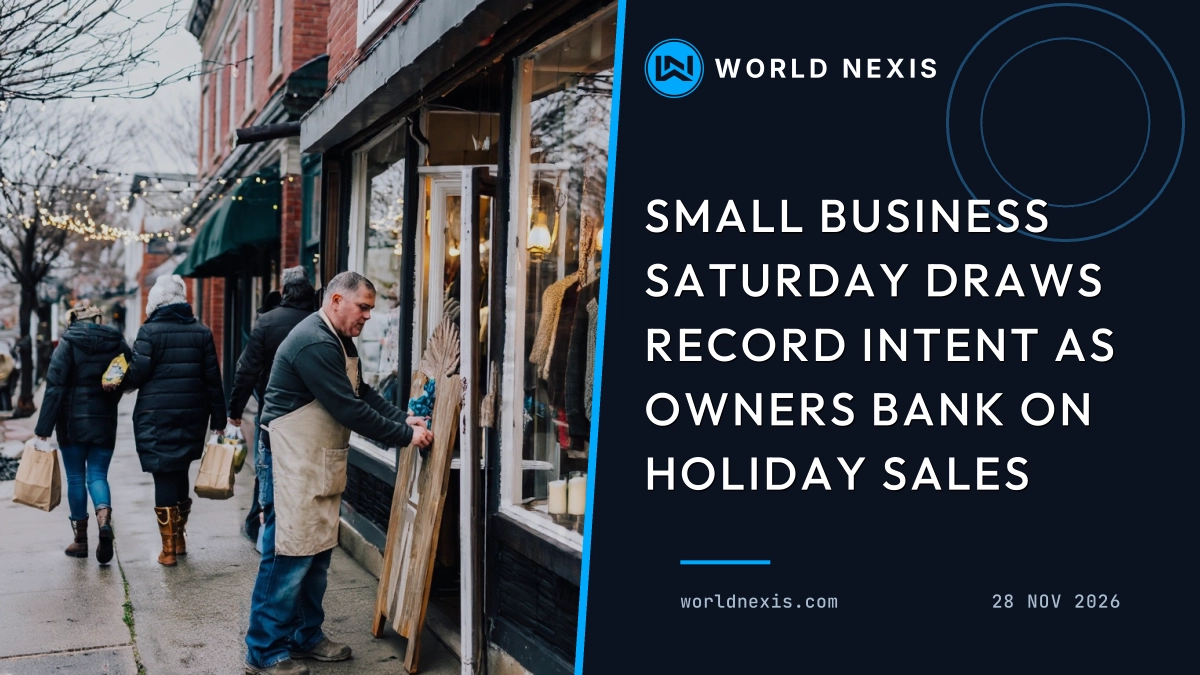
Small Business Saturday arrives on Nov. 28 with the strongest shopper intent in more than a decade, as 88% of US consumers say they are likely to spend at small businesses this holiday season. That is the highest level recorded since 2012 in the American Express Shop Small Impact Study, published last week. The same survey found that seven in ten owners say holiday sales will decide whether their business can grow in 2027.
Key points
- Small Business Saturday falls on Nov. 28, the Saturday after Thanksgiving, 16 years after American Express first promoted the day.
- 88% of US consumers say they are likely to shop at small businesses this holiday season, the highest intent since 2012.
- The National Retail Federation estimates 182.7 million people will shop over the Thanksgiving weekend, down from 186.9 million last year.
- 70% of small-business owners say holiday customer spending will affect their ability to grow in 2027.
Small Business Saturday marks its 16th year with a softer weekend overall
The day is now a fixed part of the holiday calendar. American Express introduced it in 2010, and it has settled into the Saturday after Thanksgiving. Downtown groups that joined in the first year are still running it: Scranton Tomorrow has organised events in downtown Scranton, Pennsylvania, since 2010, and more than 40 businesses there will offer specials and host events this weekend.
The wider holiday picture is mixed. The National Retail Federation estimates 182.7 million consumers plan to shop over the Thanksgiving weekend, slightly below last year’s 186.9 million. Against that softer total, the pull toward independent shops stands out, and the 88% figure is the highest the Shop Small study has recorded in 14 years.
Chamber leaders say the day works because it changes habits rather than shifting a single weekend of spending. “Small Business Saturday is a great reminder to be intentional about where we’re spending our money. Every purchase, big or small, makes a difference,” said Hailey Heimbach, marketing and communications director for the TriCounty Area Chamber of Commerce, which covers part of three suburban Philadelphia counties. She calls the stretch from Nov. 1 to Dec. 31 “small-business season,” because support should not end after one Saturday.
Dallan Yoh, director of membership at the Greater Reading Chamber Alliance in Berks County, Pennsylvania, makes a similar point about relationships. “Small Business Saturday is a great opportunity to support the businesses and people you already know and appreciate, but it’s also a chance to create new relationships,” he said.
What shopping small does for a local economy
The multiplier is the part most shoppers never see. According to the Pennsylvania Business One-Stop Shop, $73 of every $100 spent at a small business returns to the local community. The American Independent Business Alliance estimates that about $14 of every $100 spent at a national chain stays in the community it serves.
The national totals are large. The US Small Business Administration estimates customers spent about $18 billion at local merchants on Small Business Saturday last year. Natalie Ferretti, who runs Natalie Grace Boutique in Pittston, Pennsylvania, said the effect runs through a whole town: “The money you spend at my small business, I can then, in turn, spend in other businesses in the area, which keeps our downtowns flourishing.” She added that a big-box or online store “isn’t donating to your kids’ sports team or your community fundraiser.”
Preparation is a season-long job for owners. Kelliann Carey, who owns The Daisy Collective in downtown Scranton, said she had worked until 10 p.m. or 11 p.m. through the week, with stock bought months in advance. “I think it’s going to be my best year yet,” she said.
Why it matters
For readers, the day is a budget question as much as a civic one. Households are setting holiday spending now, and the shop local message has clearly landed: 88% intent suggests most will put at least part of that budget into independent stores rather than chains or online carts. Where that money lands decides which local jobs, sponsorships and services survive into next year.
For owners, the stakes are direct. Seventy per cent say small business holiday sales will shape their 2027 growth plans, and the American Express study found 96% are trying new strategies this season, with 90% expecting to use AI tools. A strong Saturday buys stock, staff hours and confidence. A weak one forces cuts in January.
Analysis
Having covered retail economics and market structure for World Nexis News, I read this weekend less as a rescue and more as a customer-acquisition event. The 88% figure is stated intent in a survey, not a sales ledger, and surveys of intent tend to run hot. The harder evidence is the roughly $18 billion the Small Business Administration counted last year and the 70% of owners who tie their growth plans to the next five weeks.
I think the chambers have the stronger argument when they say the value is relational rather than transactional. A shopper who walks in on Nov. 28 and comes back in February is worth more than any single basket, and 80% of owners in the study say the day builds relationships that outlast the holidays. The fairest counter-argument is that one Saturday cannot offset twelve months of thin margins, and that is true: the day amplifies a healthy shop far more than it rescues a struggling one.
What I will watch is conversion rather than footfall. If the intent turns into receipts, the 2027 growth plans look safer than they did a week ago. If it stays intent, I expect the first quarter to show it in closures and quieter high streets.
What happens next
Nov. 28 is the test day itself, with specials, events and extended hours in downtowns from New York to Austin and San Diego. After that comes the rest of what Heimbach calls small-business season, running to Dec. 31, when holiday revenue is booked and owners set hiring, stock and investment for 2027.
What we don’t know yet
The sources give intent, not results. It is not yet clear how much of that 88% will actually spend, or whether the slightly lower Thanksgiving weekend estimate will translate into softer takings for small shops. The first hard numbers on the day’s sales will come from the bodies and companies that track them.
Related coverage
- Black Friday deals: record-low AirPods and 100+ sales
- Mel Giedroyc jacket lost for 40 years found in Oxfam shop
- Asylum ban: record 94% denial rate as Supreme Court steps in
Further reading
- Small Business Saturday puts the focus shopping local and small
- Shopping small provides big impact to local shops, communities
About the author: Daniel Whitmore is the Business & Markets Editor at World Nexis News (WNN), covering business & markets. The analysis section reflects the writer’s view.

Daniel Whitmore
Daniel Whitmore is Business & Markets Editor at World Nexis News, based in New York. He leads coverage of companies, economies, markets and the forces that move them, from central bank decisions to corporate earnings and the cost-of-living pressures facing households on both sides of…



