Asylum ban: record 94% denial rate as Supreme Court steps in
The asylum ban has pushed national denial rates to 94% and border crossings down 95%. The Supreme Court will now decide if Trump overstepped.
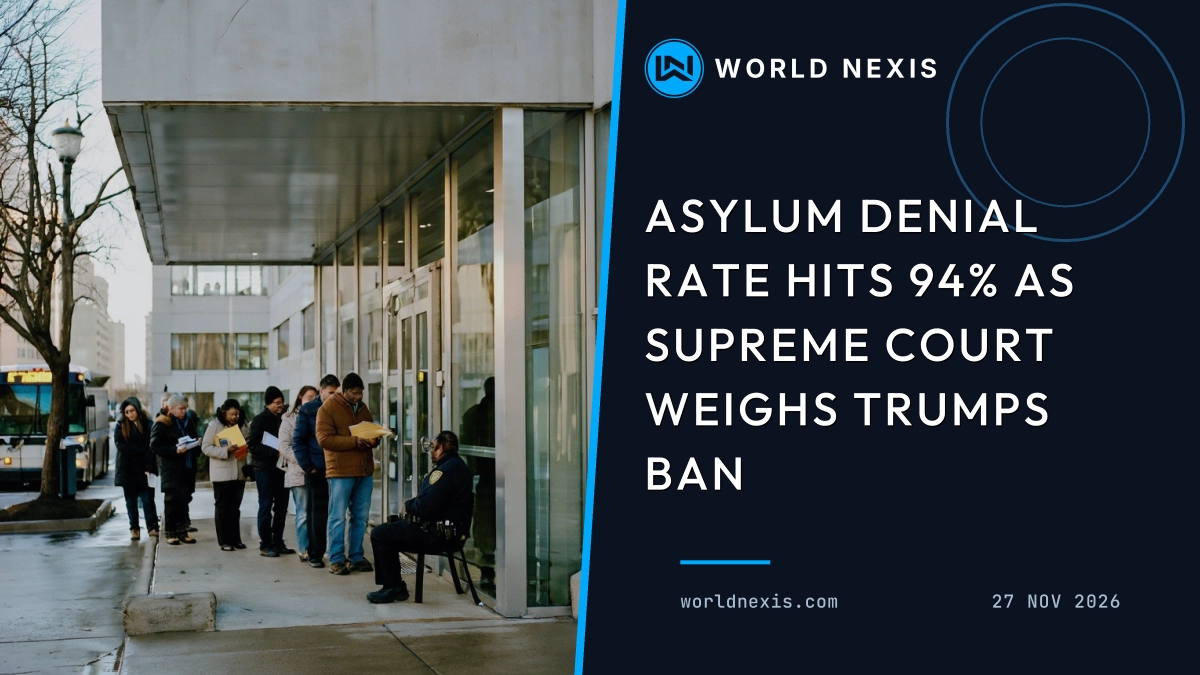
America’s asylum ban has driven national denial rates to 94% and pulled southwest border apprehensions below 99,000 for the year, and the Supreme Court is now preparing to decide whether President Donald Trump had the power to impose it. The justices will consider whether a president can bypass Congress and existing federal immigration law to suspend asylum protections unilaterally. Two lower federal courts have already rejected that argument, yet the asylum ban has remained largely in force while the litigation runs.
The policy is now approaching its second anniversary in effect. It was signed within hours of Trump returning to office, and its combined impact with mass firings in the immigration courts and thousands of canceled applications has been to close a route once used by people fleeing persecution, critics say. Supporters point to a border that has gone quiet.
Key points
- National asylum denial rates reached 94% in June, up from about 50% in 2024, according to TRAC, a research project at Syracuse University that tracks immigration court data.
- Border Patrol logged fewer than 99,000 southwest border apprehensions in fiscal year 2026, a 95% decline from more than 1.8 million a year under President Biden, according to Customs and Border Protection data.
- The asylum ban took effect within hours of Trump returning to office, and thousands of pending applications have since been canceled.
- The Supreme Court will review the administration’s third country deportations strategy in December, with a separate indefinite detention case also in play.
How the asylum ban remade the immigration courts
Under the asylum ban, claims are barred at the U.S.-Mexico border. Thousands of pending applications have been canceled, and the immigration court system has been overhauled through mass firings.
Critics say those moves together have denied asylum seekers basic due process. They argue the courts have been turned into a deportation arm of Immigration and Customs Enforcement. The administration has insisted in legal filings that the proclamation is a necessary protection against “invasion” along the southern border and against what the president and conservative critics call abuse by “fake” asylum seekers.
The court fight extends well beyond the border. In December, the justices will review the government’s practice of deporting immigrants to third countries that have agreed to adjudicate asylum claims, even where those countries face human rights abuse allegations and cannot guarantee the person will not be sent home. A third case could end the administration’s attempt to detain thousands of people in deportation proceedings indefinitely.
The asylum ban and the numbers: 94% denied, crossings down 95%
National asylum denial rates climbed to 94% in June, against roughly 50% in 2024, the last full year of the Biden administration. Advocates describe that jump as the clearest measure of how far the system has narrowed.
Since the asylum ban took effect, Border Patrol has recorded fewer than 99,000 southwest border apprehensions in fiscal year 2026, a 95% fall from the more than 1.8 million a year seen under President Biden. Customs and Border Protection data puts that at the lowest level in the agency’s history.
Simon Hankinson, a senior research fellow at the Border Security and Immigration Center at the Heritage Foundation, said the contrast between the two administrations is stark.
“The difference between an average month under Trump and an average month under Biden is just staggering.”
He argued that most people arriving at the southern border do not qualify for asylum. In his view they have already passed through Mexico, which he describes as a safe third country where Venezuelans or Afghans in particular could claim protection. “They’re here because they want to get a job,” he said, adding that a Supreme Court reversal of the ban “would be disastrous.”
Why it matters
For anyone in deportation proceedings, the stakes are concrete: detention, removal to a country they did not choose, and the loss of a claim that once carried a real chance of approval. For American readers, the change shows up as a border that is far quieter and an enforcement system that now says no to almost everyone who asks for protection.
The constitutional question underneath is bigger than immigration. If a president can suspend asylum through a proclamation, a protection written into federal law by Congress becomes reversible on a single signature. The court’s answer will set the limit on what any administration can do without new legislation.
Analysis
Having covered constitutional litigation for World Nexis News, I look first at what the lower courts actually decided. Two lower federal courts have rejected the president’s argument for the asylum ban, and the question before the justices is not whether the border is chaotic but who gets to decide. Congress wrote asylum into law; a proclamation is not a statute.
On the record as it stands, I think the advocates have the better legal argument. The administration’s “invasion” framing is a policy judgment dressed up as an emergency, and a 94% denial rate reads less like a system under strain than a system switched off. The strongest counter-argument is Hankinson’s: crossings have collapsed, the courts were overwhelmed, and judges usually defer to the executive on border security. That deserves weight, but it does not answer the statutory question.
I would not assume the conservative majority simply rubber-stamps the asylum ban. The mass firings and canceled applications leave the government with an awkward due process record, and the third country deportations cases arriving in December may complicate its position further. My expectation is a narrowing ruling rather than a clean win for either side.
What happens next
December is the pivotal month, when the Supreme Court reviews the third country deportations strategy. The challenge to the asylum ban itself is still pending, and the policy remains largely in force in the meantime. A separate fight over indefinite detention of people in deportation proceedings is running alongside both.
If the advocates prevail, they say the rulings could finally break the administration’s hold on asylum approvals, which sit at their lowest level in decades. The administration’s filings show it will keep arguing that its measures are the only thing preventing a return to the crossings seen under President Biden.
What we don’t know yet
No date has been announced for argument in the asylum ban case itself, and it is unclear whether it will be heard alongside the December third-country dispute. Nor is it known how quickly asylum processing could restart if the government loses, or whether Congress would legislate in response.
Related coverage
- UK house sales fall 8% as mortgage rate rise hits buyers
- Power grid alert: Neso issues record fourth day of warnings
- Eagles comeback stuns Cowboys 39-38 with record finish
Further reading
- Trump effectively ended asylum. Advocates look to the Supreme Court to restore it
- Trump effectively ended asylum. Advocates look to the Supreme Court to restore it
About the author: Ayesha Rahman is the Senior Political Correspondent & Columnist at World Nexis News (WNN), covering politics & opinion. The analysis section reflects the writer’s view.

Ayesha Rahman
Ayesha Rahman covers politics and opinion for World Nexis News from London, focusing on elections, legislatures and the policy choices that shape everyday life in the US and UK. She writes analysis and columns that separate what is confirmed from what is claimed, working from…



