NYC delivery bill: Mamdani takes on Amazon over $5 warning
Mayor Zohran Mamdani has renewed his push for the NYC delivery bill on Black Friday, as Amazon warns the rules could add $5 to every order in the city.
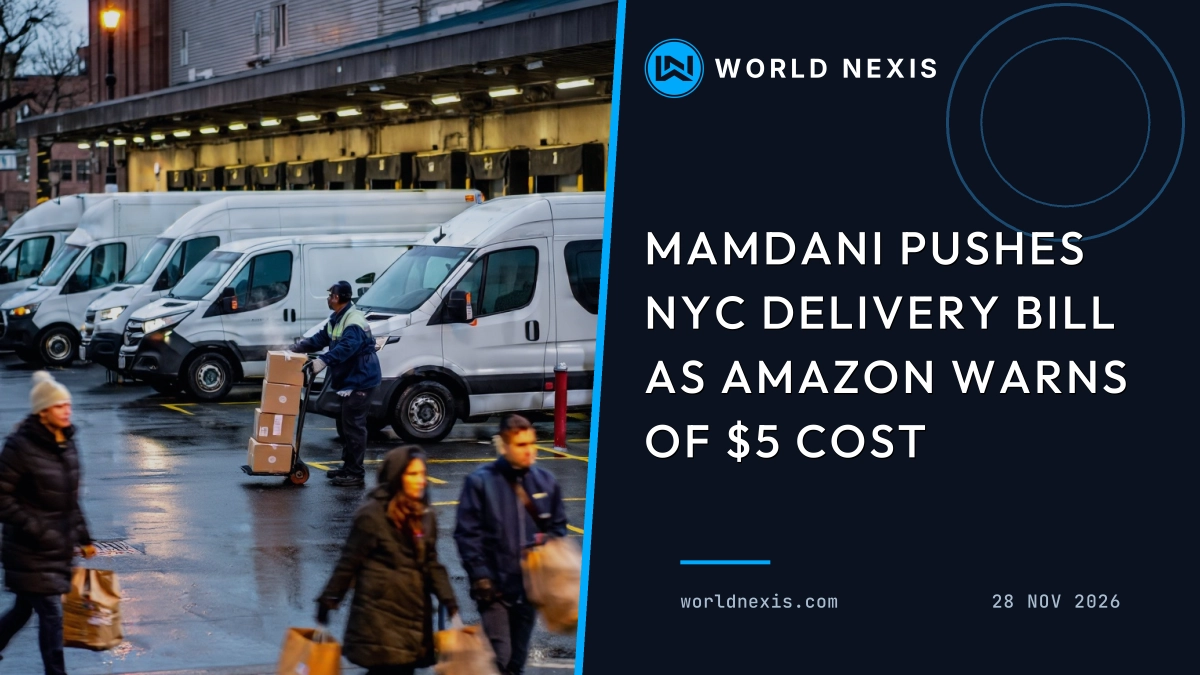
The NYC delivery bill backed by Mayor Zohran Mamdani is back at the center of a public fight with Amazon, after the mayor used a Black Friday video to press the City Council for passage and the company warned the rules could add as much as $5 to every order.
Mamdani, a Democrat, posted the video on the busiest online shopping day of the year and urged lawmakers to approve the Delivery Protection Act. The measure would place licensing and employment requirements on delivery operations across the five boroughs. Amazon answered quickly, saying the proposal would raise prices and put small contractors at risk.
Key points
- Mayor Zohran Mamdani used a Black Friday video to urge the City Council to pass the Delivery Protection Act.
- The NYC delivery bill would license warehouses that ship to New Yorkers and set safety, training and employment conditions.
- Amazon says it could add as much as $5 per order and threaten more than 40 small delivery businesses and 5,000-plus jobs.
- Council Speaker Julie Menin says she is negotiating with Amazon and wants workers protected without higher prices or lost jobs.
What the NYC delivery bill would actually do
The legislation would require operators of certain warehouses and storage facilities that ship goods to final consumers in the city to obtain a business license from the Department of Consumer and Worker Protection. Those licenses would carry conditions covering safety, training and employment. The bill also sets out enforcement options, including powers available to the city and to workers themselves.
“This bill would require operators of certain warehouses and storage facilities from which goods are delivered to final consumers in the City to obtain a business license from the Department of Consumer and Worker Protection.”
Mamdani framed the NYC delivery bill as a question of accountability rather than innovation. “If Amazon is delivering your packages, they should follow the same rules of every other delivery company,” he said in the video. He argued the measure would make companies answerable for what he called an “exploitative business model,” and said it would improve safety for workers and for pedestrians who share the roads with them.
The video also featured delivery workers who said Amazon sets their schedules, routes and uniform requirements while relying on subcontractors to carry the legal responsibility for their working conditions. That claim sits at the heart of the case for licensing: the mayor’s office points to control over the work, while the company points to the contracts it signs with outside firms.
Council member Tiffany Cabán is the bill’s sponsor. Her district has been a base of support for the measure, which would reach beyond Amazon to other operators running warehouses that feed last-mile delivery in the city.
Amazon’s warning over Amazon delivery costs
Amazon said the NYC delivery bill could raise costs by as much as $5 per order. The company also said the text, as drafted, would threaten more than 40 small delivery businesses it works with in New York City and the 5,000-plus New Yorkers they employ.
“It’s no secret that this legislation, as written, would threaten the livelihoods of more than 40 small delivery businesses we work with in New York City and the 5,000-plus New Yorkers they employ.”
Amazon spokesperson Kelly Nantel said those businesses are embedded in communities across the five boroughs and deliver from facilities throughout the city. She added that the measure “would also raise costs for New Yorkers.” The company further said more than 150,000 customers had emailed City Council members to oppose the bill since November 19.
Mamdani pushed back on the price warning, saying any $5 increase would reflect the company’s “greed” rather than the Council’s effort to protect workers. The exchange has turned a licensing debate into a public argument about who pays for faster delivery and who absorbs the risk behind it.
The Council’s balancing act
Speaker Julie Menin has said she is negotiating with Amazon and has criticized the company’s alerts to customers. She has also set out a goal of protecting workers without raising prices or costing jobs, a position that gives the chamber room to amend the text before any vote.
That stance matters because the bill’s enforcement machinery is where costs and protections collide. License conditions, inspections and penalties all create fixed expenses, and those expenses do not fall evenly across a market made up of large operators and small contractors.
Why it matters
For households, the immediate question is price. A $5 surcharge on an order is real money for families already paying delivery fees, tips and subscription charges, and the Council knows shoppers will notice at checkout.
For workers, the NYC delivery bill would decide whether the company that sets the routes and the clock also answers for the safety of the people riding them. For the country, the vote tests something larger: whether a single city can regulate a national logistics network through its licensing power, and whether other councils follow.
Analysis
Having spent five years on the business desk at World Nexis News, I read this fight through market structure rather than politics. The question is not whether delivery is cheap; it is who holds the legal risk when a model is built on subcontractors. On the evidence of the bill’s own text and the workers’ accounts in the mayor’s video, Amazon does set schedules, routes and uniform rules. That makes Mamdani’s central claim, that the company should carry a responsibility it currently pushes down the chain, the better-supported argument.
The strongest counter-argument is Amazon’s. Fixed compliance costs really can sink a contractor with a few dozen vans, and licensing regimes written in a hurry tend to protect the biggest brand while squeezing the smallest operator. If the Council gets the design wrong, Amazon keeps its margins and the subcontractor absorbs the bill. I take that risk seriously.
In my view, though, the burden of proof now sits with Amazon, not with the Council. A $5 figure released alongside 150,000 customer emails looks like a campaign, not a costing, and the company should publish the working behind it. If the number survives scrutiny, Menin should amend the bill; until then, the suggestion that worker protections are the expensive part of this model deserves scepticism.
What happens next
Menin’s negotiations with Amazon continue, and no date has been set for a Council vote. Any revised text would need to reconcile the licensing conditions with her stated aim of no price increases and no job losses.
What we don’t know yet
- Whether Amazon’s $5 figure is a full cost estimate or a worst-case scenario.
- How many delivery workers the licensing conditions would actually cover.
- Whether the Council will publish its own cost assessment before a vote.
Related coverage
- Bank tax hike: £1.5bn bill may hit borrowers, Bailey warns
- Mamdani Achilles surgery: 69 minutes, full recovery expected
- Iran war: AI video’s warning to Microsoft and SpaceX
Further reading
- Mamdani renews push for NYC delivery bill as Amazon warns of higher costs
- Mamdani renews push for NYC delivery bill as Amazon warns of higher costs
About the author: Daniel Whitmore is the Business & Markets Editor at World Nexis News (WNN), covering business & markets. The analysis section reflects the writer’s view.

Daniel Whitmore
Daniel Whitmore is Business & Markets Editor at World Nexis News, based in New York. He leads coverage of companies, economies, markets and the forces that move them, from central bank decisions to corporate earnings and the cost-of-living pressures facing households on both sides of…