Bank tax hike: £1.5bn bill may hit borrowers, Bailey warns
Andrew Bailey has warned the bank tax hike could push up mortgage and loan costs and cut savings rates, as 6.5 million households face higher payments.
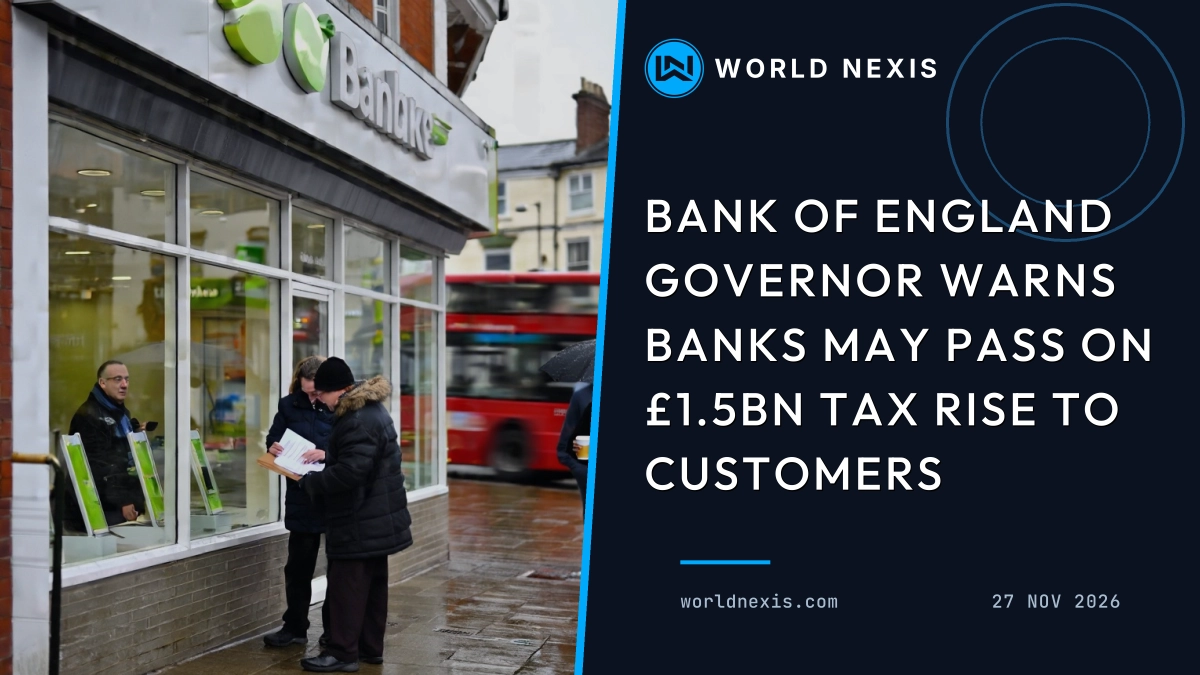
The bank tax hike announced in the Budget could reach customers as higher interest rates on loans and lower rates on savings, the Bank of England governor has warned, with around 6.5 million households projected to see mortgage repayments rise over the next three years.
Andrew Bailey said lenders may try to “protect their earnings” after Chancellor John Healey doubled the corporation tax surcharge on banks to 6% from January, a measure expected to raise £1.5 billion over 15 months.
Key points
- Andrew Bailey said banks may pass the cost of the bank tax hike on to borrowers and savers.
- The surcharge on lenders doubles to 6% in January and is due to last 15 months.
- The Bank projects around 6.5 million households will face higher mortgage repayments within three years.
- Lloyds Banking Group has called the levy “unhelpful” for UK economic growth.
Governor’s warning on the bank tax hike
Speaking in an interview, Bailey said it would be no surprise if lenders repriced their products to defend margins. Banks set their own rates, he argued, and the outcome depends on how fiercely they compete for customers.
“You could understand that they will look to pass it on because they will be targeting a rate of return,” he said. “Now, how successful they will be depends on all sorts of things: market conditions, competition within the industry and so on.”
He added: “It’s a market economy, so these are decisions banks will have to take.” On whether lenders would act, he said: “It wouldn’t be surprising to find out that they will start by trying to do that.”
Consumers would feel the change on both sides of the balance sheet: a wider margin on a loan costs a borrower more each month, while a thinner one on deposits pays a saver less.
What the levy does and how lenders responded
The bank tax hike came in the Budget, when John Healey doubled the surcharge on bank profits from January, well below the 8% rate the industry had feared beforehand. Announcing the move, the Chancellor said he was asking “a bit more of our banks to support ordinary people”, with the extra £1.5 billion helping to fund support for household energy bills. He described the measure as temporary and said it would run for 15 months.
The sector pushed back quickly. William Chalmers, chief financial officer of Lloyds Banking Group, said last month that the levy was “unhelpful” to UK growth and urged ministers to keep it time-limited. “It is ultimately important that we do what we can to reduce the cost of lending in order for the economy to grow, and of course that travels through to the cost of borrowing,” he said.
Mortgage costs are already climbing
The warning lands as borrowing costs rise for existing homeowners. In its latest Financial Stability Report, published on Thursday, the Bank projected that around 6.5 million households will see mortgage repayments increase over the next three years. The typical borrower leaving a fixed deal faces a rise of about £100 a month, roughly double the Bank’s July estimate.
More than one million households are on rates below 3% and due to refinance by the end of next year. The Bank estimates they will pay nearly £200 a month more on average, calculated on a typical new rate of 5.5%.
The Bank raised its base rate to 4% last month to contain inflation and has said further increases are possible if energy prices stay high. Ofgem’s price cap for a typical household rises 26% in January. The Bank cautioned that households facing bigger payments “may need to reduce discretionary spending or draw down savings”.
Any extra cost from the bank tax hike would compound pressure that is already building on household budgets this winter.
Why it matters
For anyone holding a mortgage, a personal loan or a savings account, the bank tax hike is not an abstract Treasury line. If lenders pass it on, the effect shows up as a fractionally higher rate on borrowed money or a thinner return on cash — small on its own, but felt across a budget already squeezed by energy bills.
It also complicates the politics of the Budget. A levy presented as a bank contribution towards energy support may end up funded, in part, by the same households the money is meant to help.
Analysis
Covering markets and central banking for World Nexis News, I look first at how a tax on bank profits reaches the price of a loan. Bailey’s remarks read to me less as a forecast than a description of how lending margins work: a levy on earnings is a cost like any other, and costs get priced into the product. I think he is right that the first instinct will be to pass it on, and I side with that reading over the claim that lenders can simply absorb £1.5 billion without adjusting what they charge.
The strongest counter-argument is competition. Mortgage and savings markets in Britain are contested, and a lender that reprices aggressively risks losing business to a rival that holds firm. That is a genuine constraint, which is why I expect any pass-through to be partial and uneven — and to appear first in savings rates, which are easier to trim quietly, long before it surfaces in a headline mortgage deal.
What bothers me is the design. A 15-month levy sits on a business that prices loans over two and five years, so the cost is likely to be recovered inside the temporary window — precisely when a wave of fixed-rate deals expires. In my view, the bank tax hike will be raised from bank profits in theory and from borrowers and savers in practice, and households should judge the policy on that basis rather than on the headline rate of the surcharge.
What happens next
The bank tax hike takes effect in January and is scheduled to expire after 15 months, with the proceeds directed towards help with energy bills. Lenders will set their own loan and savings pricing over that period, and the clearest early evidence of pass-through will appear in the rates they advertise rather than in statements from the Treasury.
Meanwhile the refinancing wave continues: more than a million households on sub-3% deals are due to move by the end of next year. The Bank’s rate-setters have said they may tighten further if energy prices remain elevated.
What we don’t know yet
It is not yet clear how much of the levy lenders will absorb and how much they will recover from customers. Nor has the government said whether the surcharge will be extended beyond the 15-month window if energy costs stay high.
Related coverage
- Mitchells & Butlers warns of £95m extra costs next year
- Trump tariffs: major duties hit 14 US trading partners
- EasyJet profits: boss warns fares will rise after 96% slump
Further reading
- Lenders may pass on Labour’s bank tax hike to customers, cautions Andrew Bailey
- Lenders may pass on Labour’s bank tax hike to customers, cautions Andrew Bailey
About the author: Daniel Whitmore is the Business & Markets Editor at World Nexis News (WNN), covering business & markets. The analysis section reflects the writer’s view.

Daniel Whitmore
Daniel Whitmore is Business & Markets Editor at World Nexis News, based in New York. He leads coverage of companies, economies, markets and the forces that move them, from central bank decisions to corporate earnings and the cost-of-living pressures facing households on both sides of…



