United Fidelity Bank failure triggers major $1.83bn hit
The United Fidelity Bank failure will cost the insurance fund $1.83bn, as 22 branches reopen under First Citizens and some brokered CDs stay put.
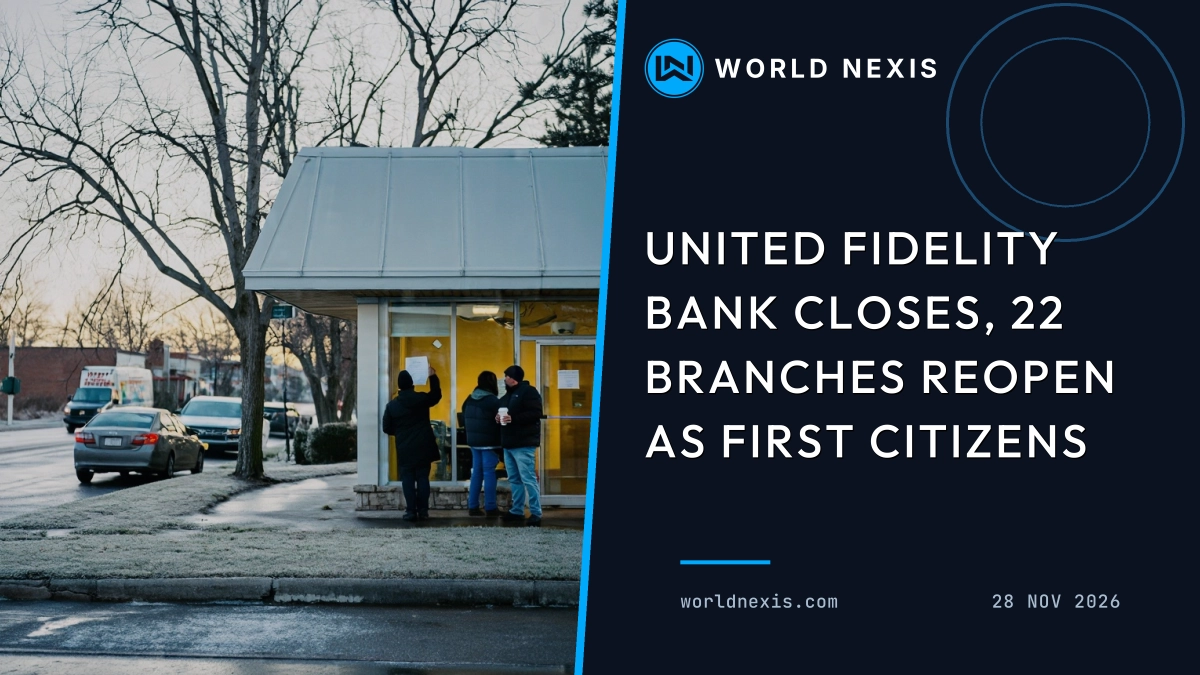
The United Fidelity Bank failure has left the federal deposit insurance fund with an estimated $1.83 billion bill and put 22 branches in four states and the US Virgin Islands into the hands of First Citizens Bank. Regulators closed the Evansville, Indiana lender on Friday night, and customer accounts moved automatically to the Raleigh, North Carolina bank.
Key points
- The Office of the Comptroller of the Currency closed United Fidelity Bank on Friday and handed the wind-down to the Federal Deposit Insurance Corporation.
- First Citizens Bank & Trust Company is taking on substantially all of the failed bank’s deposits and assets.
- The United Fidelity Bank failure will cost the Deposit Insurance Fund about $1.83 billion.
- Insured deposits remain covered to $250,000 per depositor, and all 22 branches reopen as First Citizens offices from Saturday.
What the United Fidelity Bank failure means for customers
For most savers the practical effect is small. Accounts transfer automatically, debit cards and ATMs still work, cheques continue to clear, and borrowers keep making loan payments as usual. The FDIC said depositors whose accounts move keep their money and their existing insurance coverage.
Branches that normally open on Saturdays reopen during normal Saturday hours. The rest reopen on Monday. Customers should keep using their current branch until First Citizens tells them they can bank at its wider network.
FDIC deposit insurance covers up to $250,000 per depositor, per insured bank, for each ownership category. Savers with several accounts, or with deposits opened through different platforms, should check how each holding is registered before assuming every pot is separately protected.
Brokered CDs sit outside the transfer
The FDIC said the accounts moving to First Citizens exclude certain brokered deposits. The agency has not said how many accounts are affected or why those deposits were left out of the agreement. A brokered CD is a bank deposit bought through a brokerage platform rather than opened at the branch.
The United Fidelity Bank failure leaves that smaller group in a separate queue. Holders should call their brokerage firm instead of assuming the money followed the rest of the book. They should confirm the ownership registration, the maturity date, the interest terms and the insurance position. Exclusion from the deal does not mean a deposit is uninsured or lost, because each case depends on the resolution process and the insurance rules that apply.
The biggest collapse since Republic First in 2024
United Fidelity held about $5.9 billion in assets and $5.4 billion in deposits at the end of September. The OCC said it acted because the bank was in an “unsafe or unsound” condition and was unlikely to pay what it owed or meet withdrawal requests.
The United Fidelity Bank failure is the largest in the US since Republic First Bank of Philadelphia went under in April 2024. It ranks among the biggest since Silicon Valley Bank and First Republic collapsed in 2023.
There is an irony in the buyer. FDIC records show United Fidelity had itself absorbed the deposits of at least five failed lenders since 2014, including a Florida bank in 2020. First Citizens has made a specialty of clearing up other people’s wreckage, having taken on Silicon Valley Bank’s deposits and loans in March 2023.
“We believe this transaction is both financially and strategically compelling, and we look forward to welcoming our new customers, earning their trust and positioning our company for continued success,” said Frank B. Holding, Jr., chairman and chief executive of First Citizens.
Why it matters
The $1.83 billion bill does not fall on taxpayers directly. It lands on the Deposit Insurance Fund, which is filled by premiums from insured banks, so the cost is spread across the industry and, in time, across customers. That is the price of letting ordinary savers keep their money without a queue at the door.
Then there is concentration. The United Fidelity Bank failure hands more deposits to a small group of buyers that already know how to digest a fallen rival. Anyone holding US dollar deposits through a brokerage, inside America or outside it, is exposed to exactly the paperwork question that decided who moved and who did not.
Analysis
Having covered bank resolutions and market structure for World Nexis News, I look first at speed, and on that measure the FDIC handled the United Fidelity Bank failure well. Depositors were protected inside a weekend, cards kept working and nobody was told to queue for a payout. The counter-argument is that a $1.83 billion charge is a lot to spend on a bank most Americans had never heard of, and that the same acquirer keeps turning up at the till.
My view is that the resolution itself was right and the disclosure around it was not. The FDIC has confirmed that certain brokered deposits were excluded from the transfer without saying how many accounts that covers or why. That silence is what turns a technical wind-down into a consumer story, because brokered CD buyers are typically people who shopped around for yield and now have to work out their position over a weekend.
Critics who say the system worked and the cost is manageable have a fair point on the headline numbers. But a safety net is judged by the awkward cases, and the United Fidelity Bank failure has produced a group of savers who cannot yet tell whether their money moved. Regulators should publish the excluded-deposit detail this week, not in a month.
What happens next
Branch conversions run across the weekend and Monday. Locations that open on Saturdays are trading as First Citizens now; the rest follow on Monday, and customers should stay at their current branch until they are told otherwise. Brokered CD holders should contact their brokerage firm in the coming days to establish whether their deposit transferred.
The $1.83 billion charge feeds into the Deposit Insurance Fund’s balance and into the premiums every insured bank pays. First Citizens will spend the next few quarters converting systems and deciding what to do with the 22 branches it has acquired.
What we don’t know yet
How many brokered CD accounts were excluded and why. Whether those deposits were partly uninsured or simply paid out through a separate process. Whether the bank’s former parent faces further regulatory action, and whether more mid-sized lenders run into trouble before the year ends.
Related coverage
- Bank tax hike: £1.5bn bill may hit borrowers, Bailey warns
- Hashtag United funding fuels major inclusive football push
- BAE Systems CV90 deal: major £4.5bn order for 400 vehicles
Further reading
- United Fidelity brokered CD depositors’ protection: Not every account moved when this bank failed. If you bought a CD through a broker, here’s what you need to know
- US regulators shut United Fidelity Bank in biggest bank failure since 2024
About the author: Daniel Whitmore is the Business & Markets Editor at World Nexis News (WNN), covering business & markets. The analysis section reflects the writer’s view.

Daniel Whitmore
Daniel Whitmore is Business & Markets Editor at World Nexis News, based in New York. He leads coverage of companies, economies, markets and the forces that move them, from central bank decisions to corporate earnings and the cost-of-living pressures facing households on both sides of…