Tirana clashes: tear gas at 114th independence day protest
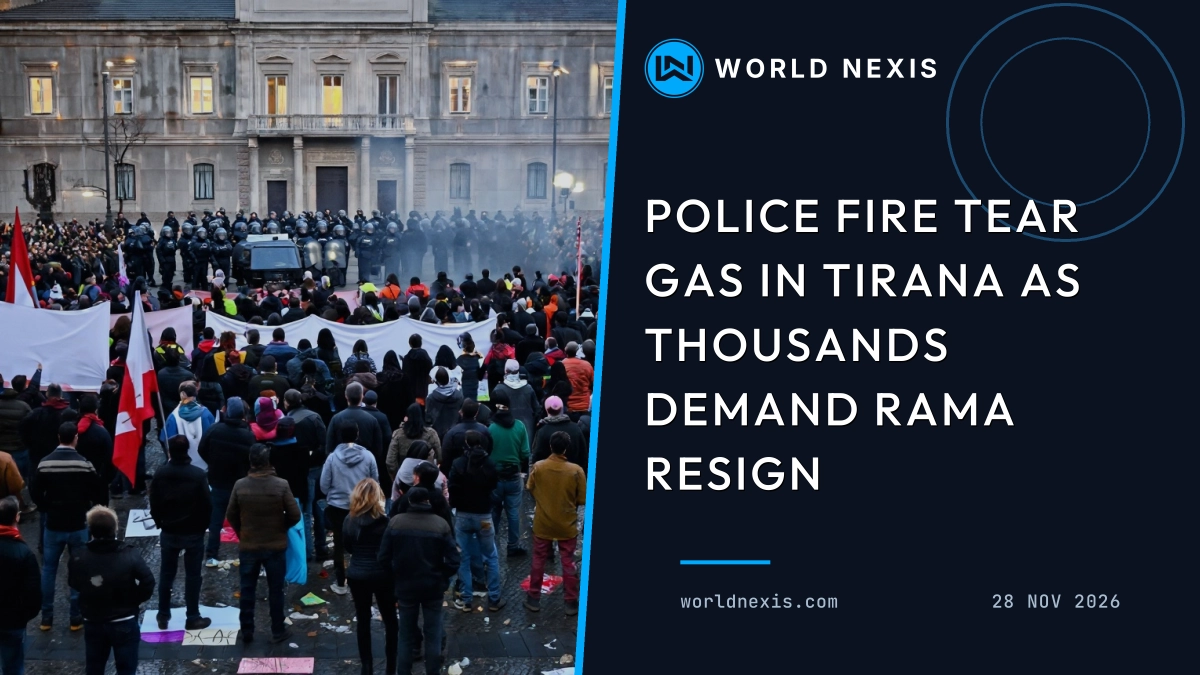
Tirana clashes broke out on Albania's independence day as thousands demanded Edi Rama resign, with police firing tear gas and water cannon at crowds.
Updated 28 Nov 2026, 20:36 (UK time): Albania’s Health Ministry said 30 people, including journalists and police officers, were injured in Saturday’s Tirana clashes, the first official casualty figure for the day.
Tirana clashes left 30 people injured, Albania’s Health Ministry said, among them journalists and police officers. It is the first official casualty figure for Saturday’s confrontation in the capital, where thousands had gathered to demand the resignation of Prime Minister Edi Rama.
The ministry’s count fills the gap our earlier reporting flagged as unknown. Reporting on the ground also described demonstrators throwing Molotov cocktails as well as rocks and wooden sticks, with police answering with tear gas and water cannon and clouds of gas spreading across several streets near Skanderbeg Square.
The toll sharpens the political question rather than settling it. A government that publishes a figure including injured journalists is conceding the day was far rougher than a routine policing operation, while a movement that can put 30 casualties on the record gains a grievance it can carry into the next rally.
A ministry number is still the government’s own number, and governments under pressure rarely count generously. Both sides now have a figure to defend, and neither has yet said how many were detained.
Tirana clashes broke out on Saturday as thousands of protesters packed Skanderbeg Square and marched through the Albanian capital demanding the resignation of Prime Minister Edi Rama, with police firing tear gas and water cannon at crowds that threw rocks and tried to smash windows on government buildings.
The rally fell on the 114th anniversary of Albania’s declaration of independence, a public holiday normally given over to national celebration. Instead, Albanians travelled to Tirana from across the country and from abroad, and by the afternoon clouds of tear gas were rolling through the streets around the square.
Key points
- The Tirana clashes came as thousands called for Edi Rama to stand down, the latest in a cycle of anti-government demonstrations running since late May.
- Police used tear gas and water cannon; demonstrators threw rocks and used wooden sticks against street cameras and the windows of government buildings.
- The rally coincided with the 114th anniversary of independence, a day usually reserved for official ceremonies.
- The movement began over a luxury coastal tourism project linked to a firm founded by Jared Kushner, Donald Trump’s son-in-law, and has widened into a demand for systemic change.
What happened at the Tirana clashes
Protesters chanted “Resignation!” as the crowd gathered in the square, and the mood hardened after groups broke away from the main route. Some demonstrators used wooden sticks to try to break street cameras, while others attacked the windows of government buildings along the march.
Police answered with water cannon and repeated volleys of tear gas. The Tirana clashes were the sharpest confrontation of a protest movement now in its sixth month, and they unfolded while the state would normally be staging its independence day events.
Many in the crowd had made long journeys to be there. Some came from towns and villages across Albania, others from the diaspora in Europe and further afield.
From a coastal resort to a call for Rama’s exit
The Albania protests began in late May, triggered by opposition to a major luxury tourism development on the country’s southern coast. The project is linked to an investment firm founded by Jared Kushner, the son-in-law of US President Donald Trump, and the campaign that grew around it took the name the Flamingo movement.
Student demonstrations followed in September, many of them violent, with calls for better education and living standards. The demonstrators’ main demand has since broadened from a single development to the resignation of the prime minister and an overhaul of a political class that, in the words of one protester, no longer represents anyone.
Voices from the square
Saturday’s Skanderbeg Square protest drew people who had travelled hundreds of miles, and the distance covered was as striking as the size of the crowd.
“I came here specifically for the protest,” said Arian Lleshi, a 33-year-old who travelled to Tirana from the United Kingdom. “We have spread ourselves across Europe and around the world, and it is almost as if we are citizens without a state.”
Lleshi said the parties that have dominated Albanian politics since the fall of communism in the 1990s “no longer represent anyone” and should make way for a new generation with a greater stake in the country’s future.
Juna Vasili, a student, said the crowd had come out to demand its rights and wanted the entire system changed. Suzana Gjeta, a retiree, said she was demonstrating for younger Albanians and for people like herself who are living on just 120 euros a month.
“We hope this system will go, that Edi Rama will go, and that this corruption will end,” she said.
Why it matters
For ordinary Albanians, the argument is no longer about a resort on the coast. It is about wages and pensions that fail to cover the cost of staying, and about a choice between emigrating and remaining to challenge a system people say ignores them. The 120 euros a month cited by a pensioner in the square is the figure that carries furthest.
The Tirana clashes also landed on an awkward date. A march of this size on independence day, drawing people back from abroad rather than sending them out to celebrate, is a visible measure of how far trust in the political class has fallen.
Analysis
Having covered migration and the Balkans for World Nexis News, I look first at who turns up to a rally like this, and Saturday’s answer is more revealing than the tear gas. A 33-year-old flying in from the UK to stand in Skanderbeg Square is not a rented crowd. He is what a country looks like when its workforce has left and still feels the pull of home.
That is why I side with Suzana Gjeta’s reading over the view that this is simply party politics in the street. The arithmetic she describes, a pension of 120 euros a month against the cost of living, explains why a campaign about a coastal development has survived six months and pulled in students, pensioners and the diaspora at once. A resignation demand built on that sum has deeper roots than any single project.
The strongest counter-argument is fair, though: “change the entire system” is a slogan rather than a programme, and street numbers do not produce a replacement government. In my view the burden now sits with those who want Rama gone to turn anger into something a parliament could act on.
What happens next
No date has been set for any parliamentary test of Rama’s position, and the movement’s strands remain separate in everything but their central demand: the Flamingo campaign born in late May, and the student groups that emerged in September. Whether they fuse into one organisation will decide if Saturday’s turnout becomes routine or a turning point.
What we don’t know yet
It is not clear how many people were hurt or detained during the Tirana clashes, and no figures have been confirmed. Nor is it known whether the prime minister will respond directly to the resignation calls, or whether the tourism project at the centre of the original dispute will be paused.
Related coverage
- Rough gas storage: 100 jobs at risk as winter deal fails
- Power grid alert: Neso issues record fourth day of warnings
- Afghanistan school explosion kills 10 and injures 110
Further reading
- Clashes erupt in Tirana as protesters call for Prime Minister Edi Rama to resign
- Clashes erupt in Tirana as protesters call for Prime Minister Edi Rama to resign
About the author: Marcus Ellington is the International Correspondent at World Nexis News (WNN), covering world affairs. The analysis section reflects the writer’s view.

Marcus Ellington
Marcus Ellington is International Correspondent at World Nexis News, reporting on diplomacy, conflict and the political forces reshaping Europe, the Middle East, Asia and the Americas. Based in London, he focuses on explaining why events unfold as they do, using official statements, diplomatic documents and…