Afghanistan school explosion kills 10 and injures 110
Afghanistan school explosion kills 10 and wounds 110, most of them children, after a blast at a mining explosives depot beside a school in Kunar province.
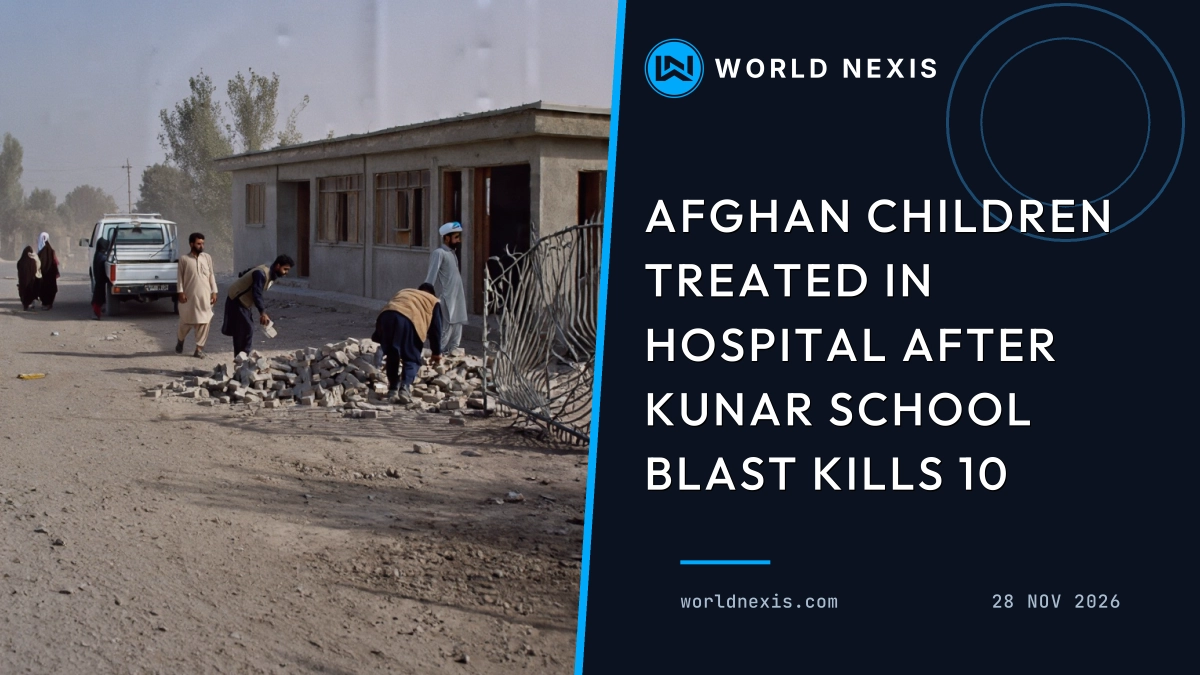
An Afghanistan school explosion has killed 10 people and wounded 110 more, most of them children, after a blast that officials say began at an explosives depot next to a primary and middle school in the eastern province of Kunar. The blast struck on Saturday morning in the Andar Ser area on the outskirts of Asadabad, the provincial capital. Abdul Mateen Qani, a spokesman for the interior ministry, put the death toll at 10 and said 110 had been wounded.
Key points
- Ten people died and 110 were wounded in the Afghanistan school explosion, which hit a primary and middle school in Kunar province.
- Kunar’s director of culture and information, Sami ul Haq Bayan, said initial information pointed to negligence at a nearby depot storing explosives for mining companies.
- Police said the blast happened at 10am in the Andar Ser area on the outskirts of Asadabad.
- Hospital footage showed injured children, several with bandaged heads, some of them lying two to a bed.
What we know about the Afghanistan school explosion
Officials have described a single blast that struck shortly after the school day began. Farid Dehqan, a spokesperson for the Kunar provincial police headquarters, said the explosion occurred at 10am at a school in the Andar Ser area on the outskirts of Asadabad.
Video shared on social media showed cars carrying wounded children to the emergency department of a hospital in Asadabad. Images of the school building showed that part of it appeared to have collapsed.
Footage from a hospital ward showed young children, several with bandaged heads and some lying two to a bed. Officials said most of those hurt were children.
A mining depot beside the classrooms
Sami ul Haq Bayan, Kunar’s director of culture and information, said initial information indicated the blast at the school occurred because of negligence at a depot storing explosives belonging to mining companies. Officials said the depot stood next to the school on the edge of the provincial capital.
Mining is a major industry in Afghanistan, a country rich in iron ore, copper, lead, zinc, gold, coal and precious stones. Safety standards at the mining companies are often poor, and accidents are common.
Gemstone mining is on the rise in Kunar, with various companies extracting precious stones that are subsequently sold at auction. The proximity of a commercial explosives store to a school is now the central question for investigators.
Witnesses describe the Kunar school blast
Noor Rahman, whose home is next door to the school, said he heard the explosion and saw dust rising. “I ran straight into the dust, our own children were there,” he said. “I entered one of the rooms, where there was screaming and shouting. I saw the hand of my niece, she was moving it. I rushed in, cleared away the bricks, and managed to pull her out, along with other injured (people).”
Haji Sulaiman, whose son was wounded, said he was on his way to his shop when he heard and saw the explosion. “Pieces of wood and human flesh were flying everywhere,” he said. “When I arrived, I found children, some were dead, others were drenched in blood, and some rooftops were collapsed, the walls were gone, and nothing remained of the school.”
Why it matters
For families in Asadabad, the Afghanistan school explosion is a reminder that the gravest danger to children is not always deliberate. An industrial explosives store beside a school turns the question from security to regulation: who licenses such depots, who inspects them, and who decides where they may sit.
The Asadabad explosion also lands on a minerals trade that supports livelihoods across Kunar. If negligence is confirmed, scrutiny will fall on the companies that held the material and on the authorities responsible for monitoring them. In August, a hand grenade attack at a school complex in the Afghan capital, Kabul, wounded more than 40 children aged between 9 and 14.
Analysis
Having covered Afghanistan’s minerals economy and its security file for World Nexis News, my first question about the Afghanistan school explosion was whether officials were describing an accident or an attack. Everything said in the first hours points to an accident: a depot, mining companies, negligence, a provincial culture director speaking on the record. In my view that explanation is the better supported of the two, and it carries the more uncomfortable consequence, because a neglected stockpile of commercial explosives beside a classroom is a failure of governance rather than of war.
The strongest counter-argument is that a single official account, offered within hours of a mass-casualty blast, can be self-serving. The authorities now describing negligence are the same authorities responsible for licensing and inspecting mining stores, so they are in effect assessing their own record. Officials have not yet said publicly who owned the depot or what permits it held, and until they do, the negligence finding should be treated as preliminary rather than settled.
Even so, I think the weight of the evidence supports the accident reading, and that the distinction matters for what follows. Treat this as a security incident and the response will be patrols and checkpoints. Treat it as a regulatory failure and the response is inspections, storage rules and buffer zones around schools. Only the second response would have prevented Saturday’s deaths.
What happens next
Provincial officials have given an initial assessment that negligence at the depot caused the Afghanistan school explosion. The next steps are an accounting of who stored the explosives, where the material came from and under what authority, and whether the wounded children can be treated in a province with limited hospital capacity.
What we don’t know yet
- Whether the death toll will rise, and how many of the 110 wounded are in a critical condition.
- Who owned the depot, and whether it held a valid permit for commercial explosives.
- Whether any criminal or regulatory proceedings will be brought against the mining companies involved.
Related coverage
- Falklands oil drilling: Milei says ruling ‘is not the final word’
- Strait of Hormuz: Iran claims control amid US blockade
- RAF Lakenheath drones: US military repelled six-drone swarm
Further reading
- Blast at explosives depot next to school leaves 10 dead and injures dozens more
- Blast at explosives depot next to school leaves 10 dead and injures dozens more
About the author: Marcus Ellington is the International Correspondent at World Nexis News (WNN), covering world affairs. The analysis section reflects the writer’s view.

Marcus Ellington
Marcus Ellington is International Correspondent at World Nexis News, reporting on diplomacy, conflict and the political forces reshaping Europe, the Middle East, Asia and the Americas. Based in London, he focuses on explaining why events unfold as they do, using official statements, diplomatic documents and…