Falklands oil drilling: Milei says ruling ‘is not the final word’
The law of the sea tribunal rejected Argentina's bid to halt Falklands oil drilling at Sea Lion by 18-3, clearing the way for a 1.7bn-barrel project.
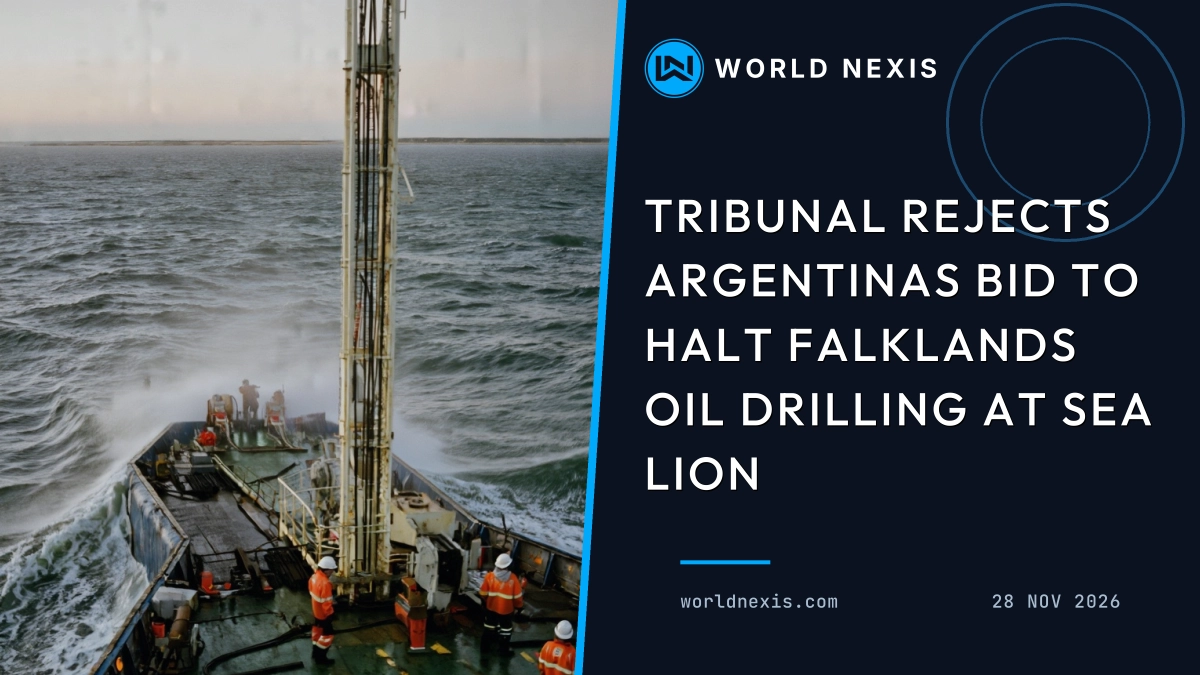
Updated 28 Nov 2026, 19:36 (UK time): Argentina said it will move quickly to convene a separate arbitration panel to hear the full Sea Lion dispute and seek protective measures, after the tribunal refused to pause Falklands oil drilling.
Argentina has said it will move quickly to convene a separate arbitration panel to hear the full dispute over Falklands oil drilling and to ask it for measures protecting the country’s rights. The announcement followed Saturday’s decision by the International Tribunal for the Law of the Sea, which voted 18-3 to reject Buenos Aires’ request to pause work at the Sea Lion field.
President Javier Milei’s office said Argentina respects the ruling but disagrees with it, and is presenting the outcome as a partial win, arguing that by tying the case to sovereignty the tribunal effectively acknowledged that a dispute exists — something London has long refused to concede. UK ministers have insisted no territorial dispute exists at all.
What this changes is the calendar rather than the substance. Drilling at Sea Lion is still not due to begin before March 2027, and Rockhopper Exploration and Navitas Petroleum are expected to press ahead under licences granted by the Falkland Islands government and backed by London. A second legal track now runs alongside the sanctions Milei wants congress to put on a statutory footing.
A fresh panel gives Buenos Aires a venue and a headline; it does not give it a wellhead. The sanctions file remains the only lever that can genuinely raise the cost of Sea Lion, and it is the one the Argentine government has yet to show it can deliver.
Updated 28 Nov 2026, 16:06 (UK time): Javier Milei has urged Argentina’s congress to pass a ‘national sovereignty defence’ law sanctioning companies and individuals tied to Falklands oil drilling, and drilling at Sea Lion is now confirmed not to begin before March 2027.
Argentina’s President Javier Milei has moved from rhetoric to legislation, urging the country’s congress to pass a proposed “national sovereignty defence” law that would impose sanctions on businesses and individuals involved in oil projects around the Falkland Islands. In a statement after Saturday’s ruling, he repeated that the islands “are Argentine”, called the tribunal’s decision “not the last word” and said his government would “keep taking all necessary action” to prevent extraction.
The practical timetable has also become clearer. Drilling at the Sea Lion field, roughly 140 miles north of the islands, will not begin before March 2027, with extraction expected to start about a year later, under licences granted by the Falkland Islands government and backed by London. That gives Rockhopper Exploration and Navitas Petroleum a firm start date, and gives insurers, shippers and suppliers a deadline by which they must decide whether Argentine penalties are worth the risk.
In London, Foreign Secretary Ed Miliband and Attorney General Ellie Reeves renewed their call for Argentina to end its “wider economic pressure” on the territory, saying Buenos Aires had sought to stop islanders making their own sovereign decisions “and failed in this attempt”. The tribunal’s president, Maurice Kamga, said the ruling did not prejudice the outcome of the case, and a hearing on Argentina’s bid is expected at a later date.
The court win was always the easy part for London; the sanctions are where this actually bites, and Milei is now trying to put them on a statutory footing rather than rely on decree. Whether his congress moves at all is another matter.
Updated 28 Nov 2026, 14:40 (UK time): Argentina’s President Javier Milei responded to the tribunal ruling by declaring the decision ‘is not the final word’ and that ‘the Falkland Islands are Argentine’, while UK ministers called the outcome a vindication of Britain’s legal defence.
Argentina’s president, Javier Milei, has responded to Saturday’s ruling by declaring that the decision “is not the final word” and that “the Falkland Islands are Argentine”. His comments came after the International Tribunal for the Law of the Sea voted 18-3 to reject Buenos Aires’ request to pause Falklands oil drilling at the Sea Lion field.
In a statement after the ruling, the Argentine government said it had not asked the court to rule on sovereignty at all, but to apply United Nations sea law to what it calls the UK’s exploitation of its resources. It repeated that sanctions would follow against those involved in the venture, without naming them.
In London, Foreign Secretary Ed Miliband and Attorney General Ellie Reeves described the outcome as “a vindication of the UK’s robust legal defence and strategy”. They urged Argentina to respect the right of the roughly 3,500 islanders to determine their own future and to end what they called its wider economic pressure on the territory.
Nothing in the judgment has changed; what has changed is the temperature. Milei’s defiance costs him little domestically and leaves London without a counterpart to talk to about sanctions, which remain the part of this dispute that actually bites. That said, Argentina is on firm ground in noting the court never tested the sovereignty claim itself, so the UK’s win settles less than it sounds.
The International Tribunal for the Law of the Sea has rejected Argentina’s bid to stop Falklands oil drilling, ruling on Saturday that it has no power to settle the sovereignty dispute at the heart of the case. Its president, Maurice Kamga, said 18 judges voted to reject Argentina’s arguments and three supported them. The decision leaves the Sea Lion project, which holds an estimated 1.7 billion barrels of oil, free to move ahead.
Key points
- The tribunal voted 18-3 to reject Argentina’s request to pause Falklands oil drilling at the Sea Lion field.
- Judges found no basis for believing the court had jurisdiction, because it cannot rule on questions of sovereignty.
- Sea Lion is a joint venture between Britain’s Rockhopper Exploration and Israel’s Navitas Petroleum.
- Argentina’s president, Javier Milei, has called the companies’ activities unlawful and imposed economic sanctions on people and firms involved.
What the court decided on Falklands oil drilling
Buenos Aires had asked the tribunal to order a halt to Falklands oil drilling until the long-running sovereignty question was resolved. At a hearing earlier this month, Argentina argued that no work should go ahead while that dispute remained open. It wanted a temporary injunction while a full arbitration hearing took place.
Kamga rejected that request. He said there did not appear to be any basis for believing the tribunal had jurisdiction, because the court is unable to rule on questions of sovereignty. He added that Saturday’s decision did not prejudice the outcome of the case, and that a hearing on Argentina’s bid is expected at a later date.
The UK’s position was that no territorial dispute exists at all. Ministers argued that any pause in Falklands oil drilling would carry severe economic consequences for the islands’ residents and for the companies backing the venture. The tribunal’s reasoning ultimately rested on its own powers rather than on the merits of either claim.
Why Argentina brought its case
Argentina has claimed sovereignty over the Falklands, which it calls Las Malvinas, for generations. In 1982 its forces landed on the islands, triggering a war as a British task force retook the territory. The islands have remained a British overseas territory ever since.
In its submission, Argentina argued that the marine environment of disputed maritime areas is protected by international law. Its government also says Falklands oil drilling should wait until the sovereignty question is settled. Milei has gone further, describing the companies’ activities as unlawful and launching sanctions on people and firms linked to exploration around the islands.
Islanders have been asked the question directly. In a 2013 referendum, 99.8% voted to remain a British overseas territory.
London turns up the pressure
After the ruling, Foreign Secretary Ed Miliband and Attorney General Ellie Reeves urged Argentina to end what they described as its wider economic pressure on the territory. The joint intervention signalled that London now intends to push back on the sanctions, not simply defend Falklands oil drilling in court.
Reeves had already told the tribunal that an injunction would have “devastating consequences” for the Falkland Islanders. She said it would stop them developing their natural resources “as they are entitled to do so, pursuant to their fundamental right to self-determination”.
Why it matters
For the islands, Falklands oil drilling is the difference between a subsidy-dependent economy and one with revenue of its own. The Sea Lion oilfield is vast relative to the size of the territory, and the development has been planned for years against Argentine objections.
For UK ministers, the win in court settles nothing politically. Argentina’s sanctions on companies and individuals remain in place, which means insurers, shippers and suppliers still face difficult decisions even with the legal block removed.
Analysis
Having covered sanctions and maritime disputes for World Nexis News, I read this ruling as a narrow legal win with a much wider political message. The tribunal did not endorse the UK’s case on sovereignty; it simply said the question belongs somewhere else. That is precisely what makes it damaging for Buenos Aires, because the one forum Argentina chose could not help it.
I think the UK side has the better of the argument on the practical question. A temporary injunction would have frozen Falklands oil drilling that islanders see as their economic future, on the basis of a sovereignty claim the tribunal had no power to test. The strongest counter-argument is that Argentina’s claim is a genuine, decades-old dispute, and this ruling expressly leaves the merits open, so nothing has been settled in principle.
That is fair, and I would not overstate the result. What matters now is whether Argentina keeps tightening economic pressure on companies and individuals, because sanctions rather than courtrooms are where this dispute will be felt.
What happens next
Falklands oil drilling at Sea Lion can continue while Argentina’s case proceeds. Kamga said a further hearing on Argentina’s request is expected at a later date, and that Saturday’s decision does not prejudice the outcome of the case.
In London, attention shifts to the sanctions regime. Miliband and Reeves have publicly called for Argentina to end its wider economic pressure, but no timetable for talks has been set out.
What we don’t know yet
It is unclear when the next hearing will be scheduled, or what Argentina will argue in full once it returns to court. Nor is it known how far the UK is prepared to go in countering the sanctions against companies and individuals involved in the Sea Lion oilfield.
Related coverage
- Solomon Islands security treaty seals major Australia shift
- North Korea nuclear: Kim Jong Un vows major arms expansion
- Pharmacy prescription powers: major overhaul of 1968 rules
Further reading
- Argentina’s bid to stop Falklands oil drilling rejected
- International court rejects Argentina’s bid to block Falklands oil drilling
About the author: Marcus Ellington is the International Correspondent at World Nexis News (WNN), covering world affairs. The analysis section reflects the writer’s view.

Marcus Ellington
Marcus Ellington is International Correspondent at World Nexis News, reporting on diplomacy, conflict and the political forces reshaping Europe, the Middle East, Asia and the Americas. Based in London, he focuses on explaining why events unfold as they do, using official statements, diplomatic documents and…



