North Korea nuclear: Kim Jong Un vows major arms expansion
Kim Jong Un ordered a major expansion of North Korea nuclear forces during a tour of uranium plants, dimming already faint hopes for new US talks.
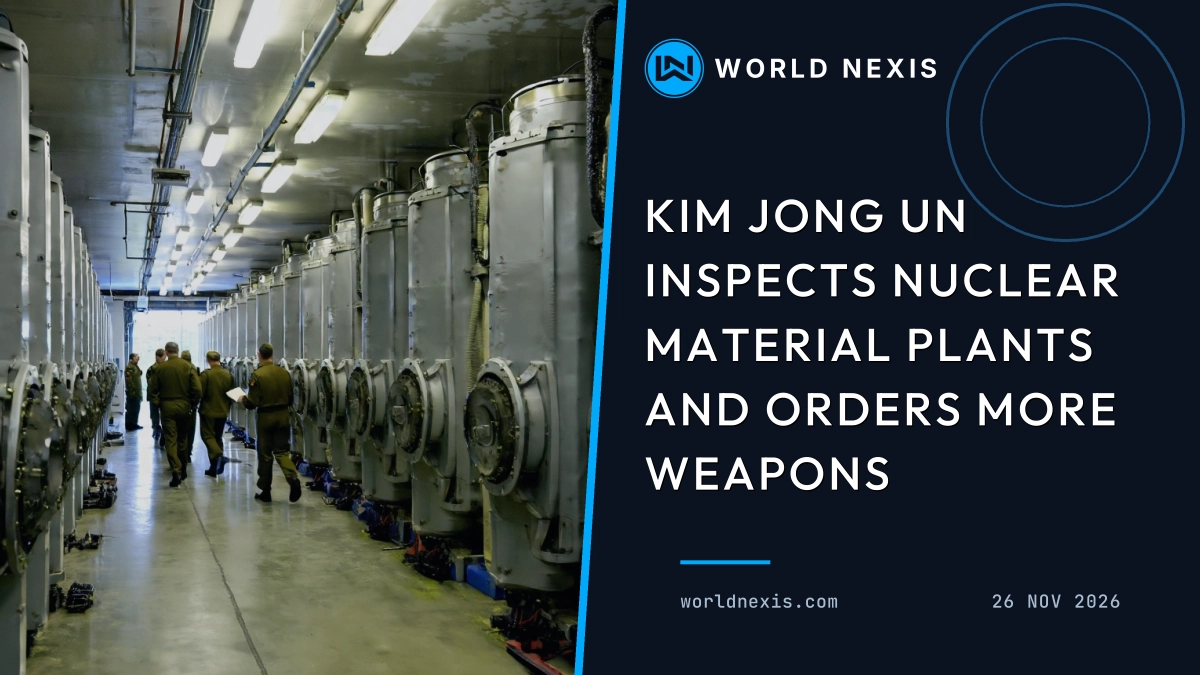
Kim Jong Un has ordered a major expansion of the North Korea nuclear program, touring facilities that produce weapons-grade material and calling for battlefield nuclear weapons to be deployed more widely. The instructions were made public on Thursday, days after Donald Trump’s offer of a meeting went unanswered during the US president’s trip to Asia.
Key points
- State media said Kim inspected nuclear material production facilities and demanded a bigger arsenal.
- He called for wider deployment of low-yield battlefield nuclear weapons across several domains and missions.
- The tour followed Trump’s public offer of talks, which produced no meeting during his Asia visit.
- South Korea said it takes the remarks seriously and stays ready alongside the United States.
North Korea nuclear expansion: what state media showed
The Korean Central News Agency said Kim toured two facilities that produce nuclear materials, one newly inaugurated and the other being expanded. He also visited a nuclear-powered equipment production base and a nuclear research institute on Wednesday, the agency reported.
It gave no location for the plants. Photographs published alongside the report showed Kim walking between long rows of equipment that appeared to be centrifuges of the kind used in North Korea uranium enrichment work, flanked by senior military officials.
Kim presented the expansion as a response to what he called variable nuclear threats approaching the Korean Peninsula moment by moment. He accused Washington of encouraging regional allies to acquire nuclear-powered submarines and of committing to share its own nuclear weapons with them.
“The validity and substantiality of our possession of nuclear weapons and the trend of bolstering up its nuclear capability in quality and quantity are an irreversible reality.”
He added that deploying low-yield battlefield nuclear weapons across multiple domains and missions is crucial and urgent, citing what he called the border with the most dangerous enemy state, his standard description of South Korea.
Trump’s unanswered offer
The announcement came days after Trump spent a week in Asia, including the APEC summit in China, saying he was open to restoring diplomacy with Kim. No meeting took place.
Moon Seong Mook, an analyst at the Seoul-based Korea Research Institute for National Strategy, said the North Korean leader is using the arsenal to set the terms of any future contact. “Trump has talked about a willingness to meet Kim Jong Un, but the basic U.S. position that North Korea must denuclearize remains unchanged,” he said. “So Kim Jong Un wants to say ‘Look at how powerful we are. Don’t talk about denuclearization if you want to meet us.'”
Reaction in Seoul
South Korea’s Defense Ministry said it takes Kim’s comments on battlefield nuclear weapons seriously. Under its alliance with the United States, Seoul maintains a firm military readiness against the North’s nuclear threats, the ministry said.
Its Joint Chiefs of Staff declined to give an assessment of the facilities shown in the state media report, describing that analysis as confidential information shared between Seoul and Washington.
Why it matters
The North Korea nuclear program is no longer a frozen dispute waiting for a deal. It is a live production line, and allied governments in East Asia now have to plan on the assumption that the stockpile will keep growing whoever sits in the White House.
For ordinary people in the region, that shapes everything from civil defence planning to the cost of missile defences and the tempo of military exercises. It also narrows the room for any future agreement, because every month of production adds material that would have to be declared, verified and dismantled.
Analysis
Having covered conflict and foreign policy for World Nexis News, I look first at the sequencing here rather than the rhetoric. Kim did not fire a missile to make his point. He opened the doors of the plants, released the photographs, and let the machinery speak while Washington waited for a reply that never came.
In my view, the facts support Moon Seong Mook’s reading better than the hope in Washington that personal diplomacy can restart talks. Kim’s own words describe the arsenal as an irreversible reality. Once that is the starting point, a negotiation designed to end the program cannot even begin, and both capitals understand that.
The strongest counter-argument is that walking away carries its own price: without talks there are no inspectors, no test monitoring and no cap on output. That is a serious objection, but it points towards a different kind of engagement, arms control rather than disarmament, not towards pretending the old formula still works.
What happens next
Moon Seong Mook said the tour was probably also meant to check how far this year’s nuclear objectives had been met before a year-end Workers’ Party conference, where fresh targets are likely to be set. Seoul says it is maintaining readiness, and no date has been set for any contact between Washington and Pyongyang.
What we don’t know yet
- Where the two production facilities are, since the agency disclosed no location.
- Whether the expanded plant is already producing material or is still being fitted out.
- Whether Washington keeps denuclearization as a precondition for talks or moves towards arms control.
Related coverage
- North Korea nuclear: Kim tours 2 plants, vows major buildup
- Nuclear test veterans win major truth panel by 2027
- Cairo fire kills 31 as fuel tanker overturns on major road
Further reading
- North Korea’s Kim vows to build more nuclear weapons after ignoring Trump’s overture
- Russia accuses Ukraine of trying to widen conflict zone
About the author: Marcus Ellington is the International Correspondent at World Nexis News (WNN), covering world affairs. The analysis section reflects the writer’s view.

Marcus Ellington
Marcus Ellington is International Correspondent at World Nexis News, reporting on diplomacy, conflict and the political forces reshaping Europe, the Middle East, Asia and the Americas. Based in London, he focuses on explaining why events unfold as they do, using official statements, diplomatic documents and…



