Cairo fire kills 31 as fuel tanker overturns on major road
At least 31 die and 21 are injured in a Cairo fire after a fuel tanker overturns on the Ring Road, as Egypt opens an investigation into the crash.
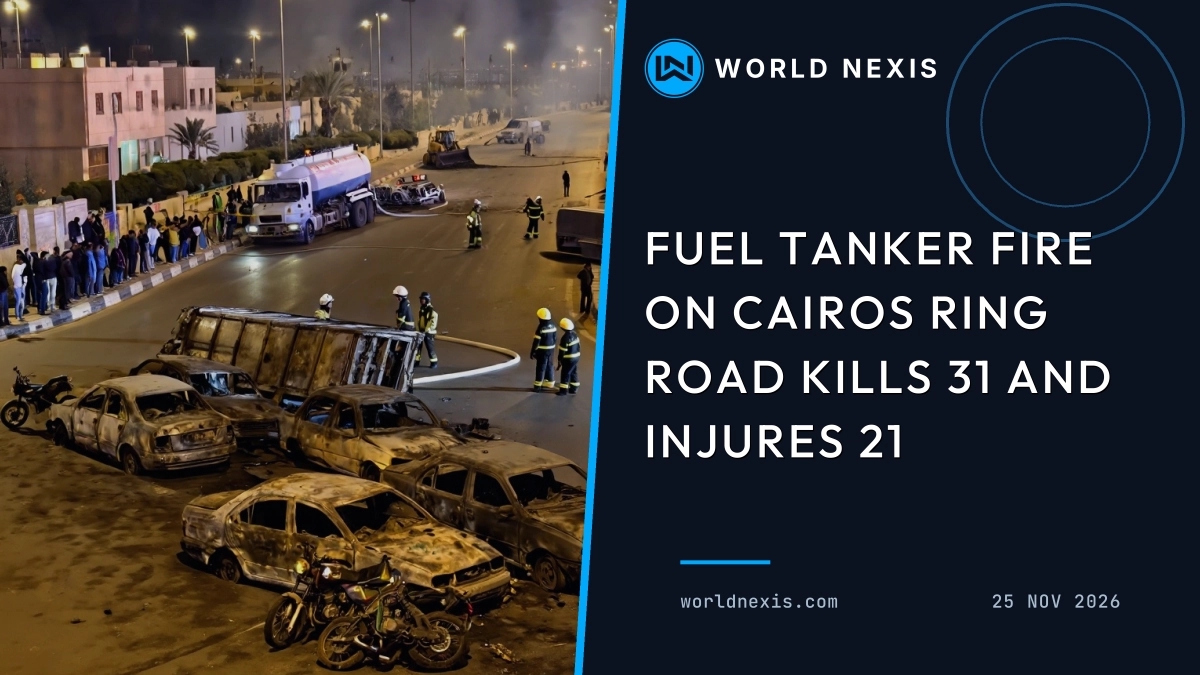
A Cairo fire that began when a fuel tanker overturned on the Ring Road has killed 31 people and injured 21 others, Egypt’s health ministry said, in one of the worst accidents on the capital’s road network in recent years. The crash happened on Wednesday evening in the Warraq district, north of the old city centre, and sent flames and black smoke across one of the busiest arteries in Greater Cairo.
Key points
- 31 people were killed and 21 injured in the Cairo fire on the Ring Road, the health ministry said.
- The fuel tanker overturned in Warraq, a densely populated district in the north of the capital, on Wednesday evening.
- More than two dozen cars and motorcycles were burned, according to the ministry, and the highway has since reopened.
- The public prosecutor has opened an investigation, and President Abdel-Fattah el-Sissi has offered his condolences.
What we know about the Cairo fire
The Cairo fire took hold after the tanker overturned on the carriageway and ignited, spreading flames to vehicles queued around it. Firefighters worked to stop the blaze jumping between cars while rescue workers pulled injured people from burning vehicles. The health ministry sent 39 ambulances to the scene and posted images of its minister overseeing treatment at a Cairo hospital.
The stretch of the Ring Road where the crash happened runs through a densely populated neighbourhood that forms part of the wider Greater Cairo area. It is a section that carries heavy commuter traffic around the city centre every evening.
Health minister Khaled Abdel Ghaffar said the injured were taken to nearby hospitals and that he would head to the scene. He described the death toll as preliminary, which suggests the figure could rise as hospitals report on patients with severe burns.
President Abdel-Fattah el-Sissi expressed his condolences to the victims. Hundreds of people gathered near the cordon in Warraq as emergency services blocked entry routes to the highway, and a bulldozer was later filmed clearing the burnt-out wrecks of cars.
A driver’s account
Ahmed Sameer, who was stuck in traffic after the road was blocked, saw the fuel truck and many cars on fire. He said he watched at least eight bodies being removed from burned vehicles.
“It was a huge fire, the cars got stuck together because of the fire,” he said. “It was a shocking scene.”
Cairo fire investigation and the search for a cause
Officials have not given a full account of how the Cairo fire started. The regional public prosecutor has launched an investigation and asked that DNA samples be taken from the bodies of the dead, a step that usually indicates some victims are hard to identify.
Road collisions are common in Egypt and are widely blamed on speeding, poorly maintained roads and weak enforcement of traffic laws. Official figures show nearly 6,000 people died on the country’s roads last year, several hundred more than in the previous year.
Deadly fires are also a recurrent problem in Egypt. Densely built informal districts and run-down infrastructure make blazes harder to contain, and slow emergency response times complicate rescue efforts even in the capital.
Why it matters
The Ring Road is the spine of Greater Cairo, linking outer districts that have few alternative routes. A single crash can trap thousands of drivers within minutes, and a tanker fire turns that queue into the hazard itself.
For ordinary Egyptians, the Cairo fire also tests a familiar promise: that each disaster brings an investigation, and that the investigation changes something. Road safety and fire response depend on maintenance budgets and enforcement, not on condolences.
Analysis
I think the most useful way to read this is not as a freak accident but as an exposure of systems that were already strained. Having covered emergency response and transport safety for World Nexis News, I look first at how quickly crews arrived and whether the road gave anyone an escape route. Thirty-nine ambulances is a serious mobilisation, and the response looks faster than in some previous Egyptian disasters.
The strongest counter-argument is that a tanker overturning is genuinely unpredictable, and that no amount of enforcement can rule it out. That is fair, as far as it goes. But the overturn does not explain the toll on its own. What explains it is the minutes afterwards: fuel across a crowded carriageway, vehicles packed nose to tail, and people with nowhere to run.
On the evidence available, I side with those who treat Egypt’s transport safety record as a policy failure rather than bad luck. Nearly 6,000 road deaths in a single year is not a geographical accident. It is the predictable result of weak enforcement and under-investment, and nothing in this Cairo fire suggests the pattern is about to break on its own.
What happens next
The inquiry into the Cairo fire is continuing, with DNA sampling under way to identify the dead. The health ministry is expected to update casualty figures as hospitals assess the injured. The Ring Road has been cleared and reopened to traffic.
What we don’t know yet
Investigators have not established why the tanker overturned, and no official finding has been published. It is also too early to say whether the death toll will rise, although the number of patients treated for burns and smoke inhalation makes that a real possibility.
Related coverage
- Watford fire attack: woman, 80, dies as murder probe opened
- Nuclear test veterans win major truth panel by 2027
- Abrego Garcia Spain move ends major US deportation battle
Further reading
- Thirty-one killed in massive fire as fuel tanker crashes on Cairo highway
- Dozens killed as fuel tanker crash ignites massive fire on major road near Cairo
About the author: Marcus Ellington is the International Correspondent at World Nexis News (WNN), covering world affairs. The analysis section reflects the writer’s view.

Marcus Ellington
Marcus Ellington is International Correspondent at World Nexis News, reporting on diplomacy, conflict and the political forces reshaping Europe, the Middle East, Asia and the Americas. Based in London, he focuses on explaining why events unfold as they do, using official statements, diplomatic documents and…



