Solomon Islands security treaty seals major Australia shift
The Solomon Islands security treaty names Australia as its primary security partner and bars foreign military bases, in a Pacific shift away from China.
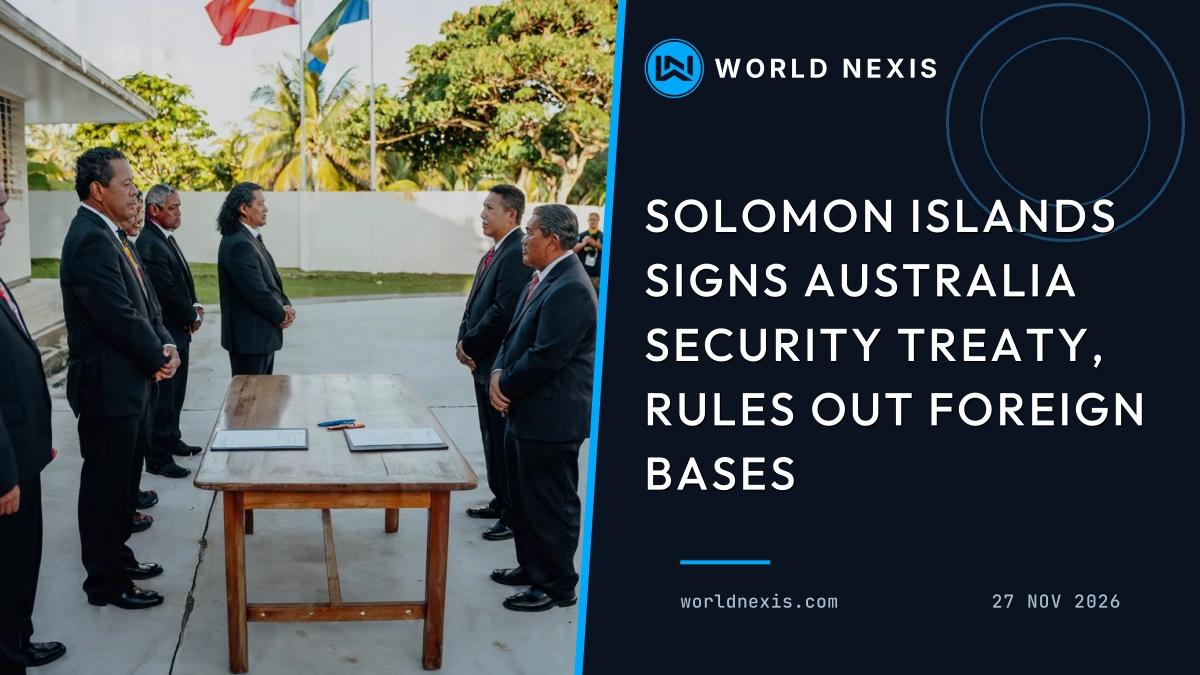
The Solomon Islands security treaty with Australia has been signed, naming Australia as the country’s primary security partner and ruling out foreign military bases on its territory. The agreement, concluded with the government of Australian Prime Minister Anthony Albanese, is the clearest signal yet that the Pacific nation is moving away from China. It restructures a relationship that had become one of the most closely watched in the region.
Key points
- Australia is named the Solomon Islands’ primary security partner under the new treaty.
- The agreement rules out foreign military bases in the Solomon Islands.
- The deal is widely described as a shift away from China and towards the West.
- It lands in the middle of a wider contest for influence across the Pacific islands.
What the Solomon Islands security treaty actually does
The Solomon Islands security treaty rests on two pillars. The first names Australia as the country’s primary security partner, a status that makes Canberra the first government the Solomon Islands is expected to turn to. The second rules out foreign military bases on Solomon Islands soil.
The base clause carries the weight. A ban on foreign bases constrains any arrangement that would let an outside power build a permanent military foothold in the islands. It narrows the options of any government tempted to trade strategic access for money or infrastructure.
The partner clause matters just as much for Canberra. In practice, first-call status gives Australia the strongest claim to be consulted before the Solomon Islands signs security arrangements with anyone else. For a small state, that is worth more than a single aid package.
What the treaty does not do, on the text now public, is sever economic ties with anyone. Trade, infrastructure contracts and diplomatic recognition sit outside its two central clauses. That distinction will decide how much actually changes on the ground.
Why the Solomon Islands security treaty is a setback for Beijing
Beijing has spent years deepening commercial and political ties across the Pacific islands, and the Solomon Islands has been central to that effort. A treaty that names Australia as the primary security partner, and closes the door on foreign bases, takes away the most valuable card a Pacific government can play.
The timing is uncomfortable for China. Signed pacts are harder to reverse than warm statements, and the Solomon Islands security treaty sets a template other Pacific capitals will be asked to follow. The deal is already being read in the region as a security loss for Beijing.
It also changes the terms of the argument inside the islands themselves. Governments that have defended Chinese investment as pragmatic now face a direct comparison with a Western partner offering security. That comparison will be made in public, not only in cabinet rooms.
Why it matters
For ordinary Solomon Islanders, the Solomon Islands security treaty will be judged by who turns up when help is needed. A cyclone, a maritime incident or a breakdown in public order all demand a fast answer about which partner responds. Naming a primary partner is meant to make that answer predictable.
The risk is that predictability shades into dependence. For Australia, the deal turns a sprawling aid relationship into a security one. The Solomon Islands security treaty also changes what other Pacific governments can ask for when they negotiate their own arrangements. For the wider region, it signals that the contest for influence is now settled in treaty text rather than in press releases.
Analysis
Having covered foreign policy and sanctions for World Nexis News, I read agreements like this one backwards: I start with what a small state gives up. On that test, I think the Solomon Islands security treaty is a better deal for Honiara than the first headlines suggest. The base clause is a defensive instrument, and it is the part that costs the islands least.
My view is that the exclusion of foreign bases is the substantive win, because it lets a small government say no to everyone at once without singling out a single suitor. Critics of the deal make a fair point that it narrows the room to hedge between great powers, and that is a genuine loss of flexibility. Even so, a country of that size was never going to sustain a true balancing act for long. The facts favour the argument that a clear, written partnership is safer than an ambiguous one.
What I will watch is delivery. A primary-partner label with no money, equipment or trained people behind it is a diplomatic trophy, not a shield. Washington will also read this as a win it did not have to sign anything to secure. The real test is whether Australian support becomes more visible in Solomon Islands waters and villages over the next year.
What happens next
Implementation of the Solomon Islands security treaty is now the story. Both governments must turn two clauses into practical arrangements, including who pays, who deploys and how disputes are handled. The treaty also gives Canberra a flagship agreement in the Pacific at a time when Pacific governments are weighing their options carefully.
What we don’t know yet
- What the treaty says in detail about policing, maritime surveillance and disaster response.
- How Beijing responds publicly, and whether it adjusts its investment plans in the islands.
- Whether other Pacific governments sign similar pacts, and on what terms.
Related coverage
- North Korea nuclear: Kim Jong Un vows major arms expansion
- North Korea nuclear: Kim tours 2 plants, vows major buildup
- Cairo fire kills 31 as fuel tanker overturns on major road
About the author: Marcus Ellington is the International Correspondent at World Nexis News (WNN), covering world affairs. The analysis section reflects the writer’s view.

Marcus Ellington
Marcus Ellington is International Correspondent at World Nexis News, reporting on diplomacy, conflict and the political forces reshaping Europe, the Middle East, Asia and the Americas. Based in London, he focuses on explaining why events unfold as they do, using official statements, diplomatic documents and…