Pharmacy prescription powers: major overhaul of 1968 rules
New pharmacy prescription powers let chemists swap out-of-stock medicines by strength or form, and let children get missed flu jabs there.
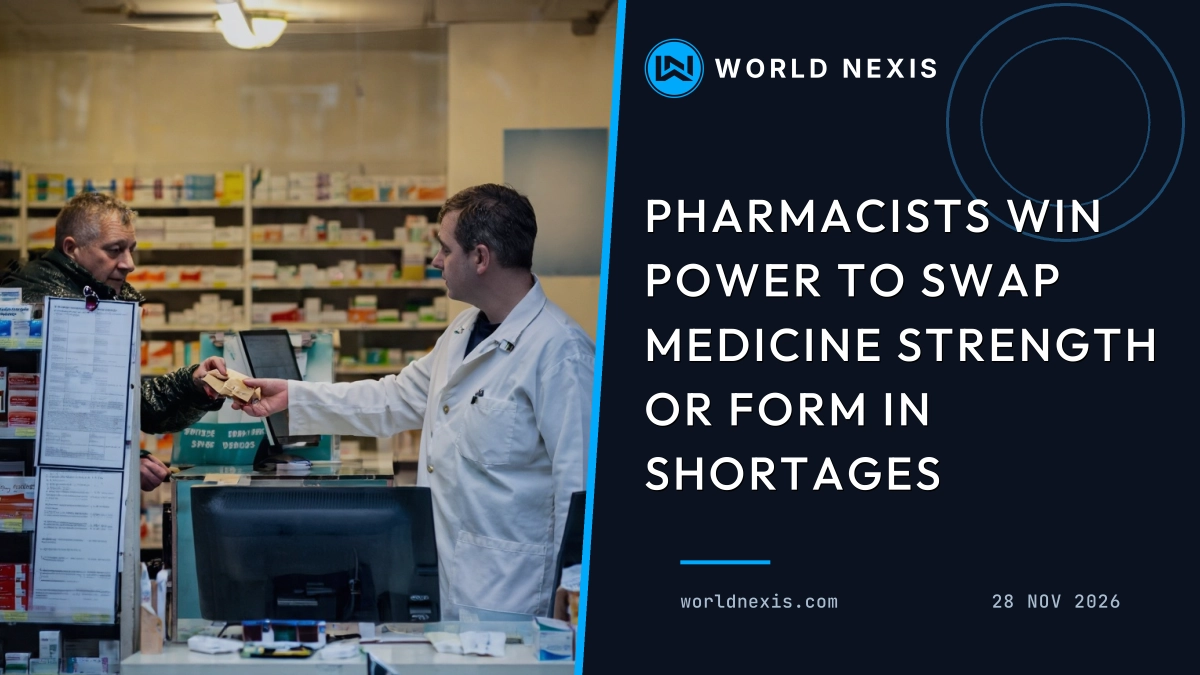
New pharmacy prescription powers will let chemists supply an out-of-stock medicine in a different strength or form, so patients are not sent back to their GP for a fresh prescription. The change, unveiled by ministers as flu cases climb this winter, will apply across the UK once the relevant parliaments and assemblies approve it. Public health minister Diana Johnson said it would help patients “get the treatment they need with less hassle, and no delay”.
Key points
- The new pharmacy prescription powers let pharmacists offer the same drug in a different strength or form.
- Patients should avoid a repeat GP appointment, and a wait for new stock, in simple cases.
- Children in England who miss their school flu vaccination can now have it at a pharmacy instead.
- The flexibility replaces a strict approach rooted in the 1968 Medicines Act.
What the new pharmacy prescription powers allow
Under the pharmacy prescription powers, a pharmacist can supply the same dose of a drug using pills of a different strength, or switch the form of a medicine, such as a capsule rather than a tablet. The adjustment must be safe and suitable for the patient. The flexibility covers the same drug delivered differently, not a swap to a different medicine.
The change matters because of how tight the old rules were. For decades, pharmacists have generally had to dispense exactly what a doctor wrote under the 1968 Medicines Act. When a product ran out, patients often had to return to their GP for an alternative prescription, or wait for supplies to arrive if that was safe.
The intention is that a patient leaves the counter with treatment, rather than with instructions to contact their surgery. These powers are separate from the Serious Shortage Protocol, an existing tool the government can use when it is worried about national stocks of a particular medicine or product. That route has been used during shortages of some hormone replacement therapy products, when pharmacists could already supply an alternative without contacting a GP.
“When you go to the pharmacy to pick up your prescription, there is nothing worse than being told you need to contact your GP again because the exact medicine they’ve prescribed isn’t available at that time, or in that form.” — Diana Johnson, public health minister
Flu jabs and pressure on high street pharmacies
Alongside the pharmacy prescription powers, children in England who miss their flu vaccination at school will be able to receive it at a pharmacy for the first time. The offer lands as influenza cases rise and health officials push for wider take-up of the vaccine. It also extends a broader expansion of pharmacy services in England, which has given pharmacists powers to prescribe certain medicines without a GP visit at all.
Many everyday products, from some painkillers to cold remedies, can already be bought over the counter without any prescription. The new arrangements push the same logic further: settle at the counter whatever can be settled there safely.
Henry Gregg of the National Pharmacy Association welcomed the move but said it left the causes of shortages untouched. He called shortages endemic and said the government “undervalues medicines, including underfunding vital local pharmacies”. He added: “These measures are a step forward but do not fix the underlying causes of shortages.” He also urged ministers to act so that manufacturers “don’t favour other countries when stocks are low internationally”.
Why it matters
For anyone on repeat medication, an empty shelf can mean days without treatment and an extra journey to a surgery where appointments are scarce. Letting a pharmacist make a small, safe adjustment keeps treatment going and takes pressure off GP lists in a difficult winter. Families also gain a second chance at the pharmacy flu vaccine when a school session is missed.
The new pharmacy prescription powers make shortages easier to manage. They do not make shortages rarer. A tweak at the counter cannot create stock that does not exist, and community pharmacies argue they are squeezed by funding and by manufacturers who prioritise other markets when supplies run tight.
For the health service, the prize is fewer wasted appointments and fewer abandoned courses of treatment. Pharmacies swap prescriptions only where the swap is safe, which keeps a clinical check in place while removing a purely administrative detour.
Analysis
Having covered patient safety and health inequality for World Nexis News, I read the pharmacy prescription powers as sensible, overdue housekeeping rather than a cure for the medicines supply crisis. Pharmacists are trained clinicians. Asking them to match a prescription to what is actually on the shelf is a smaller risk to patients than leaving treatment interrupted while someone chases a GP appointment.
In my view the government’s framing is honest about what the change does and quiet about what it does not. Henry Gregg is right that the underlying problem sits with supply and funding, not with the rules at the dispensing counter. The strongest counter-argument is that these flexibilities will genuinely prevent interrupted treatment this winter, and that is worth a great deal to a patient standing in a queue.
But convenience is not the same as resilience. I will be watching whether ministers pair the new discretion with money for local pharmacies and with pressure on manufacturers who ship elsewhere first.
What happens next
The pharmacy prescription powers take effect across the UK once the relevant parliaments and assemblies have approved them. The Serious Shortage Protocol stays available for national stock problems, so the two mechanisms will run side by side. Meanwhile the flu vaccination offer for children at pharmacies in England is already part of this winter’s programme, with officials urging families to take it up as cases rise.
What we don’t know yet
No date has been set for the approval votes, and it is not yet clear which products the flexibility will cover in practice. No new funding for community pharmacies has been announced alongside the rules.
Related coverage
- Gracias x Todo: Snoop Dogg and Feid’s major holiday single
- American Airlines wing clip: FAA probes major tarmac contact
- Co-op Live investigation: major hunt for 100 gig-goers
Further reading
About the author: Sofia Alvarez is the Health & Medicine Reporter at World Nexis News (WNN), covering health & medicine. The analysis section reflects the writer’s view.

Sofia Alvarez
Sofia Alvarez is Health & Medicine Reporter at World Nexis News, covering public health, clinical research, mental health and the policy decisions that shape care. Based in Manchester, she prioritises evidence over anecdote, checks claims against peer-reviewed research and official guidance, and explains uncertainty plainly…