Childhood vaccine poll finds 72% support, sharp party divide
A new childhood vaccine poll finds 72% of Americans rate routine shots essential, up from 2024 but far below 2019, as US measles cases hit 5,838.
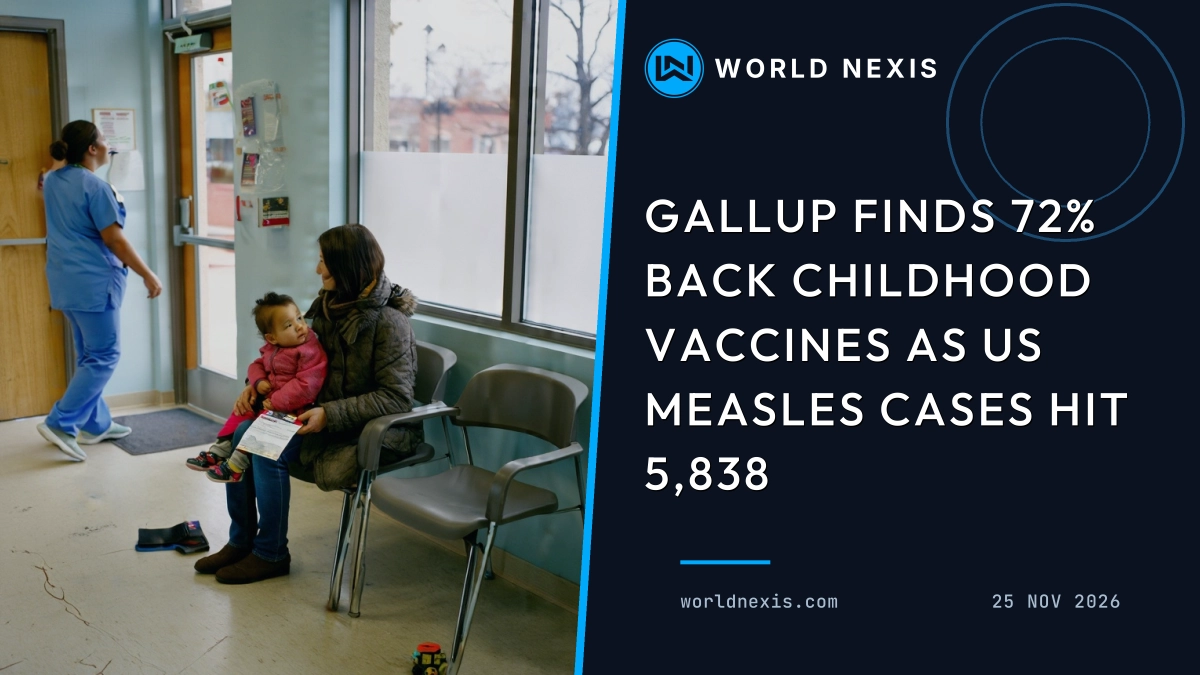
A new childhood vaccine poll finds that 72% of Americans rate routine childhood vaccinations as extremely or very important, a modest rebound that still leaves confidence far below pre-pandemic levels. Gallup published the survey on Tuesday, with responses collected last month. The fieldwork finished shortly before the United States lost its measles elimination status for the first time in 26 years.
Key points
- The childhood vaccine poll was published on Tuesday, from responses collected last month.
- 72% of Americans call childhood vaccinations extremely or very important, up from 69% in 2024 but down from 84% in 2019 and 94% 25 years ago.
- Only half of Republicans rate the shots that highly, compared with 91% of Democrats.
- The Centers for Disease Control and Prevention has confirmed 5,838 measles cases this year, with the disease spreading at its highest rate in more than three decades.
What the childhood vaccine poll found
The childhood vaccine poll’s headline number is an improvement, but a small one. Support has climbed three points since 2024 while staying 12 points below the 2019 reading. A quarter of a century ago, 94% of Americans held the same view.
The partisan split is wider than the national trend. Half of Republicans told Gallup that childhood vaccinations are extremely or very important, while 91% of Democrats said the same. Between 2001 and 2015 the two groups moved in lockstep, and the gap only began forming a decade ago.
Beliefs about risk follow the same pattern. Overall, 17% of Americans think vaccines are more dangerous than the diseases they are designed to prevent, down slightly from 20% two years ago. Among Republicans the figure is nearly a third, against just 5% of Democrats. Gallup also found that 16% of Americans believe there is a link between vaccines and autism, and said 29% of Republicans hold that view.
Misinformation and complacency, experts warn
Dr. Juan Salazar, chair of pediatrics at Vanderbilt Health, called the erosion of support for childhood vaccines “very, very unfortunate”. He blamed a “megaphone” of misinformation from social media influencers that has sown doubt among parents and the wider public.
“This is not a matter of people not caring for their children. They do. But the misinformation leads them to make the wrong decisions, and that’s what the problem is.”
Salazar said the slide did not begin with the pandemic, though sentiment may have taken extra damage during a period of broader distrust in government health recommendations. Silence or unclear messaging from officials makes the job harder, he added.
He also pointed to complacency. Vaccines have worked so well for so long that the diseases they prevent no longer feel like a “real and present danger” to a couple of generations of Americans.
“We should not be seeing an outbreak of measles in 2026 in the United States. That should not be the case. And it is directly related to this decrease in the belief of the importance of childhood vaccinations based on misinformation that has been fueled extensively” through social media.
The measles backdrop to the childhood vaccine poll
Measles was never eradicated in the United States, but elimination status meant outbreaks stayed small and contained. It required no sustained local transmission of the virus for 12 months or more. Since the country reached that benchmark in 2000, it recorded fewer than 100 cases in a year on 14 separate occasions.
That record has collapsed. The US recorded 2,289 confirmed measles cases last year, the most since 1991, and the latest CDC figures show 5,838 confirmed cases this year. The childhood vaccine poll was in the field before the loss of status was confirmed.
Jennifer Nuzzo, director of Brown University’s Pandemic Center, said she was encouraged to see the childhood vaccine poll reflect an uptick. “Perhaps people are starting to see the peril in taking childhood vaccines for granted,” she said. She then warned how far vaccine confidence had already fallen.
“And particularly, we have a long way to go when it comes to partisan views on this issue. And so, that is deeply worrisome.”
Why it matters
The measles elimination status the US held for 26 years was a practical guarantee that a single case would not become a chain of them. Losing it changes the calculation for every parent of an unvaccinated child, and for schools and clinics that have not seen sustained transmission in a generation.
The childhood vaccine poll also shows that vaccine confidence in America is now two separate conversations. One national message cannot reach a country where nine in ten Democrats and half of Republicans answer the same question differently.
Analysis
Having covered public health and patient safety for World Nexis News, I look first at whether a survey reflects a real shift or a blip. This childhood vaccine poll looks like a genuine, if fragile, stabilisation: 72% is better than 69%, and Nuzzo’s reading that some parents are starting to see the cost of taking vaccines for granted is the most plausible explanation. The measles numbers give that argument its force.
In my view the evidence supports Salazar and Nuzzo, not the vaccine-sceptical minority. A country that recorded fewer than 100 measles cases in 14 separate years since 2000 does not reach 5,838 by accident, and the sequence convinces me: confidence slid first, transmission followed. The strongest counter-argument is that lecturing parents from the top rarely works and that official messaging has itself fed distrust, which is why Salazar’s complaint about official silence cuts both ways.
What I would watch is the Republican figure. A gap that opened a decade ago now stands at 41 points between the parties, and that is not a communications problem alone. Until trusted voices on the right make the case, the national average will keep drifting lower even in a good year.
What happens next
The CDC’s confirmed case count remains the number to watch, with measles spreading at its highest rate in more than three decades. The next childhood vaccine poll on the same questions will show whether the 2024-to-2026 uptick becomes a trend or stalls.
What we don’t know yet
Gallup’s figures do not explain why the parties diverged, only that the gap began forming about 10 years ago. It is also unclear whether losing elimination status will change how parents weigh vaccination, or whether vaccine confidence can recover towards its 2019 level.
Related coverage
- UK sex survey: one in three young Britons never had sex
- Veteran suicide: Face the Fight passes $58m in grants
Further reading
- ‘Long way to go’: Partisan divide shadows childhood vaccine support, Gallup poll finds
- ‘Long way to go’: Partisan divide shadows childhood vaccine support, Gallup poll finds
About the author: Sofia Alvarez is the Health & Medicine Reporter at World Nexis News (WNN), covering health & medicine. The analysis section reflects the writer’s view.

Sofia Alvarez
Sofia Alvarez is Health & Medicine Reporter at World Nexis News, covering public health, clinical research, mental health and the policy decisions that shape care. Based in Manchester, she prioritises evidence over anecdote, checks claims against peer-reviewed research and official guidance, and explains uncertainty plainly…