Strait of Hormuz: Iran claims control amid US blockade
Iran's army says its navy controls the Strait of Hormuz to the northern Indian Ocean, as US forces redirect 158 ships and disable a merchant vessel.
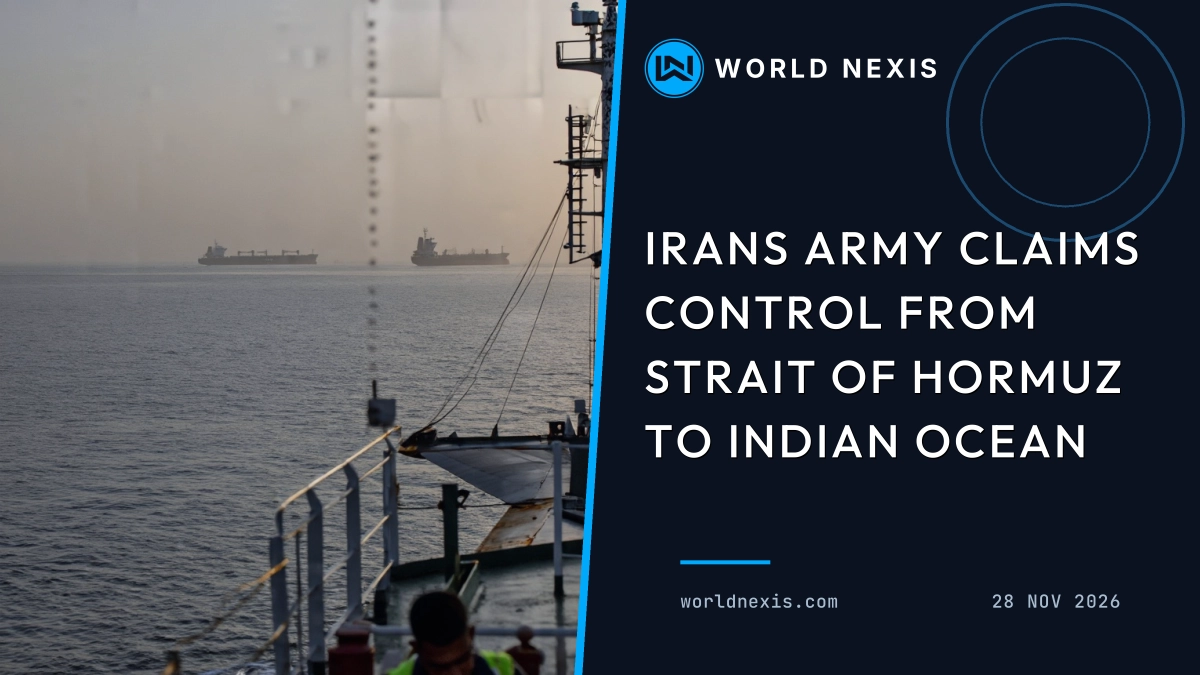
Iran’s army claimed on Saturday that its navy controls the waters from the Strait of Hormuz to the northern Indian Ocean. Brigadier General Mohammad Akraminia, spokesman for the Islamic Republic of Iran Army, said in a post on X that the navy was maintaining surveillance and guarding the region “with authority”. The claim lands as the US naval blockade of Iranian ports tightens and merchant traffic is turned away.
The announcement followed an interview in which the Iranian navy commander dismissed the blockade as proof that Washington has already lost the war. US Central Command, meanwhile, has published its own tally of ships stopped or disabled while trying to run the blockade.
Key points
- General Akraminia says Iran’s navy guards the waters from east of the Strait of Hormuz to the north of the Indian Ocean.
- The Iranian navy commander, Admiral Shahram Irani, said the blockade proves the war is already lost and that Iran’s ports remain open.
- US Central Command says it disabled the Palau-flagged M/V Pacific Archer after its crew tried to breach the blockade.
- Central Command says it has redirected 158 commercial vessels and disabled six that refused to comply.
Iran’s claim over the Strait of Hormuz and beyond
General Akraminia framed the announcement as a repeat of Iran’s naval record in the 1980s war with Iraq, which Tehran calls the first imposed war. He said the Iranian navy overwhelmed the Baathist navy 67 days into that conflict, leaving it unable to move until the war ended.
“In the current war, it controls and guards with authority from the east of the Strait of Hormuz to the north of the Indian Ocean,” he said.
The statement gave no figures, no named units and no evidence to support the extent of the area described. It also did not say how many vessels or aircraft would be needed to patrol waters that stretch far beyond the narrow channel itself.
Admiral Shahram Irani, the Iranian navy commander, used an interview with state television on Friday to argue that the blockade reveals Washington’s weakness. “A naval blockade makes no sense. Naval blockades are imposed before a war. When a blockade is imposed during a war, it means the war has been lost,” he said.
Irani said Iran’s ports were still operating and that its vessels were receiving naval escorts. He also repeated Tehran’s assertion that Iran struck the USS Abraham Lincoln, the carrier at the centre of the US deployment, on the second day of the war. That claim has not been independently verified.
Inside the US naval blockade: 158 vessels redirected
American forces are enforcing the blockade at sea. On Friday, Central Command said the Palau-flagged commercial ship M/V Pacific Archer tried to breach it despite repeated warnings, and that precision munitions disabled its propulsion system. The command said the civilian crew was unharmed.
Central Command added that it has redirected 158 commercial vessels that complied with the blockade and disabled six that refused to comply. The figures give the clearest public measure so far of how much traffic the blockade is diverting, and they suggest enforcement is steady rather than episodic.
Tanker explosion reported north of Ghanam Island
In a separate incident, Iran’s state broadcaster, citing the Revolutionary Guard navy, said an oil tanker struck a naval mine and exploded north of Ghanam Island in the Strait of Hormuz. The vessel was said to be trying to navigate an unauthorised route at the time. No casualty details were given, and the account has not been independently confirmed.
Why it matters
The Strait of Hormuz confrontation now reaches from the Gulf of Oman into the northern Indian Ocean, well beyond the channel most shipping planners focus on. For households in Europe, Asia and North America, the practical effect travels through fuel prices and the cost of imported goods, because disruption in this corridor feeds quickly into freight and insurance rates.
For Iran, the claim is as much about politics as navigation. A navy that says it controls the approaches to the Gulf is telling its own public that the blockade can be survived, and telling shipowners that the risk premium should stay high.
Analysis
Having covered conflict and sanctions for World Nexis News, I look first at what can be counted, and here only one side is counting. Central Command has published numbers: 158 vessels redirected, six disabled, one ship’s propulsion destroyed by precision munitions, a crew left unharmed. The Iran navy claim offers a map reference and a historical analogy instead.
The strongest counter-argument is that Iran does not need to control the waterway to make it dangerous. A handful of mines, a few warning shots and a nervous insurer can push premiums up and reroute ships even when warships are present, and the reported explosion near Ghanam Island points to exactly that kind of asymmetric pressure. Denial is cheaper than control, and Tehran’s own account of the 1980s war suggests it knows the difference.
Even so, I side with the reading the facts support better: Washington, not Tehran, is currently deciding who passes through the Strait of Hormuz and who turns back, and the Iranian statement is a declaration of intent dressed as a situation report. The assertion about hitting the USS Abraham Lincoln belongs in the same category until someone produces evidence. My caution is that a blockade is a blunt instrument, squeezing Tehran slowly while handing Iran a grievance to sell to governments that would rather stay out of this war.
What happens next
Diplomatic contacts mediated through Pakistan and Qatar have slowed, and Iran’s envoy to Pakistan has warned that Tehran has “more surprises” if Washington resumes large-scale attacks. No new round of talks has been announced.
At sea, neither side has signalled a pause. Iran says its escorts and port operations continue, while Central Command’s running tally of redirected and disabled ships indicates enforcement is continuing around the clock.
What we don’t know yet
- Whether Iran’s navy can sustain a presence across such a wide area, or whether the claim describes intent rather than capability.
- Whether the USS Abraham Lincoln was damaged at all; Iran says it struck the carrier and the claim remains unverified.
- What happened to the tanker reported to have hit a mine near Ghanam Island, and who was on board.
Related coverage
- Iran naval blockade vow as MP warns over Hormuz control
- Iran naval blockade: US disables 15th ship in Gulf of Oman
- Iran war: AI video’s warning to Microsoft and SpaceX
Further reading
- Iranian Army claims control over strategic waters from Strait of Hormuz to northern Indian Ocean – The Tribune
- Iranian Army claims control over strategic waters from Strait of Hormuz to northern Indian Ocean
About the author: Marcus Ellington is the International Correspondent at World Nexis News (WNN), covering world affairs. The analysis section reflects the writer’s view.

Marcus Ellington
Marcus Ellington is International Correspondent at World Nexis News, reporting on diplomacy, conflict and the political forces reshaping Europe, the Middle East, Asia and the Americas. Based in London, he focuses on explaining why events unfold as they do, using official statements, diplomatic documents and…



