RAF Lakenheath drones: US military repelled six-drone swarm
RAF Lakenheath drones were repelled by US counter-drone systems on 13 November, with Iran suspected of a link and none of the aircraft recovered.
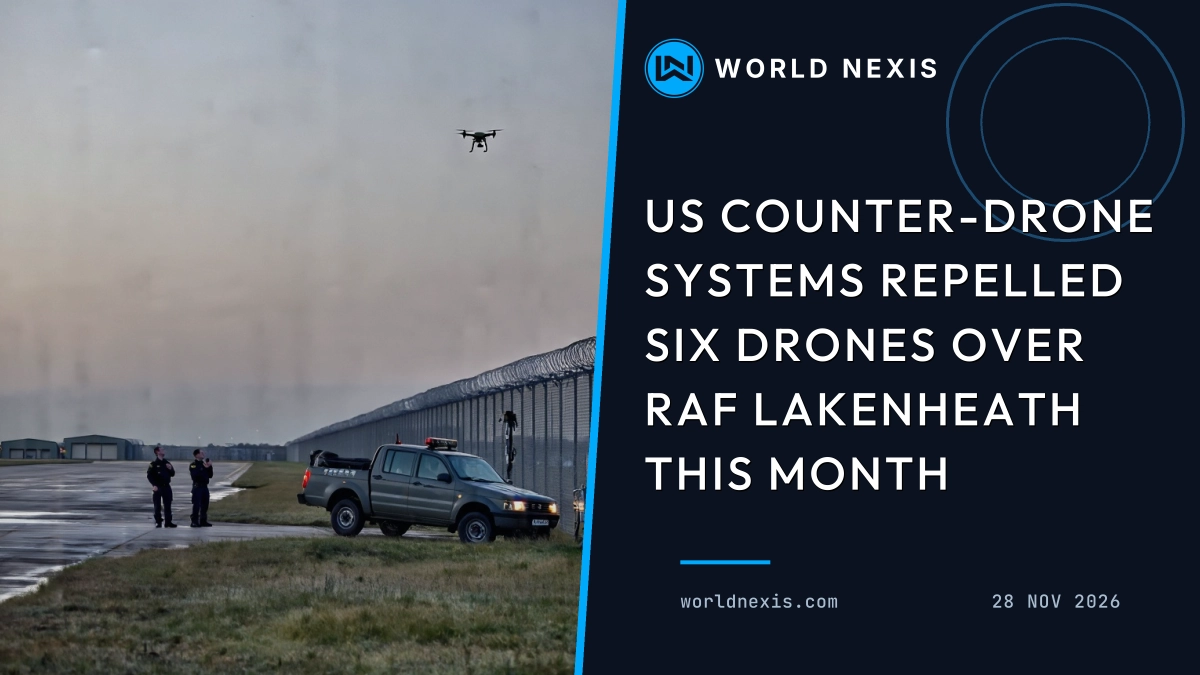
RAF Lakenheath drones were driven off earlier this month when US military personnel deployed counter-drone technology against a swarm of about half a dozen unmanned aircraft over the Suffolk base on 13 November, according to people familiar with the matter. No personnel, aircraft or infrastructure were affected, the US Air Force said at the time, and the Ministry of Defence says the site has returned to normal security and force protection measures.
Key points
- The RAF Lakenheath drones appeared over a British base used by the US Air Force on 13 November.
- US personnel used counter-drone technology to repel the swarm, and no aircraft were recovered by British or American teams.
- Iran has been suspected of a link to the flight; Tehran has rejected accusations of malign activity in Britain.
- The Ministry of Defence says the situation was quickly resolved and the base is back to its normal security posture.
How the RAF Lakenheath drones were repelled
The incursion was handled as a security scare rather than an attack. US Air Force personnel at the base responded to what their service described at the time as “suspected unauthorised drone activity”, with British police forces working alongside them.
A Ministry of Defence spokesperson said in an emailed statement: “Ministry of Defence Police and Suffolk Police worked closely with USAF Security Forces to respond to reports of unauthorised drone activity at RAF Lakenheath on 13 November and the situation was quickly resolved, with RAF Lakenheath returning to normal security and force protection measures.”
People familiar with the matter say the American response went further than observation, with counter-drone systems deployed to break up the formation. The US Air Force said at the time that no personnel, aircraft or infrastructure were affected.
The RAF Lakenheath drones were not recovered by British or American personnel, those people said. That leaves investigators without airframes, flight controllers or payloads to examine, and pushes any judgement about who was flying them back onto intelligence assessments rather than physical evidence.
The White House and the Pentagon did not immediately respond to requests for comment. Neither government has published further details of the RAF Lakenheath drones beyond the assurances given in the days after the incident, and no formal account of the flight has been released.
Iran suspicion and the Fairford precedent
Suspicion has settled on a state-linked actor. People familiar with the matter have said Iran was suspected of being linked to the swarm, which is why the episode has been treated inside Whitehall as more than a policing matter.
The closest parallel is a September episode at RAF Fairford, another British base used by the US Air Force. A threat linked to Iran prompted the removal of American B-1 bombers from the site, a decision President Donald Trump disclosed in October.
Tehran has rejected accusations of involvement in the Fairford incident and of other malign activity in Britain. UK authorities have for years accused Iran of involvement in plots and attempted assassinations against dissidents and Israeli and Jewish targets on British soil.
Against that backdrop, a swarm of cheap, deniable aircraft probing the edge of allied airspace fits a warning British officials have repeated for years. It also meant the response drew in civilian police as well as military security, an unusual combination for a routine airfield alert.
Why it matters
RAF Lakenheath is not a remote test range. It is a working British base used by the US Air Force, with American personnel stationed there, and it sits close to ordinary communities in Suffolk.
If small unmanned aircraft can reach a base of that kind, the same technology can reach airports, prisons, substations and stadiums. The RAF Lakenheath drones therefore raise questions about domestic airspace security that stretch far beyond one East Anglian airfield.
The episode also tests the working relationship between London and Washington. Counter-drone systems are scarce and sensitive, and using them over British soil raises questions about who authorises what, and who is told afterwards.
Analysis
Having covered conflict and foreign policy for World Nexis News, I look first at what can actually be proved. The solid facts here are narrow: about six drones appeared over a base used by US forces, counter-drone equipment was used, and nothing was hit. Who sent them remains an intelligence judgement rather than a forensic finding, because no airframe was recovered.
That is why I think the case for more disclosure is stronger than the case for silence. Those arguing for saying as little as possible have a real point: describing how counter-drone systems work, and where they sit, helps the next intruder. But the cost of that position is paid by people living near these bases, who learn weeks later that hostile hardware was circling overhead. Somewhere between a press release and total silence there is a briefing that informs without instructing.
What convinces me is the Fairford precedent. When a threat linked to Iran was judged serious enough to move B-1 bombers out of a British base, the assumption that these flights are nuisance behaviour collapsed. I would rather see ministers and the Pentagon set out what they can confirm about the RAF Lakenheath drones, and what they cannot, than let suspicion harden into fact by default.
What happens next
No timetable has been published for further statements from London or Washington on the RAF Lakenheath drones. The Ministry of Defence has pointed to its account of the response on 13 November and the return to normal force protection measures.
What we don’t know yet
- Whether any of the aircraft were recovered elsewhere, and by whom.
- What evidence, if any, links the flight to a state actor rather than criminal or amateur operators.
- Whether counter-drone arrangements at bases used by US forces in Britain will change permanently.
Related coverage
- Pentagon drone talks: GM and Ford face major conversion test
- Taiwan local elections as China sends 33 warplanes, 8 ships
- George Heyman dies at 77: labour giant who shaped CleanBC
Further reading
- US military reportedly repelled drones at UK air base
- US military reportedly repelled drones at UK air base
About the author: Marcus Ellington is the International Correspondent at World Nexis News (WNN), covering world affairs. The analysis section reflects the writer’s view.

Marcus Ellington
Marcus Ellington is International Correspondent at World Nexis News, reporting on diplomacy, conflict and the political forces reshaping Europe, the Middle East, Asia and the Americas. Based in London, he focuses on explaining why events unfold as they do, using official statements, diplomatic documents and…



