Taiwan local elections as China sends 33 warplanes, 8 ships
Taiwan local elections are under way in all 22 cities and counties as China sends 33 warplanes and eight warships around the island. Results due tonight.
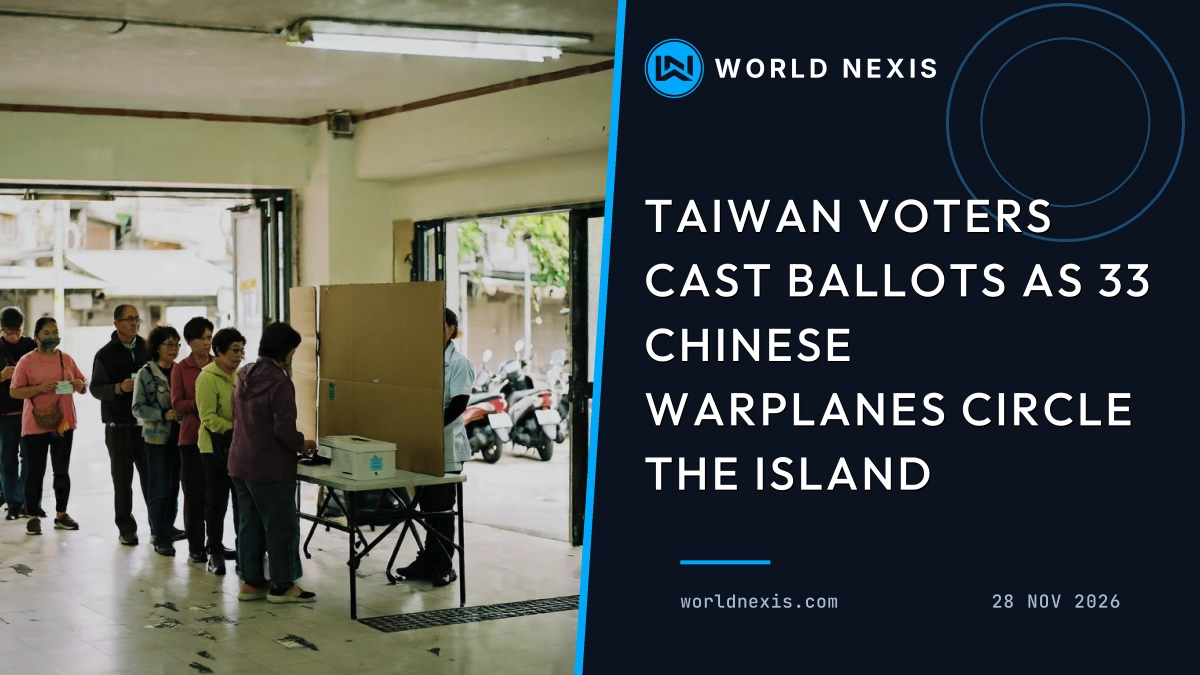
Taiwan local elections are being held today across all 22 cities and counties. Voters are choosing mayors and county chiefs, with results expected early on Saturday evening. Taiwan’s defence ministry says China sent 33 military aircraft and eight warships around the island in the previous 24 hours.
Campaigning centred on transport, the environment and other everyday services. Even so, Beijing has weighed in repeatedly on the Taiwan local elections. Its state media spent Friday attacking the governing Democratic Progressive Party’s candidate for mayor of Taipei.
Key points
- Voters in all 22 cities and counties are electing mayors and county chiefs, with results due early on Saturday evening.
- Taiwan’s defence ministry reported 33 Chinese military aircraft and eight warships around the island in 24 hours.
- Chinese state media accused DPP Taipei candidate Puma Shen of taking money from the United States; Chinese police want him for “separatism”.
- The Kuomintang took 14 of 22 seats at the last local elections four years ago; this vote shapes the run-up to 2028.
Taiwan local elections held as warplanes circle the island
Enormous crowds turned out at polling stations from the morning. The defence ministry said on Saturday that it had detected 33 military aircraft encircling the island, along with eight Chinese warships, in the previous 24 hours.
Alex Huang, an adviser to Taiwan’s National Security Council, said China had mobilised its propaganda platforms and the Taiwan Affairs Office on Friday night. He described the push as Beijing marking its own “election eve”.
Beijing views Taiwan as its own territory and refuses to recognise its government. The outcome of the Taiwan local elections will not directly affect that policy, yet the government has chosen to intervene in public anyway.
Taipei mayoral race draws Beijing’s fire
The capital’s contest has become the sharpest flashpoint. Puma Shen, the DPP candidate, is wanted by Chinese police for “separatism”. On Friday, Chinese state media launched a new wave of attacks against him, accusing him of taking money from the United States.
The same state media reports said Washington was “using extremely covert methods to deeply interfere” in the vote. Shen said Chinese police had never contacted him. He also said that whoever wins, the Taipei election would be a victory for democracy in the face of pressure from China.
His team said it could not comment before polls close. Speaking to reporters after casting his ballot, Shen did not mention China, talking instead about how he had slept, what he would eat for breakfast and the good weather.
Shen’s main opponent is the incumbent mayor, Chiang Wan-an of the Kuomintang. His team declined to comment on the state media reports.
What the Taiwan local elections signal for 2028
At the last local elections four years ago, the Kuomintang thrashed the DPP. It won 14 cities and counties to five for the governing party, with other parties and independents taking the remaining three.
Manoeuvring for the presidential and parliamentary elections of early 2028 will begin in earnest once Saturday’s count is complete. President Lai Ching-te will almost certainly stand for a second term, the maximum the constitution allows.
The Kuomintang has not confirmed its candidate, though its likely frontrunner is Lu Shiow-yen, the mayor of the central city of Taichung and a former journalist. The party traditionally favours close ties with Beijing.
China’s government refuses to talk to Lai and labels him a “separatist”. Lai says only Taiwan’s people can decide their future.
Why it matters
For most voters, these are the elections that decide how often buses run, how waste is collected and how neighbourhoods are maintained. City and county governments also run the schools and local health services that residents use every day.
For the wider region, the Taiwan local elections are a live test of how much pressure Beijing will apply in public while insisting it is not interfering. The result gives both sides a reading on public mood before the 2028 race opens.
Analysis
Having covered cross-strait security for World Nexis News, I look first at the timing rather than the aircraft count. Beijing’s message was not aimed at local budgets or bus routes. Its state media went after a single candidate in a single city, and did so on the eve of the vote.
I think the picture set out by Alex Huang of Taiwan’s National Security Council fits the facts better than the view that this is routine sabre-rattling that happened to land on polling day. The coordination between propaganda platforms and the Taiwan Affairs Office looks deliberate, and the language used was about Washington and separatism, not about municipal services.
The strongest counter-argument is that the DPP gains from talking up the China threat, so a party that raises the alarm also raises its own profile. That is fair, but it does not explain why the pressure came from outside Taiwan rather than from the DPP’s own campaign. Shen himself said nothing about Beijing after voting.
In my view, Beijing is treating the Taiwan local elections as a rehearsal for 2028. That matters for how voters feel, and for how the Kuomintang’s likely candidate positions herself. But the mayors chosen today will be judged on transport and the environment, not on warplanes.
What happens next
The Taiwan local elections results are expected early on Saturday evening, settling the balance between the DPP and the Kuomintang across the island. Attention will then shift immediately to the 2028 presidential and parliamentary contests.
What we don’t know yet
Whether Puma Shen wins Taipei, and whether Beijing escalates its rhetoric if he does, remains open. The Kuomintang has still not named its 2028 candidate, so the size of any leadership bounce from these results is unclear.
Related coverage
- George Heyman dies at 77: labour giant who shaped CleanBC
- Iran war: AI video’s warning to Microsoft and SpaceX
- Uyghur forced labour: WUC urges urgent global sanctions
Further reading
- Taiwan votes in elections as China flexes military
- Taiwan votes in elections as China flexes military
About the author: Marcus Ellington is the International Correspondent at World Nexis News (WNN), covering world affairs. The analysis section reflects the writer’s view.

Marcus Ellington
Marcus Ellington is International Correspondent at World Nexis News, reporting on diplomacy, conflict and the political forces reshaping Europe, the Middle East, Asia and the Americas. Based in London, he focuses on explaining why events unfold as they do, using official statements, diplomatic documents and…



