Uyghur forced labour: WUC urges urgent global sanctions
The World Uyghur Congress has urged coordinated global action on Uyghur forced labour after a US trade report linked coerced labour to unfair competition.
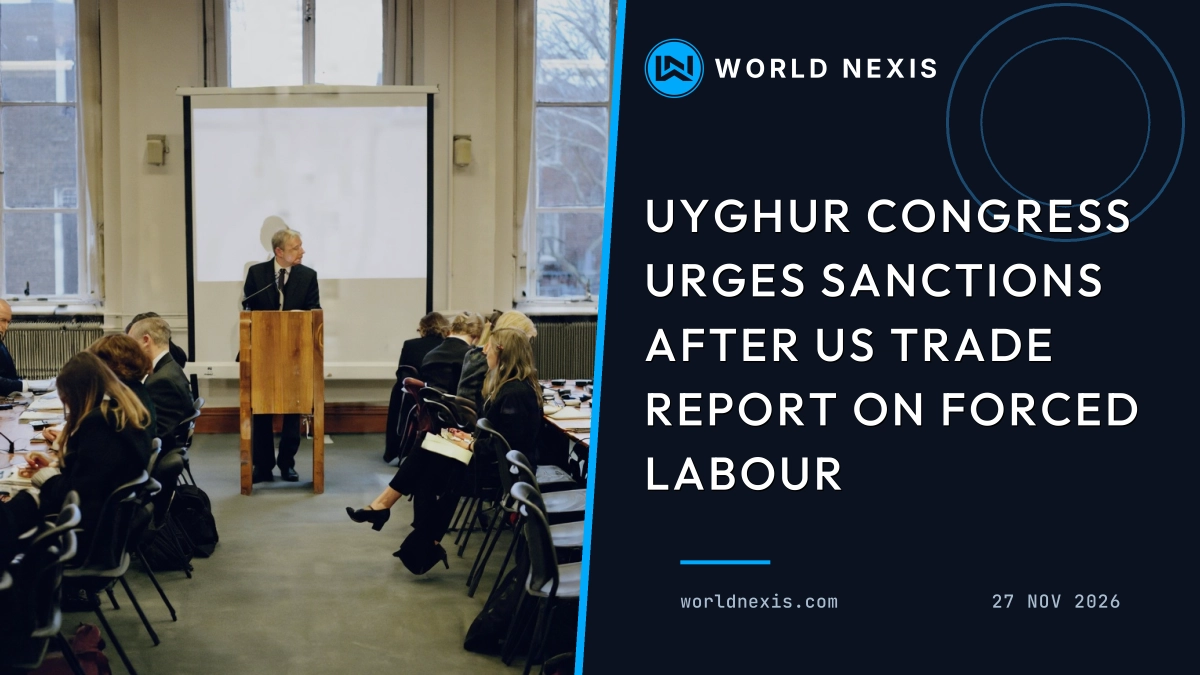
Uyghur forced labour is now a trade enforcement problem as well as a human-rights one. The World Uyghur Congress has urged governments to adopt coordinated economic, legal and political measures to end the practice and to hold those responsible to account. It acted after a US trade investigation found that state-imposed labour transfer feeds structural overproduction and unfair competition, the congress said.
The report was published on 25 November by the Office of the United States Trade Representative. In a statement, the WUC called for targeted sanctions, import bans and tighter public procurement rules across the European Union, the United Kingdom, Canada, Switzerland and Norway.
Key points
- The World Uyghur Congress is pressing for coordinated global action against Uyghur forced labour.
- It says a US Trade Representative report published on 25 November ties coerced labour to excess manufacturing capacity.
- The congress wants targeted sanctions on Chinese officials and companies, plus firm bans on goods made with forced labour.
- It points to a companion legal report concluding that the system amounts to enslavement.
What the US trade investigation found
The USTR report is titled China’s Acts, Policies, and Practices Relating to Structural Excess Capacity and Production in Manufacturing Sectors. According to the WUC, it identifies the use of Uyghur forced labour in the region the congress calls East Turkistan. It also names state-imposed labour transfer and so-called poverty alleviation programmes as practices driving excess capacity.
The congress said those practices artificially depress production costs and leave responsible businesses at a disadvantage. Chinese authorities have folded the exploitation of Uyghurs into domestic and global supply chains, the WUC added. It named cotton, textiles, solar energy, wind energy and aluminium among the industries affected.
The congress says Uyghurs and other Turkic peoples have faced mass detention, forced labour and persecution since 2016. It notes that numerous national parliaments and the European Parliament have recognised the abuses as genocide or crimes against humanity. The independent Uyghur Tribunal, it adds, reached the same conclusion.
Uyghur forced labour and the legal risk for business
The WUC also highlighted a report published the same day by Anti-Slavery International. According to the congress, it concludes that the widespread and systematic use of forced labour against Uyghurs and other Turkic peoples constitutes the crime against humanity of enslavement.
That report sets out the legal implications for companies operating in or sourcing from the region, the WUC said. It also flags heightened risks linked to labour transfer programmes across China. On the congress’s reading, this is a compliance problem before it is a reputational one.
“Uyghur forced labour is not simply an issue of unfair competition. It is a crime against humanity and an integral part of the ongoing Uyghur genocide,” WUC president Turgunjan Alawdun said.
Alawdun said governments and businesses must ensure that economic interests do not come at the expense of the fundamental rights of Uyghur people. He called on the international community to dismantle the system of exploitation, end corporate complicity and hold those responsible to account.
The congress welcomed growing recognition of the economic consequences of the practice. It insisted, though, that responses stay grounded in human rights, international law and accountability, not in trade balances or industrial competitiveness alone.
Why it matters
For readers in Britain, the EU and North America, the Uyghur forced labour findings point at goods that reach shop shelves and public contracts. Cotton, solar panels, wind components and aluminium feed consumer supply chains, procurement and pension portfolios. If the WUC’s account is right, ordinary purchases can keep the system running.
The demands also land on governments that have recognised the abuses through their parliaments. Sanctions and import bans aimed at Uyghur forced labour would raise compliance costs for importers and force public bodies to audit their suppliers.
Analysis
Having covered sanctions and conflict for World Nexis News, I look first at whether the measures the WUC wants against Uyghur forced labour can actually be enforced. In my view the congress is right to move the argument from competitiveness to enslavement. A tariff complaint invites a negotiation over quotas, while a crime against humanity opens the door to asset freezes, visa bans and import refusals that regulators already know how to use.
The strongest counter-argument is that unilateral bans rearrange supply chains rather than clean them. Coerced labour can shift into goods routed through third countries, and clumsy enforcement can cost the workers it aims to protect. That risk is real, but it argues for coordination between capitals rather than delay.
I side with Alawdun and the WUC on the framing, with one condition attached: the EU, UK and Canada have to move together or the pressure leaks away. The corporate liability strand is what I would watch most closely. Boards tend to answer legal exposure faster than they answer statements.
What happens next
The WUC has asked the European Union, Canada, the UK, Switzerland, Norway and other governments to recognise state-imposed Uyghur forced labour as a crime against humanity. It wants targeted sanctions on Chinese officials, companies and entities responsible for or complicit in the practice. It also seeks robust prohibitions on products made with forced labour, drawing on the experience of the US Uyghur Forced Labor Prevention Act.
Beyond that, the congress urged governments to ensure their domestic markets, public procurement systems and investments do not sustain or reward the practice.
What we don’t know yet
The congress attached no deadline to its demands. Its statement named the governments it wants to act but gave no sign that any has committed to sanctions, import bans or procurement changes.
Related coverage
- Sean Rooney inquest: captain’s urgent bid after gunshots
- Trump Putin talks: he urges major pull-back in Europe
- Ambulance response times face urgent change after baby death
Further reading
About the author: Marcus Ellington is the International Correspondent at World Nexis News (WNN), covering world affairs. The analysis section reflects the writer’s view.

Marcus Ellington
Marcus Ellington is International Correspondent at World Nexis News, reporting on diplomacy, conflict and the political forces reshaping Europe, the Middle East, Asia and the Americas. Based in London, he focuses on explaining why events unfold as they do, using official statements, diplomatic documents and…



