Sean Rooney inquest: captain’s urgent bid after gunshots
Sean Rooney inquest: Captain David Kelly tells Dublin court he heard screams and gunshots down the phone and drove to Aaqbiyah after help failed to arrive.
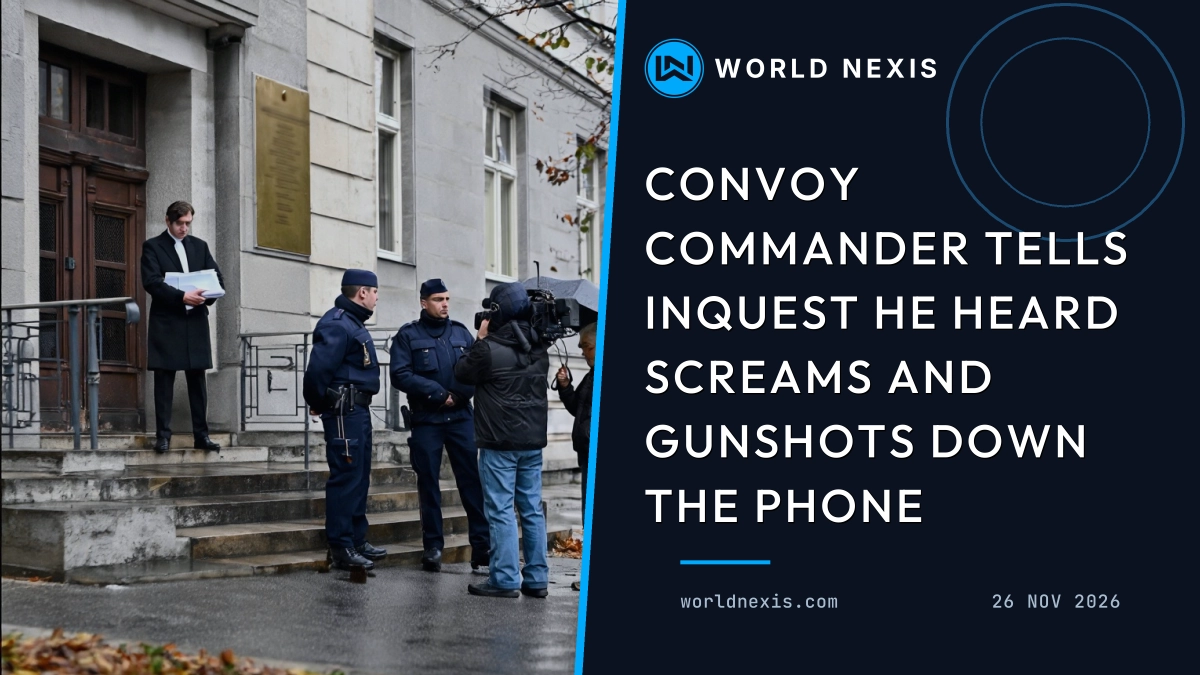
The Sean Rooney inquest has heard that the convoy commander heard screams and gunshots down a mobile phone as a crowd of up to 60 people surrounded an armoured Land Cruiser in southern Lebanon. Captain David Kelly told Dublin District Coroner’s Court on Thursday that he “assumed the worst” when firing broke out.
The court was told how the two-vehicle convoy split on the road to Beirut Airport on 14 December, and how the lead car drove on towards the village of Aaqbiyah after every promised source of help failed to appear.
Key points
- Captain David Kelly, who commanded the convoy, gave evidence at the Sean Rooney inquest in Dublin on Thursday.
- The lead vehicle left outpost EP28 several minutes before Pte Rooney’s Land Cruiser, which was held up by a key fob problem.
- Pte Rooney’s vehicle missed a turnoff and was surrounded by a crowd of up to 60 people in Aaqbiyah.
- Cpt Kelly said the Irish quick reaction team was more than 40km away and the Lebanese Armed Forces were “evidently not coming”.
How the Sean Rooney inquest heard the convoy split
The two armoured Land Cruisers were travelling between the Irish UN peacekeeping base and Beirut Airport. The plan was simple: Pte Rooney, driving the second vehicle, would follow Cpt Kelly’s lead car along a route the captain knew well.
Both stopped at an outpost known as EP28, which marks the edge of the United Nations Interim Force in Lebanon’s (Unifil) area of operations. Cpt Kelly’s vehicle then left several minutes before the second Land Cruiser, where an apparent issue with a key fob delayed the departure.
Shortly afterwards the lead car took a sharp turnoff onto a highway. The second vehicle could not close the gap after the staggered start and carried straight on, ending up in Aaqbiyah, where it was surrounded, attacked and fired upon. Pte Rooney, from Co Donegal, was shot dead.
Turning back to the outpost
Once he noticed the separation, Cpt Kelly turned his vehicle around on the highway and returned to EP28. The Sean Rooney inquest has already heard that he found no sign of his colleagues there.
He then called Corporal Josh Phelan, the convoy’s second in command and a passenger in Pte Rooney’s vehicle, to establish where they were. Cpt Kelly ordered the Land Cruiser to turn back and meet him at the turnoff for the highway.
More calls followed in quick succession. Cpl Phelan described a crowd of up to 60 people blocking the road, an obstruction the military calls a denial of freedom of movement. The crowd grew hostile, striking the vehicle with poles, smashing the rear window and breaking into the boot.
Twenty minutes that never came
At the Sean Rooney inquest, Cpt Kelly set out his efforts to find help for the second car. The jury was played a recording of his exchanges with Lebanese Armed Forces officials at EP28, who said they would send assistance in “about 20 minutes”.
He is heard acknowledging that and replying that he was “going to Aaqbiyah now”. By that point, he said, he knew the Irish quick reaction team had not deployed and was more than 40km away, Italian peacekeepers were not en route, and the Lebanese Armed Forces were “evidently not coming”.
In an earlier call to the besieged vehicle, Cpt Kelly said he could hear what was unfolding: “The boot was open, the screams, the gunshots.” He told the court he was not willing to leave the two men there, and that his group would “do it ourselves”.
Why it matters
Ireland’s contribution to peacekeeping in southern Lebanon is among the state’s longest overseas deployments, and the questions raised at the Sean Rooney inquest go to whether the protections promised to troops on the ground hold when a situation turns. For serving personnel and their families, the evidence is a test of how fast a blocked road is escalated and who answers the call.
The Sean Rooney inquest also sets out in public how thin the safety net can be at the edge of Unifil’s area of operations. The Unifil convoy attack highlights how national contingents and Lebanese forces must coordinate in real time, with minutes deciding the outcome.
Analysis
Having covered peacekeeping and conflict for World Nexis News, I look first at the timeline rather than the emotion, and this timeline says more about the system than about the officer in the lead car. In my view the evidence supports Cpt Kelly’s judgement on the day.
He had been told by the Lebanese Armed Forces that help was about 20 minutes away. He knew the Irish quick reaction team was more than 40km out and not yet moving. He could hear gunshots over the phone. Driving alone towards Aaqbiyah was the least bad option left to him, and the real question for the Sean Rooney inquest is why it was the only one.
The strongest counter-argument is that the convoy should never have been allowed to separate, and that a lead vehicle leaving EP28 without confirming the second car was moving is exactly the kind of small decision an inquest exists to test. Even granting that, a mission that cannot close a 40km gap in the minutes it takes a crowd to break a window is letting down the troops it deploys.
What happens next
The Sean Rooney inquest continues at Dublin District Coroner’s Court, with the jury to hear further evidence before returning findings on the circumstances of Private Sean Rooney’s death.
What we don’t know yet
No findings have been delivered and the hearing has not finished. The precise sequence of the calls, and the response of the Lebanese Armed Forces, are still being examined.
Related coverage
- Imperial Brands takeover: Altria weighs major all-cash bid
- Ambulance response times face urgent change after baby death
- Lambhill shooting: £20,000 reward in urgent appeal
Further reading
- Captain ‘assumed the worst’ after hearing gunshots, peacekeeper’s inquest hears
- Captain ‘assumed the worst’ after hearing gunshots, peacekeeper’s inquest hears
About the author: Marcus Ellington is the International Correspondent at World Nexis News (WNN), covering world affairs. The analysis section reflects the writer’s view.

Marcus Ellington
Marcus Ellington is International Correspondent at World Nexis News, reporting on diplomacy, conflict and the political forces reshaping Europe, the Middle East, Asia and the Americas. Based in London, he focuses on explaining why events unfold as they do, using official statements, diplomatic documents and…



