Economic revolution needed, Badenoch warns CBI chiefs
Kemi Badenoch tells CBI leaders Britain needs an economic revolution, not a new Brexit debate, warning the UK risks being left behind in the AI race.
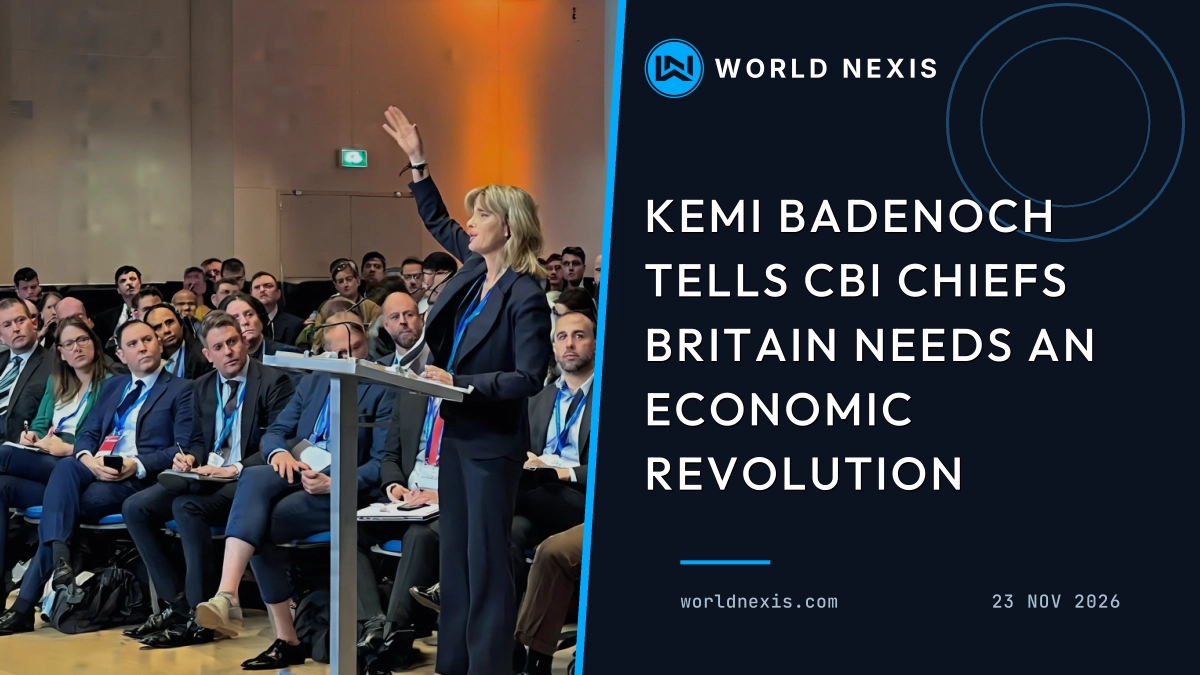
Kemi Badenoch has called for an economic revolution, telling the Confederation of British Industry’s annual conference that changing Britain’s relationship with Brussels will not fix the country’s growth problem. In her address at the Queen Elizabeth II Centre in central London, the Conservative leader accused the Prime Minister, Andy Burnham, of looking backwards by reopening the Brexit argument. She also promised to cut taxes, slash regulation and champion wealth creation if she entered No 10.
Key points
- Badenoch used the CBI stage to demand an economic revolution built on lower taxes, lighter regulation and cheaper energy.
- She said rejoining the EU “is not going to fix it”, and that staying outside the bloc would not fix it either.
- She accused Andy Burnham of restarting an argument that “created uncertainty” and “froze investment”.
- Labour said the Tory leader had her “fingers in her ears” over business support for the government’s EU deal.
The economic revolution pitch to business
Badenoch framed the choice facing Britain in stark terms. She told the conference that the country could “accept our fate, accept ever lower living standards, manage our decline”, or it could “forge something new”. She pointed to France, and to what has been happening in Paris, as a warning of what follows when a society grows poorer and feels powerless.
Her alternative was to harness “great minds, world-class universities, brilliant innovators”, plus a legal system, language and culture that still carry weight abroad. That, she argued, could “make Britain rich again”, but only if ministers fix the real drags on the economy: high energy costs, high taxes and red tape.
The Kemi Badenoch CBI speech was built around a single choice, and she returned to it repeatedly. “Something bad is happening in our economy and rejoining the EU is not going to fix it,” she said. “Nor will staying outside the EU automatically fix it either. Britain needs to be more ambitious than just changing our relationship with Brussels. We need an economic revolution.”
Why she says the Brexit row must wait
The Tory leader described a return to the Brexit argument as “the last thing our country needs right now”. She said Mr Burnham had “chosen to look backwards and restart an argument that created uncertainty, froze investment and distracted politicians from concentrating on economic growth”.
Her wider warning was about technology. Badenoch said the United States and China are “racing to develop some of the most exciting and disruptive technology ever created”. Britain, she added, faced being left behind with no say in that future if it tied itself to a “stagnating” Europe.
She also rejected the idea that the EU question settles the growth question, saying Britain is “stagnating, crushed under a welfare state we can no longer afford” and unable to blunt global energy shocks. The economic revolution she wants, she argued, depends on fixing those domestic problems first.
Business reaction and Labour’s counter-attack
A Labour Party spokesman said Badenoch had her “fingers in her ears” when it came to business. “She’s doubling down on a failed status quo because she’s too scared to admit that the Tories’ botched Brexit deal has held Britain back,” he said. He added that “more and more businesses back Labour’s new deal with the EU”.
Reform UK leader Nigel Farage, who also addressed the conference, said Mr Burnham held a “romantic” view of the EU that was not matched by the modern reality.
The Prime Minister has denied that the Burnham EU deal is a prelude to a referendum on Britain returning to the EU. That denial sits at the centre of the row, because a fresh vote on membership is precisely the outcome Badenoch says would wreck investment again.
Why it matters
For households and firms, this argument is about what actually moves the bills. Energy costs, taxes and planning rules set the price of doing business here; the EU relationship sets the terms of trade with Britain’s biggest market. Badenoch is asking voters to judge her on the first set and to stop arguing about the second.
That is a gamble on growth. Her economic revolution promises relief without yet saying what it costs, while the government’s deal offers movement with Brussels. Whichever shows results first will shape the next general election.
Analysis
Having covered devolution and public services for World Nexis News, I look first at what a speech like this means for the money that reaches councils, hospitals and colleges. Badenoch’s diagnosis is hard to dispute: energy costs, a tangled tax system and slow consenting genuinely hold firms back, and no change to the Brussels relationship rewrites those numbers overnight. On that narrow point I side with her, not with Labour’s suggestion that business enthusiasm for its EU deal answers the growth question.
My difficulty is the arithmetic. Cutting taxes, cutting regulation and cutting energy prices at once, while repairing the public finances and funding a technology push, is not yet a plan; it is a list. She gave the CBI no costings, no timetable and no account of which services would absorb the difference.
The strongest counter-argument is that a leader who picks one battleground looks more credible than one who picks five, and that Badenoch is deliberately refusing to fight where she believes her party has been weakest. I accept the discipline of that. Even so, credibility on growth needs at least one hard, costed commitment, and today we got the vision instead of the economic revolution she promised.
What happens next
Badenoch’s economic revolution now becomes the Conservative frame for the months ahead: growth first, Brussels later. The immediate test is whether she converts the slogan into specific promises, and her party’s next round of fiscal proposals is the obvious place to do it.
For the government, the pressure runs the other way. Mr Burnham has said MPs could vote on his EU deals before Christmas, which would move the argument from conference rhetoric to a Commons division.
What we don’t know yet
No date has been set for that vote, and there is no detail yet on what the deals would change in practice for exporters. Badenoch has also not said which taxes she would cut first, or how she would pay for them. Those gaps will decide whether the phrase outlasts the week.
Related coverage
- Center Parcs costs hit tipping point, boss warns of red tape
- Next cyber attack: retailer warns over supplier data breach
- Christmas posting dates: Post Office warns of 7 Dec peak
Further reading
- Badenoch calls for ‘economic revolution’ rather than reopening Brexit debate
- Badenoch calls for ‘economic revolution’ rather than reopening Brexit debate
About the author: Liam O’Connor is the UK Politics Reporter at World Nexis News (WNN), covering uk politics. The analysis section reflects the writer’s view.

Liam O'Connor
Liam O'Connor is UK Politics Reporter at World Nexis News, covering Westminster, devolved politics and the issues that matter to voters across England, Scotland, Wales and Northern Ireland. Based in London, he reports from primary sources — Hansard, official statements, published data — and explains…



