Netanyahu unity government offer sets 6 December deadline
Netanyahu unity government: Netanyahu has offered Gadi Eisenkot the first turn as prime minister in a unity government, but the coalition mandate expires…
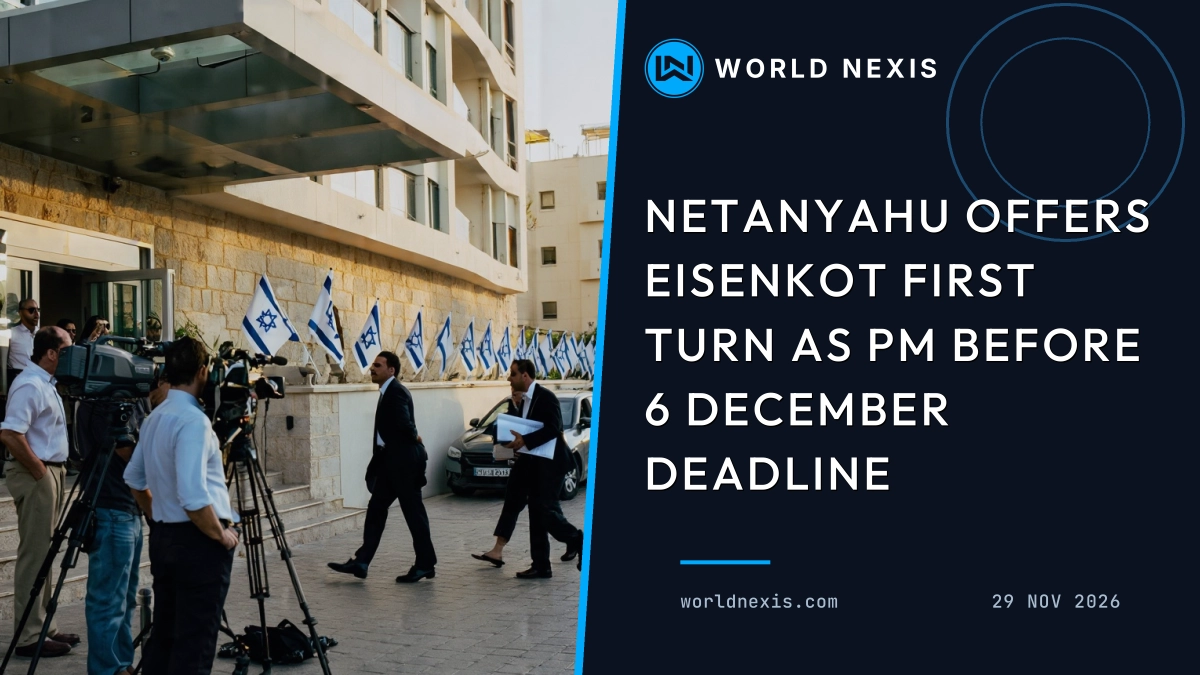
Benjamin Netanyahu’s offer to let his rival Gadi Eisenkot serve first in a Netanyahu unity government has handed Israel a seven-day sprint, because the mandate to build a coalition expires on 6 December and neither camp holds the 61 seats it needs. In a statement on Saturday, the prime minister said he would take the role of alternate prime minister at the start of a rotation and set aside what he called the principle of the largest party.
Key points
- Netanyahu said Eisenkot, who leads the centrist Yashar party, would serve first as prime minister in a cabinet that includes Likud.
- Eisenkot invited Likud to “genuine and accelerated negotiations” and gave the party 24 hours to prove it is serious.
- Likud’s bloc won 53 seats in October’s election and Eisenkot’s bloc 48, against the 61 needed in the 120-seat Knesset.
- President Isaac Herzog gave Eisenkot the first chance to form a government, and that mandate runs out on 6 December.
What the Netanyahu unity government offer actually says
Netanyahu was explicit about the concession at the heart of the Netanyahu unity government proposal. “My responsibility as a leader requires me to put everything aside, including the principle of the largest party, and agree that Gadi Eisenkot will serve first as prime minister, and I will serve at the beginning of the term as alternate prime minister,” he said.
He framed the pitch around security, citing “the magnitude of the existential danger and the possibility that a government will be formed that does not have the capacity to deal with this danger”.
Eisenkot answered within hours. He invited Netanyahu’s team to talks at his hotel and set a short clock: “If Likud is ready for genuine unity, I am ready to assess the seriousness of its intentions over the next 24 hours.” He said negotiations would be on a “detailed proposal” sent to Likud last Sunday, to which he said no response had arrived.
The exchange followed a public complaint. On Friday, Eisenkot accused Likud of stalling Israeli coalition talks and said the party had put forward no concrete proposals in two weeks. Netanyahu’s counter-offer landed hours later.
The seat arithmetic behind the Netanyahu unity government
The arithmetic has driven this crisis from the start. No party has ever won an outright majority in Israel, so every government is a coalition, and 61 of the Knesset’s 120 seats is the only threshold that counts. Likud and its allies took 53 seats in October; Eisenkot’s Yashar and three other Jewish opposition parties took 48.
Eisenkot has already banked two deals, with Yisrael Beiteinu and The Democrats. The fourth member of his bloc, Beyachad, is led by former prime minister Naftali Bennett, who said on Thursday that he favored a unity government involving Likud with Eisenkot serving first.
After Netanyahu’s announcement, Bennett said the prime minister had made the right decision in being “willing to join a unity government led by Eisenkot, a government based on an alliance of those who serve”.
An alternative route runs through Arab-led parties. Election results give the United Arab List and the Joint List a combined 19 seats, an unprecedented total after a surge in turnout among Arab voters, which makes both potential kingmakers. All but one of the Jewish parties pledged before the polls not to sit with them in government.
A possible bridge
One opening appeared on Saturday, when Raam leader Mansour Abbas said in a televised interview that his party recognized Hamas as a “terror group” and confirmed he had voted for a bill his party co-sponsored that carried the designation. Such a step could ease his party’s path into a coalition and loosen Eisenkot’s dependence on the Netanyahu camp.
Why it matters
For Israelis, the choice is not abstract. Whoever assembles 61 seats will govern on a razor-thin margin, with every partner able to extract a price for its support. A Netanyahu unity government would put two rival blocs inside one cabinet, and the terms settled in the next week would shape security policy and the budget for the life of the parliament, not just the name of the prime minister.
The wider cost is repetition. Israel held five elections between 2019 and 2022 as Netanyahu and his rivals failed again and again to work together, and the present standoff has the same shape. A sixth round would freeze decisions that cannot wait.
Analysis
Having covered foreign policy for World Nexis News, I look first at the sequence rather than the statement. Eisenkot says a detailed proposal went to Likud last Sunday and drew no reply for six days. The counter-offer arrived only after he accused Likud of stalling in public. I think that timing supports Eisenkot’s account of the past fortnight, and his 24-hour test is the correct response to it.
The strongest counter-argument is that the concession is real and expensive. Abandoning the principle that the largest party governs first is not a small move for a prime minister who has spent his career at the center of Israeli politics. If the offer is honest, Israel gets a broad cabinet at a moment of acute external threat.
My view is that the offer reads better as a bid to stay inside the room than as a plan to hand over power. The rotation terms have not been published, and that silence is where the next crisis is stored. Eisenkot should sign nothing that does not put the timing in writing.
What happens next
Eisenkot’s 24-hour clock, set on Saturday, puts the immediate pressure on Likud to send a team to his hotel for talks on the proposal already on his desk. Herzog’s mandate expires on 6 December, leaving roughly a week for a signed coalition agreement to be deposited. If that route fails, the seat count says Eisenkot could still reach 61 by relying on parties outside his own bloc, an arrangement that would be contested among his own partners.
What we don’t know yet
Likud has not said whether it will accept the 24-hour test. The length of each turn in the rotation has not been published, nor has the mechanism for enforcing it. It is also unclear whether Beyachad and the rest of Eisenkot’s bloc would sign a cabinet that includes Likud, or what price the Arab-led lists would set for their support.
Related coverage
- Putin G20: Trump says he can come to December 14-15 summit
- Iran Starlink use alleged in classified US war update
- Francesca Albanese leaves Costa Rica after 50-hour standoff
Further reading
- Netanyahu proposes Israeli unity government where rival Eisenkot becomes PM first
- Netanyahu offers to temporarily step aside in power sharing deal with rival Eisenkot
About the author: Marcus Ellington is the International Correspondent at World Nexis News (WNN), covering world affairs. The analysis section reflects the writer’s view.

Marcus Ellington
Marcus Ellington is International Correspondent at World Nexis News, reporting on diplomacy, conflict and the political forces reshaping Europe, the Middle East, Asia and the Americas. Based in London, he focuses on explaining why events unfold as they do, using official statements, diplomatic documents and…