Nvidia investigation: Huang faces 3 days of hearings
Todd Blanche won't discuss the Nvidia investigation as Jensen Huang prepares for three days of hearings over chips, China and Trump's key role.
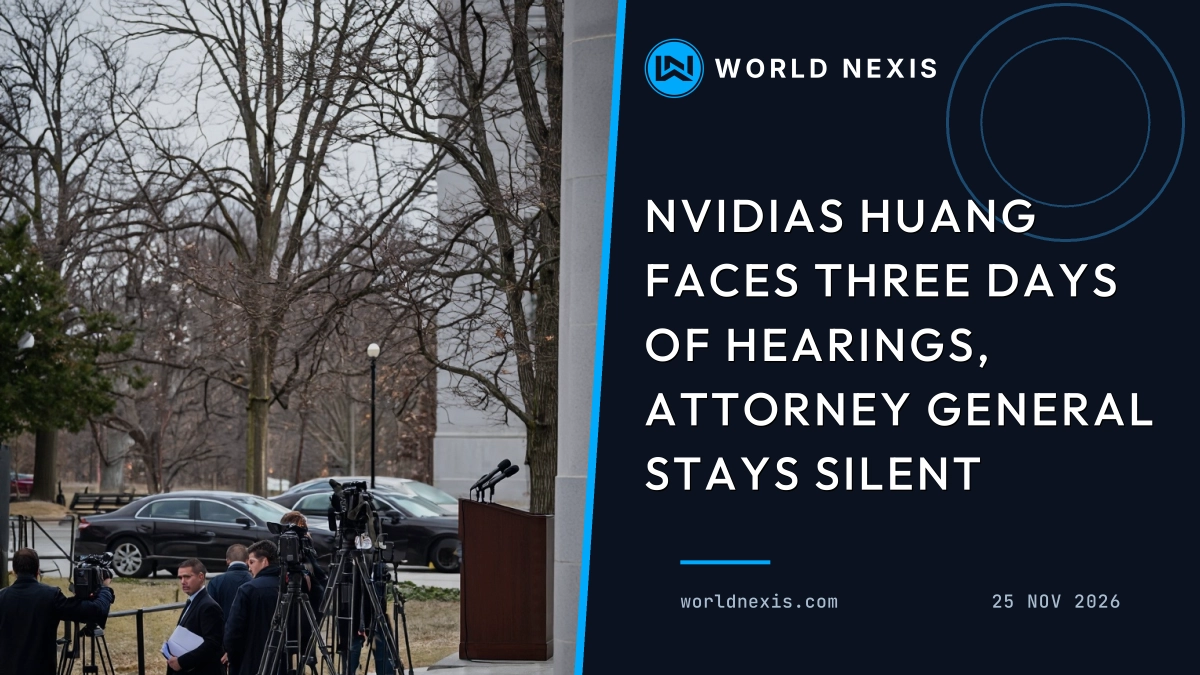
Attorney General Todd Blanche refused on Tuesday to say whether the Nvidia investigation into how advanced chips reached China ever examined Jensen Huang, as the company’s reinstated chief executive prepares for three days of congressional questioning. Speaking to reporters in Washington, Blanche would neither confirm nor deny any federal inquiry into Huang, and instead called the chipmaker “a good corporate citizen.”
Key points
- Blanche declined to answer repeated questions about the Nvidia investigation, saying: “I’m not going to talk about investigations.”
- Nvidia’s board reinstated Huang on Monday, days after he resigned over previously undisclosed relationships, including one with a woman US intelligence suspects of spying for China.
- Huang and Nvidia general counsel Tim Teter face closed-door interviews with congressional panels on December 1 and 2, then a public Senate Banking Committee hearing on December 3.
- Lawmakers in both parties want answers on President Donald Trump’s role in the reversal and on how Nvidia technology reached China.
Nvidia investigation: what the attorney general would not say
Blanche’s answers left the central questions of the Nvidia investigation untouched. Asked what he meant, he shot back: “What does that mean? Had Huang been investigated? For what?”
Pressed on whether an export inquiry was still running, he said: “I don’t know what you’re talking about,” noting the department has “hundreds, if not more” export investigations open at any one time. He added that he had no information about Huang’s security clearance status.
He did offer a firm defense of the company itself: “I have no reason to stand up here and say Nvidia is anything but a good corporate citizen.”
The White House’s role is why the questioning has sharpened. President Donald Trump has said he spoke with Nvidia’s directors and pushed them to bring Huang back, a sequence that turned a boardroom decision into a political one.
The Megaspeed question at the heart of the Nvidia investigation
Scrutiny centers on Megaspeed, a Singapore-based data-center company and Nvidia customer. It employed Alice Huang, a former executive whom US intelligence suspects of passing information to China and who is alleged to have had a relationship with Jensen Huang.
Megaspeed is alleged to have smuggled Nvidia’s most advanced chips into China and provided remote access to the technology in breach of export controls. The Commerce Department has said it is preparing to blacklist the firm, and the justice and commerce departments have said they opened a review of Megaspeed in 2024 over potential export-control violations.
Nvidia’s board says it took input from senior levels of the US government and was satisfied that Huang’s return posed no national security risk. Its chairman, Harvey Jones, said reinstatement was in the “best interests of our stockholders, employees, partners and customers.”
Lawmakers are not reassured. The Republican chairs of the House committees due to interview Huang said the board’s “brief internal investigation” does not “erase the national security threats and questions that must be addressed.” Republican Senator Pete Ricketts said Huang’s conduct “doesn’t absolve Nvidia of answering for national security concerns and unaccounted-for chips.”
Democrats are aiming at the president. Representative Robert Garcia, incoming chairman of the House oversight committee, said Trump’s “direct involvement” raises “serious national security and corruption questions,” while Senator Ruben Gallego said Congress must “investigate what stock positions took place before the announcement.” Even Republican congressman Don Bacon said Nvidia should have “ignored the Administration’s inexplicable desire to save Huang.”
Why it matters
Nvidia’s chips are the bottleneck of the artificial intelligence economy, and export rules decide who can buy them and at what price. Tighter licensing would raise the cost of building AI services and hand an advantage to overseas suppliers.
The money angle reaches ordinary households. Nvidia is held widely through index funds and pension portfolios, so a repricing tied to the Nvidia investigation lands in retirement accounts as well as on trading desks.
Analysis
Having covered AI policy and export controls for World Nexis News, I look first at the paper trail rather than the personalities, and on the record of the Nvidia investigation so far the sceptics have the stronger case. A board that cites “input” from senior government officials, an attorney general who will not discuss whether an inquiry exists, and a chief executive rehired within two weeks of resigning is not a picture of independent governance.
Nigel Green of the advisory firm deVere Group put the real test well: “Three tests will now decide how strongly it builds from here: how its leadership sits with Washington, how it handles China and how long AI spending keeps growing at this speed.”
The counter-argument deserves a hearing. No charges have been filed, the board says it received assurances, and a private relationship is not by itself evidence of a crime. Enforcement of chip rules, not a chief executive’s marriage, is what actually keeps technology out of China. Still, when the White House openly takes credit for a boardroom U-turn, the public interest in a clear account outweighs the company’s wish to move on.
What happens next
The Nvidia investigation now moves into open session. Huang and Teter sit for closed-door interviews with several congressional panels on December 1 and 2, before the Jensen Huang hearing in public before the Senate Banking Committee on December 3, covering export rules and global AI competition.
The Commerce Department is expected to act on Megaspeed, and analysts expect tighter licensing for sales across Asia. “There will definitely be tighter restrictions, and any dealings directly with China will be the government’s primary focus,” StoneX analyst Cody Acree said.
Nvidia stock jumped on news of the return and gave back part of that gain in volatile trading on Tuesday, a sign investors are pricing political risk rather than celebrating. Charles Elson of the University of Delaware’s corporate governance center said the reinstatement is likely to trigger shareholder lawsuits over disclosure.
What we don’t know yet
Whether any federal investigation into Huang exists, and whether his security clearance is intact, remain unanswered. Nvidia has not said whether it will pursue an independent inquiry into whether Huang was targeted by Chinese intelligence, and the board has not explained which government officials provided its “input.”
Related coverage
- Jensen Huang reinstated as Nvidia CEO, shares surge 30%
- Nvidia reinstates Jensen Huang as shares surge more than 31%
- Nvidia rehire: board reinstates Jensen Huang as CEO after Trump call
Further reading
- US attorney general dodges questions about Nvidia investigation
- Can Jensen Huang put out the fire he started at Nvidia?
About the author: Priya Nair is the Technology Correspondent at World Nexis News (WNN), covering technology. The analysis section reflects the writer’s view.

Priya Nair
Priya Nair is Technology Correspondent at World Nexis News, covering artificial intelligence, cybersecurity, consumer devices and the companies building them. Based in London, she explains how new technology works, who it affects and what the evidence actually shows, with attention to privacy, competition and the…