Nvidia rehire: board reinstates Jensen Huang as CEO after Trump call
Trump urges Nvidia rehire of Jensen Huang, saying it would be best for the company and the US, as Treasury demands answers on China chip sales.
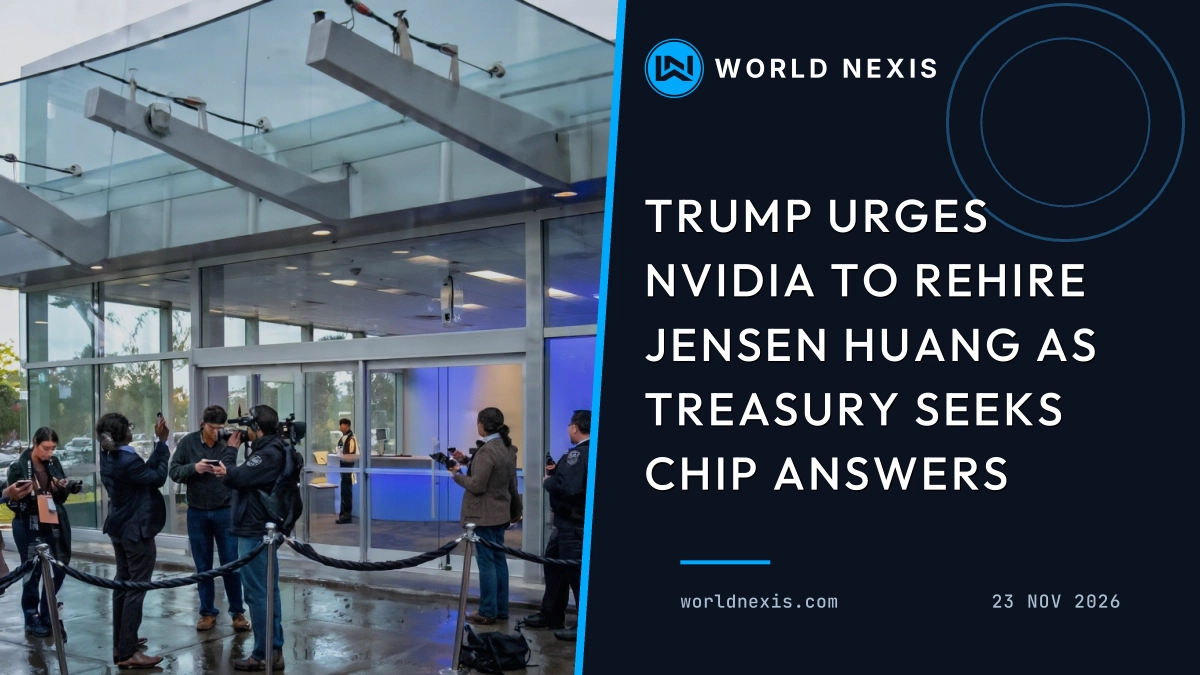
Updated 25 Nov 2026, 00:11 (UK time): Nvidia’s board reinstated Jensen Huang as chief executive on Monday, answering the rehire campaign Trump had publicly demanded, while the attorney general declined to say whether the Justice Department ever investigated Huang.
The Nvidia rehire question has been answered by the company itself. Nvidia’s board of directors reinstated Jensen Huang as chief executive on Monday, following President Donald Trump’s public call for directors to bring him back. Chairman Harvey Jones had said the board had no plans to do so; that position no longer stands.
Markets moved first and then reconsidered. Nvidia shares rallied on the announcement before the gains gave way to broader doubts about the artificial intelligence boom, with AI-linked stocks swinging sharply as investors questioned whether spending and valuations can hold.
Accountability is unresolved. Attorney General Todd Blanche declined to say whether the Justice Department investigated Huang, when pressed on the matter. The department had not substantiated the earlier spy allegation, but it is now unclear whether any formal inquiry was opened, closed or never began.
The sequence is what matters for World Nexis News readers: the president campaigned, the board complied, and the official who could confirm or close an investigation will not say. Treasury’s questions about who signed off on export compliance have not been answered by a personnel decision, and a reinstatement is not a finding. Shareholders are entitled to know which one they have been given.
The Nvidia rehire push reached the White House on Monday, when President Donald Trump publicly urged the chipmaker’s board to bring back Jensen Huang, its co-founder and former chief executive. In a post on Truth Social that morning, Trump said reinstating Huang would serve both the company and the country. His intervention came a day after Treasury Secretary Scott Bessent said Washington was still waiting for answers about Nvidia’s compliance with US export controls on chips sold to China.
Key points
- Trump wrote that he hopes Nvidia’s board rehires Huang: “It would be the best thing for the Company, and also, for the U.S.A.”
- Bessent said the administration had contacted Nvidia’s interim management, board members and lawyers to establish what happened.
- A Republican senator has called for senior officials to testify under oath about China’s access to advanced American chips.
- Nvidia’s chairman has said the board has no plans to bring Huang back.
Trump’s Nvidia rehire call puts the board on the spot
Trump has backed Huang repeatedly since allegations about his personal relationships ended his tenure at the company he helped build. The president now wants directors to reverse that outcome, framing a Jensen Huang return as a matter of national interest as much as corporate strategy.
Nvidia’s chairman, Harvey Jones, has said the board has no plans to bring Huang back. That leaves the Nvidia rehire question caught between a president who keeps speaking up and directors who have so far refused to move.
Treasury is still pressing for answers on Nvidia China chip exports
Bessent used a Sunday morning interview on CBS’s Face the Nation to set out what the administration still does not know. Officials have approached Nvidia’s interim leadership, its lead directors and its lawyers, and are trying to establish who was responsible for compliance with rules covering advanced AI processors.
“We do need to see who was in charge of compliance there,” Bessent said. He added that investigators wanted to know how far any knowledge travelled inside the company: “Was it at the lower levels? Was it the middle levels? Did it go all the way to the top?”
Bessent said Nvidia’s board was reviewing the matter and that he expected a full account. He also put accountability ahead of any talk of a comeback: “I think we have to see where the buck stops.”
Senators want sworn testimony on chip exports
The scrutiny is not confined to the Treasury. A Republican senator has called for senior officials to testify under oath about China’s access to advanced American chips, widening an inquiry that already touches the company, the export-control agencies and the White House.
At the centre of the dispute is whether processors built for artificial intelligence reached Chinese customers in breach of US restrictions. Washington has spent years trying to limit Beijing’s access to the most powerful AI hardware, and Nvidia sits at the heart of that effort. None of this has slowed the Nvidia rehire campaign.
What is established about the spy allegation
The row began with allegations about Huang’s relationships with a Chinese businesswoman and a company executive, which preceded his departure. Online speculation then suggested the businesswoman, Alice Huang, who is not related to him, might have been a Chinese agent. The Justice Department has not found sufficient evidence to support that claim.
Why it matters
Nvidia’s chips power the AI systems that governments, banks, hospitals and schools are beginning to depend on, so the identity of its chief executive and its export record are not private matters. A president lobbying openly for one executive, while his own Treasury demands accountability from the same company, shapes how investors and foreign buyers read American rules.
The Nvidia rehire argument is also a test of board independence. If a public campaign can decide who runs a strategic supplier, the line between industrial policy and personal loyalty becomes much harder for voters and shareholders to see.
Analysis
Having covered accountability fights in Washington for World Nexis News, I look first at who is asking whom for answers, and in what order. Here the order is upside down. The Treasury Secretary says he has still not established who signed off on compliance, yet the president is already campaigning for a chief executive’s reinstatement. On the public evidence, Bessent has the stronger case: find out what happened first, then decide who runs the company.
The best counter-argument is that Huang built Nvidia into the most important chipmaker in the world, and that pushing him out in the middle of an export dispute leaves the firm without the one leader who understands both its technology and its China exposure. That is a genuine cost. But it is an argument about performance, not accountability, and Trump has not tied his Nvidia rehire demand to any finding from the review now under way.
What concerns me more is the precedent. A president who announces which private executive should be reinstated hands every future board a reason to weigh political weather alongside governance. The Nvidia rehire decision should turn on what the review finds, and nothing in the public record suggests that review is anywhere near finished.
What happens next
Nvidia’s board continues its internal review, and Bessent has said he expects a comprehensive set of answers from the company. If the Republican senator’s demand for sworn testimony is taken up, current and former officials would be put on the record about how advanced chips reached China. Trump’s Nvidia rehire call, meanwhile, shows no sign of fading.
What we don’t know yet
It is not clear whether any senior Nvidia figure knew about possible breaches, or whether the compliance problems under examination sat at a lower level. No timetable has been set for a hearing, and the board has not said when its review will conclude.
Related coverage
- Credit card cap: Trump backs 10% limit in major shift
- Stewart Rhodes Trump split: ‘absolutely done’ with president
- Fred Nile state funeral call dropped after LGBTQI backlash
Further reading
- Jensen Huang’s Penchant for Leather Jackets Riles Men’s Designers
- Trump Urges Nvidia To Rehire Jensen Huang, Says It Would Be Best For US & Company
About the author: Ayesha Rahman is the Senior Political Correspondent & Columnist at World Nexis News (WNN), covering politics & opinion. The analysis section reflects the writer’s view.

Ayesha Rahman
Ayesha Rahman covers politics and opinion for World Nexis News from London, focusing on elections, legislatures and the policy choices that shape everyday life in the US and UK. She writes analysis and columns that separate what is confirmed from what is claimed, working from…



