Stewart Rhodes Trump split: ‘absolutely done’ with president
Stewart Rhodes Trump split: the Oath Keepers founder says he is 'absolutely done' with the president and plans to modify his Trump tattoo in Texas.
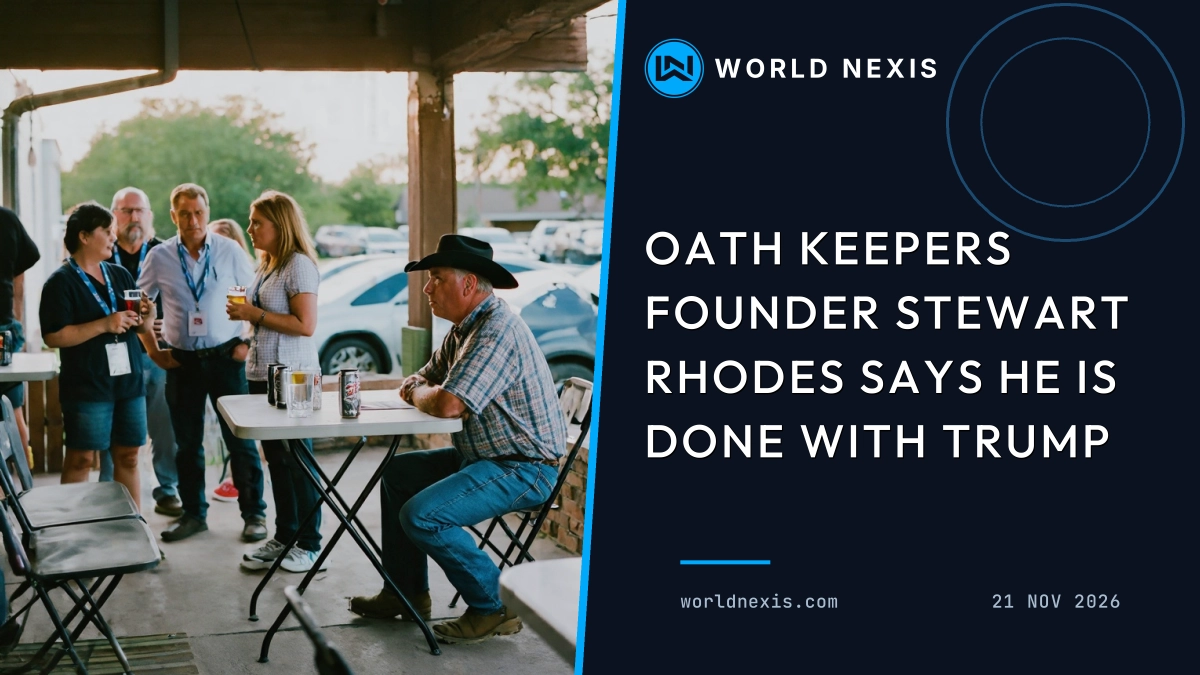
The Stewart Rhodes Trump split is now out in the open: the founder of the Oath Keepers, convicted of seditious conspiracy over the January 6 attack on the Capitol, says he is “absolutely done” with the president he once went to prison for. Rhodes spoke in Irving, Texas, during a three-day conference he titled “Christ is King: America After Trump”.
The Stewart Rhodes Trump rupture is not a quarrel about tactics. In his account the president is a traitor and “one of the very worst in our nation’s history”, a verdict delivered from a yellow table outside a pub while supporters drank nearby.
Key points
- Rhodes says he is “absolutely done with Trump” and calls the administration “one of the most corrupt administrations in U.S. history”.
- He dates the break to clemency for January 6 defendants: hundreds were pardoned, while his own sentence was only commuted.
- He blames Republican midterm losses, including historic Democratic wins in Texas, mainly on Trump alienating his own base.
- Rhodes says he will get his tattoo of Trump’s face, inked in prison, modified.
How the Stewart Rhodes Trump split took shape
Rhodes founded the Oath Keepers in 2009 to persuade serving soldiers and police officers to refuse what he called unconstitutional orders, from disarming citizens to warrantless searches. He is a Yale Law School graduate who worked for former Representative Ron Paul of Texas. After 2020 he was among the loudest voices claiming Joe Biden had won only through election fraud.
That loyalty was expensive. He served prison time for his role in the Capitol attack, and while inside he had Trump’s defiant face tattooed on his body after a gunman opened fire on the president in Butler, Pennsylvania.
He says the break began with paperwork. Trump pardoned hundreds of January 6 defendants but only commuted Rhodes’ sentence, leaving the conviction on his record. “That was the first inkling,” he said.
Other grievances piled up. Rhodes says the war with Iran broke the promise to end foreign conflicts. He was angered when the president dismissed people demanding the release of files on the Jeffrey Epstein case as “PAST supporters”. And he argues the promise to “drain the swamp” has been reversed.
“We elected him to end the corruption in Washington, D.C. ‘Drain the swamp.’ Unfortunately his administration has been one of the most corrupt administrations in U.S. history,” Rhodes said. “The pardons are pay-for-play and everything is pay-for-play.”
The White House did not respond to a request for comment.
A Texas conference, a tattoo and the Stewart Rhodes Trump fallout
The setting sharpened the message. Guests at his “Christian Warriors After-Party” signed up for Oath Keepers membership and for training in community defence and hurricane relief. Rhodes held court in a black cowboy hat, an eye patch covering an old gun injury.
He also rejected the fraud explanation he once pushed for Republican defeats. “The lion’s share is because Trump pissed off his own base,” he said of this year’s midterms, in which Democrats posted historic victories in Texas. He added that he and other January 6 defendants had been taken for granted by the Republican Party.
Then there is the tattoo, a portrait he now wants altered. He has not said how he intends to change it.
What extremism researchers see
Sam Jackson, an associate professor at the University at Albany who studies anti-government extremism, said the shift follows a pattern rather than breaking one. “They went from seeing Donald Trump as their ally in this fight against the conspiracy, to actually being co-opted by the conspiracy,” he said, describing a world view “driven by hidden, evil actors”.
Why it matters
The Stewart Rhodes Trump split puts a spotlight on how clemency has been used since January 6. Rhodes alleges the pardons were a transaction, and he makes that claim after receiving one himself. That argument stands or falls on records, not on his reputation.
For voters, the practical point is that the audit of the president’s promises no longer comes only from his opponents. It comes from people who once treated him as the answer to a conspiracy and now say they were used.
Analysis
In five years covering accountability and constitutional law for World Nexis News, I have learned to look past the theatre of a cowboy hat and an eye patch to the mechanism underneath. On the evidence here, the most important fact in the Stewart Rhodes Trump split is not that a militia founder changed his mind. It is that January 6 defendants were sorted into pardoned and merely commuted, and that one of them now calls the exercise pay-for-play. Where clemency is discretionary and unexplained, that charge is hard to answer.
So I side with the reading that this is a story about transactional power, not a movement collapsing. Rhodes is not renouncing the conspiracy thinking that put him in prison; he is applying it to the president, who becomes another hidden actor. The strongest counter-argument is that his grievance is personal and narrow, and that a convicted seditionist’s opinion should carry no weight. That is fair on his credibility, but it does not settle the pardon question.
What I would watch is whether other January 6 defendants echo him. If they do, the Stewart Rhodes Trump feud stops being a curiosity and becomes a problem for a party that Rhodes now says took him and others for granted.
What happens next
The White House has not responded to the criticism, and no hearing or deadline has been set over the clemency decisions Rhodes is attacking. He is using the conference circuit to rebuild instead, with events openly recruiting for the Oath Keepers and for training programmes.
What we don’t know yet
It is unclear how the White House will answer the pay-for-play allegation, or whether other January 6 defendants will follow him. Nor is it known what the modified tattoo will look like, or whether his break with Trump will shrink or expand the Oath Keepers’ reach.
Related coverage
- Marine Band donation: Trump and White’s $500,000 Grammy boost
- Data center tax: Trump threatens firms building AI abroad
- Trump crypto wealth nears $3bn as Democrats vow probes
Further reading
- Oath Keepers founder and Jan. 6 leader Stewart Rhodes is ‘absolutely done’ with Trump
- Oath Keepers founder and Jan. 6 leader Stewart Rhodes is
About the author: Ayesha Rahman is the Senior Political Correspondent & Columnist at World Nexis News (WNN), covering politics & opinion. The analysis section reflects the writer’s view.

Ayesha Rahman
Ayesha Rahman covers politics and opinion for World Nexis News from London, focusing on elections, legislatures and the policy choices that shape everyday life in the US and UK. She writes analysis and columns that separate what is confirmed from what is claimed, working from…



