Data center tax: Trump threatens firms building AI abroad
Trump says US tech firms face a 'tremendous tax' if they build AI data centers abroad, but gave no detail on the data center tax or enforcement.
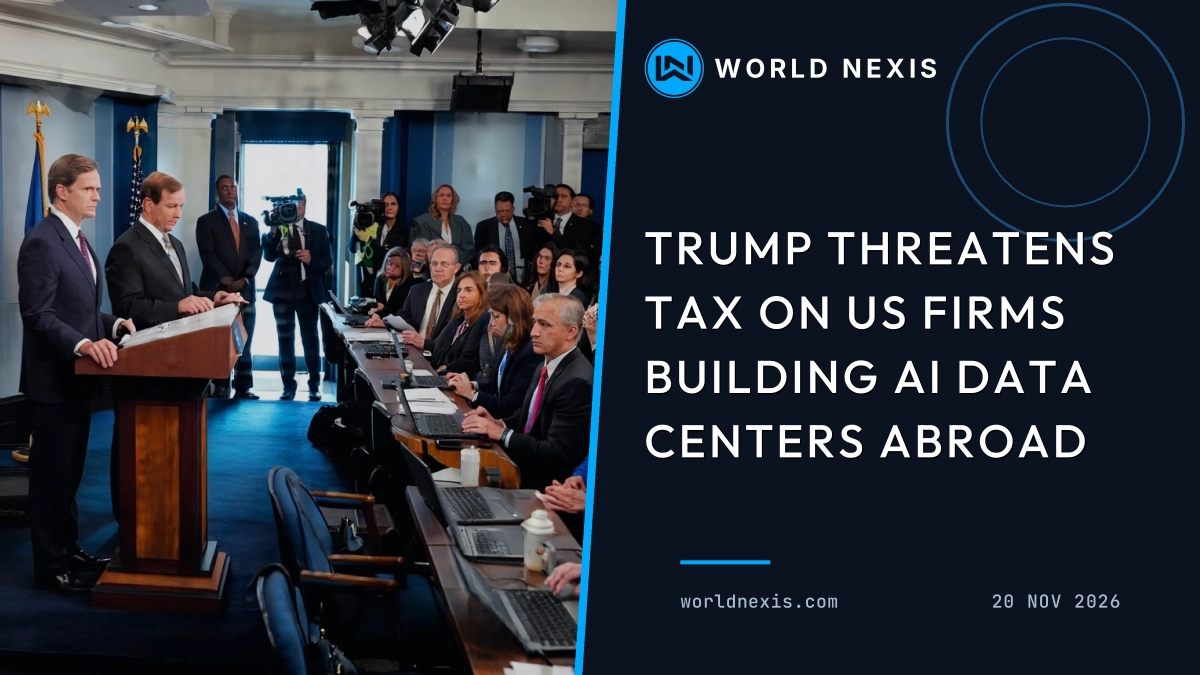
President Donald Trump said on Friday that US technology companies would face “a tremendous tax” under a proposed data center tax if they build artificial intelligence facilities overseas, but he offered no rate, no mechanism and no warning to the officials who would have to enforce it.
Speaking at a White House news conference after returning from a long trip to Asia, Trump said his administration would not permit American firms to build AI data centers abroad, and he pointed to China as the reason.
“We’re not going to allow our companies to build data centers outside of our country,” he said. “Because China will take all of them, and we’re not allowing that to happen.”
Key points
- Trump announced a data center tax threat against US firms building AI facilities abroad, without a rate, timeline or legal basis.
- He conceded that his own team was hearing about the policy for the first time at the briefing.
- Data centers were a potent issue in this month’s midterms, in which Democrats won control of Congress.
- He urged host communities to extract payments from developers instead of blocking projects.
Inside the data center tax announcement
Trump framed the move as a way to keep the artificial intelligence boom, and the electricity demand, construction jobs and tax revenue that come with it, inside the United States. “We’re going to keep it all in this country,” he said.
Yet the president gave almost no indication of how such a charge would work, and he appeared to surprise even his own advisers. Vice President JD Vance and Secretary of State Marco Rubio stood alongside him in the briefing room as he described the plan.
“I don’t know if that’s a breaking story, but I haven’t even said that to my people. But I’m telling them now, they’re here,” Trump said.
That admission matters. A tax on corporate activity abroad would normally be drafted by the Treasury, costed by analysts and defended by lawyers before it was ever announced. Instead, the data center tax arrived as a remark at the end of a long opening statement that ranged well beyond trade and technology.
The practical questions are unanswered. Would the data center tax apply to a company’s own overseas investment, or also to computing power it rents from partners abroad? Would it be collected as a corporate levy, a charge linked to exports, or a condition attached to approvals? No bill, executive order or agency guidance was described.
Why the data center tax lands now
Data centers have become one of the most divisive pieces of local politics in the United States. As of April there were about 3,000 across the country, with a further 1,500 at various stages of approval or construction, according to Pew Research Centre estimates.
The warehouses are power-hungry and often sited in rural areas, and disputes over noise, land and electricity bills have turned planning meetings into referendums. In the midterm elections earlier in November, candidates who promised tougher rules on construction won seats, and Democrats took control of Congress.
Trump’s answer is not to slow the build-out but to bargain over it. “You ought to take advantage of the data centers. Make them pay you, make them pay your community, but don’t shut them off,” he said. He argued that the places which want the facilities have energy and land, and that they are “tremendous assets”.
Canada trade talks and the Asia trip
The news conference ranged into trade. Trump said Washington was working toward a Canada trade deal that would be “fair”, while making clear the Canada trade talks remained difficult and that Ottawa had come to the table feeling “emboldened”.
He did not outline what a final agreement might contain or when one could be reached, and no timetable was given. The remarks came at the end of a trip during which Trump met Chinese President Xi Jinping and Russian President Vladimir Putin in China, an encounter he has presented as a demonstration of American strength.
“The United States entered this trip from a position of unmatched economic and diplomatic strength,” he said. He also said he and Xi had agreed on “joint guardrails” for artificial intelligence, telling reporters: “Problem is, it may be too super. So, President Xi and I agree that we’re going to do some joint guardrails, the two of us.”
Why it matters
For households, the immediate stakes are local: electricity bills, land use, noise and the terms a town can negotiate before a server campus arrives. If the data center tax ever takes effect, the costs would land differently, on shareholders, on the price of renting computing power, and possibly on the cloud services and AI tools consumers already pay for.
For the country, the announcement raises a bigger question about how the United States means to compete in AI: by attracting investment with permits and power, or by trying to trap it inside its borders with penalties that nobody has yet defined.
Analysis
Having covered White House policy for World Nexis News, I judge announcements by what comes attached to them: a bill number, a signing ceremony, a Treasury official with a spreadsheet. The data center tax has none of that. It was a sentence at a podium, delivered by a president who admitted his own people had not heard it, and that is not how a tax is made. I side with the sceptics, not because the goal is wrong but because a threat that cannot be administered is not a policy. It is a message aimed at boardrooms, and markets will price it accordingly within days.
The strongest counter-argument is that Trump’s instinct is sound. Computing capacity, grid demand and the corporate tax base that follows it are strategic assets, and other governments are only too willing to host the projects Washington is making awkward. A president who shrugs while the next wave of AI infrastructure is built elsewhere is also making a choice.
Even so, a serious version of this policy would look nothing like Friday’s version. It would define what counts as an overseas facility, set a rate, anticipate the legal challenges and survive contact with the companies expected to pay. I would rather judge the administration on the detail it publishes than the tax it invents at a podium.
What happens next
No legislation, executive order or agency guidance was announced, and officials did not say when the data center tax might be drafted. Congress returns with Democrats in control after this month’s elections, and the White House has not said whether it believes new legislation is needed.
What we don’t know yet
The rate, the scope and the enforcement route are all undefined. It is also unclear whether the tax would cover facilities US firms build and own, or only capacity they lease from partners overseas, and whether existing treaty obligations would allow it at all.
Related coverage
- Data center tax: Trump threatens firms building AI abroad
- Trump arch: federal judge extends 14-day building freeze
- Trump crypto wealth nears $3bn as Democrats vow probes
Further reading
- Trump threatens ban on US firms building AI data centres overseas
- Trump touts meeting with Xi and Putin but offers little results
About the author: Ayesha Rahman is the Senior Political Correspondent & Columnist at World Nexis News (WNN), covering politics & opinion. The analysis section reflects the writer’s view.

Ayesha Rahman
Ayesha Rahman covers politics and opinion for World Nexis News from London, focusing on elections, legislatures and the policy choices that shape everyday life in the US and UK. She writes analysis and columns that separate what is confirmed from what is claimed, working from…



