Data center tax: Trump threatens firms building AI abroad
Data center tax: Trump says US firms building AI sites abroad will face a 'tremendous tax', with no enforcement details and officials not told.
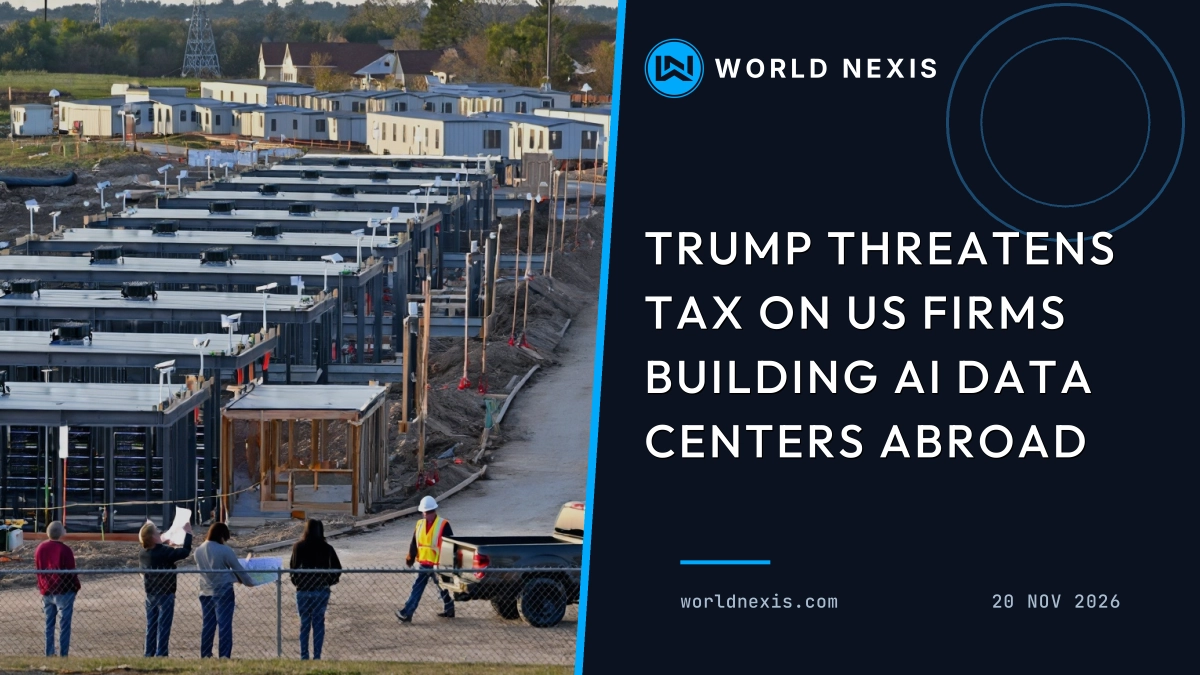
President Donald Trump said on Friday that US technology companies building artificial intelligence data centers in other countries will face a “tremendous tax”, unveiling a data center tax threat at the White House with no detail on how it would work or who would collect it.
“We’re not allowing data centers to go into other countries because China will take all of them, and we’re not allowing that to happen,” Trump said at a press briefing in Washington. “And we’re going to put tremendous penalties on companies that try and do it.”
Key points
- Trump announced the data center tax threat at a White House briefing on Friday, saying overseas AI construction would attract “a tremendous tax”.
- He named no rate, no legal mechanism and no enforcement agency, and said he had not yet told his own officials.
- He urged American communities to negotiate with developers instead of rejecting them: “Make them pay you, make them pay your community, but don’t shut them off.”
- The remarks came a day after the Republican-led Senate passed bipartisan permitting legislation, which now goes to the House.
What the data center tax threat actually says
Trump cast the policy as a national security question rather than an industrial one. On his account, computing capacity built outside the US would fall under Chinese influence, so Washington should keep it at home.
Beyond that framing, the announcement left the machinery blank. The president did not provide details on how such a policy would be enforced, and he said he had not yet told his own officials about the plan.
The gap matters because a tax needs a base, a rate and a collector. Companies weighing new campuses in Europe or Asia have no way to price the risk, and no agency has been named to write rules.
Trump also used the briefing to sell the buildings to the towns that host them. He said Americans should welcome construction and bargain hard for money and community benefits, rather than turning projects away.
Why Washington is squeezing data centers abroad
The politics at home explain much of the pressure. Host communities across the US are turning against the vast server warehouses that power the AI boom, and local opposition to permits has become a real bottleneck for developers.
Anger over the buildings and rising electricity prices helped carry Democrats to control of Congress in the midterms. Trump, by contrast, has championed the industry, and on Friday he repeated an argument he made before the vote: towns should extract concessions rather than refuse projects.
On Thursday the Republican-led Senate approved bipartisan legislation to speed up permitting for power plants, transmission lines and other energy infrastructure. The bill would shorten timelines for large energy projects and require data centers to pay for the electricity they use and for grid upgrades. It now goes to the House, and Trump said it would cause “tremendous amounts of new building”.
What it means for Google, Meta and the AI build-out
Overseas sites are how cloud providers serve customers in distant markets, and sometimes how they satisfy local data rules. A data center tax on construction abroad would land on those plans directly, and on the companies furthest into expansion.
Google and Meta have said they are trying to address mistrust by being more transparent with the communities where they want to build. The industry is also promising to take fewer taxpayer handouts, keep fewer secrets and spend more money in host areas.
Those pledges are aimed at the domestic fight, not the overseas one. Nothing in Friday’s announcement addressed how a company would be treated if it built in both places at once, which is the standard pattern for the largest operators.
Why it matters
For most readers the first effects will show up in electricity bills and planning meetings, not in cloud storage. Data centers compete for power, and the Senate bill would push developers to fund the grid upgrades they trigger.
For the country, the question is whether AI computing is now treated as a strategic asset that must stay inside the US. If the data center tax is enforced, the cost of training and running models could rise, and the firms that dominate the industry would have to re-plan years of spending.
Analysis
Having covered AI policy for World Nexis News, I look first at whether an announcement has a mechanism behind it. This one has a sentence and a threat, but no rate, no agency and no draft text, and the president said his own officials had not been briefed.
In my view the evidence supports the skeptical reading. Congress has just sent the White House a permitting bill that treats data centers as an energy problem to be managed, not an export to be banned. That bill, not a press conference, is what will shape where servers get built.
The strongest counter-argument is fair: computing capacity built in overseas data centers sits beyond US jurisdiction, and the China concern is not imaginary. Even so, the data center tax as described is a bargaining position, and companies will treat it as one until something is written down.
What happens next
The permitting bill now goes to the House, where no floor timetable has been set. The White House has not said when more detail on the tax threat will follow.
What we don’t know yet
There is no draft text, no rate and no named agency. It is also unclear whether the administration believes it needs Congress to create a tax, or intends to work through existing trade powers.
One test will be whether the biggest developers slow their overseas plans. The other will be at home, where the industry’s promises of transparency and money face continued resistance in host towns.
Related coverage
- Trump arch: federal judge extends 14-day building freeze
- Trump crypto wealth nears $3bn as Democrats vow probes
- Peace declaration caps Trump Xi Putin summit in Shenzhen
Further reading
- Trump vows to stop U.S. companies from building data centers abroad, threatens ‘tremendous tax’
- Trump says he plans to penalize companies that build data centers in other countries
About the author: Priya Nair is the Technology Correspondent at World Nexis News (WNN), covering technology. The analysis section reflects the writer’s view.

Priya Nair
Priya Nair is Technology Correspondent at World Nexis News, covering artificial intelligence, cybersecurity, consumer devices and the companies building them. Based in London, she explains how new technology works, who it affects and what the evidence actually shows, with attention to privacy, competition and the…