Peace declaration caps Trump Xi Putin summit in Shenzhen
The peace declaration signed by Trump, Xi and Putin in Shenzhen covers nuclear risk and UN reform but sets no arms cuts and leaves Ukraine unaddressed.
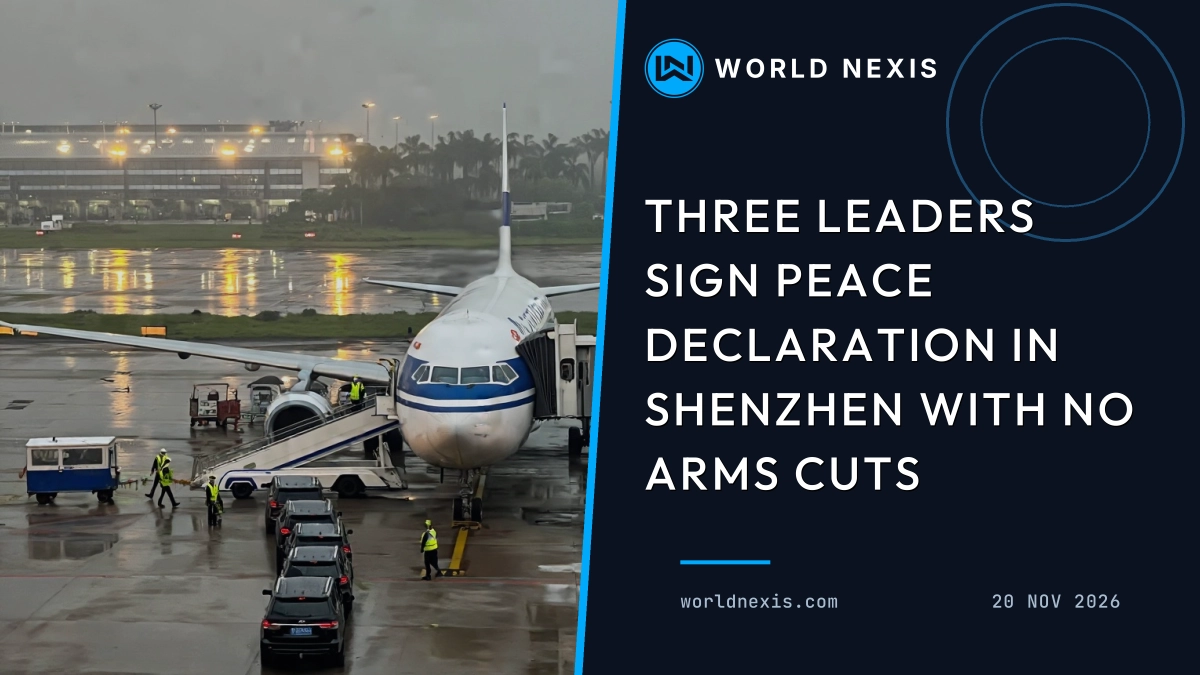
The peace declaration signed by Donald Trump, Xi Jinping and Vladimir Putin in Shenzhen commits the world’s three largest nuclear powers to talks on cutting nuclear risk, to reform of the United Nations and to higher oil supply, but contains no pledge to shrink their arsenals. The three leaders met on 19 November 2026 at the Asia-Pacific Economic Cooperation summit, in the first trilateral talks of their kind.
Key points
- Trump, Xi and Putin held the first three-way meeting of the three countries, at the APEC summit in Shenzhen.
- The peace declaration covers nuclear risk, UN reform, petroleum supply and opposition to the International Criminal Court’s “jurisdiction abuse”.
- No commitments were made to cut nuclear arsenals, and the text did not address Russia’s war in Ukraine.
- Trump will hold a White House news conference on Friday after a nearly 15-hour nonstop flight home.
What the peace declaration actually says
The document rests on four points. The leaders said nuclear war “cannot be won and must never be fought”. They committed to reform the UN so that it responds more effectively to global challenges, and to increase the production and supply of petroleum. The fourth point flagged the immunity enjoyed by state officials and said the International Criminal Court and similar institutions “must not abuse their jurisdiction”.
Before the closed-door session, Xi cast great-power cooperation as an obligation rather than an option. “Positive interaction among major powers is not a matter of choice, but a mandatory requirement,” he said. Putin said the three shared an interest in ending the war in Ukraine and in food and energy security.
Trump closed the opening remarks by saying the leaders of three of the world’s largest countries carry a “special responsibility” to keep talking. “Too often past leaders have avoided talking to nations with whom they had disagreements,” he said. “We feel the opposite.”
Nuclear risk, Iran and the gaps in the text
Trump had insisted that arms control sit at the centre of the summit. “As the world’s three largest nuclear powers by far, the United States, Russia, and China are uniquely positioned to discuss how to reduce the number of nuclear weapons on Earth, and also to lessen the risk that those weapons will ever be used,” he said before the talks. The statement issued afterwards promised an “in-depth exchange of views on the current international situation” and a commitment to “maintaining strategic stability and international security”. It also set up a three-way dialogue on reducing nuclear risks and preventing proliferation, but the peace declaration announced no reductions.
Instead, Trump used the nuclear theme to defend the US war with Iran. He said it was vital the three countries cooperated against the threat of proliferation elsewhere, adding: “That’s what we’re doing in Iran. We’re not going to let Iran have a nuclear weapon.” The peace declaration made no reference to Russia’s war in Ukraine, launched in 2022, or to Iran.
Putin called the meeting “an important chapter in the history of diplomacy”. He said Ukraine and Europe were not yet ready to make the compromises needed to end the war, and that Russia had invited EU representatives to Moscow to understand Europe’s position better.
Air Force One record flight and a summit short on detail
Trump left Shenzhen without taking questions from reporters. In a post on his social media platform while flying home, he called the trip “a great and highly consequential trip” and announced a White House news conference for Friday. The return leg produced its own story: Air Force One flew nearly 15 hours nonstop from China back to Washington, setting aviation records for the presidential aircraft.
The symbolism of the Shenzhen summit was never in doubt, with three leaders who between them command the largest nuclear arsenals posing as a stabilising directorate. The substance is thinner, and the warm words about dialogue sat awkwardly beside a continued absence of any mechanism to verify what the three governments say they will do.
Why it matters
Two parts of the peace declaration reach beyond the summit room. The promise to increase petroleum production and supply was the only economic commitment the leaders made, and energy prices feed into fuel bills, transport costs and inflation. The passage on the International Criminal Court touches something more fundamental: whether state officials can be held to account for war crimes and other abuses. A text that links officials’ immunity to a warning about “jurisdiction abuse” offers comfort to governments that resist scrutiny.
For ordinary readers, the nuclear element is the least concrete. Three states with the largest arsenals agreed to talk about risk, not to cut stockpiles, so nothing in the document changes how many warheads exist or where they point.
Analysis
Having covered summit diplomacy and arms control for World Nexis News, I read these declarations backwards: I start with what the leaders did not promise. This time it is a single warhead. Trump arrived saying the three countries were “uniquely positioned” to reduce the number of nuclear weapons on Earth, and he leaves with an agreement to keep discussing the risk of using them. Those are different things, and only one of them changes the arithmetic of an arsenal.
In my view the facts support the sceptical reading, and the clause that worries me most is the one on the International Criminal Court. Framing the court’s work as potential “jurisdiction abuse”, in the same document as a reference to officials’ immunity, points in one direction: it gives cover to states that would rather their officials never stood in a dock. Nuclear dialogue is worth having, but a peace declaration that pairs it with a swipe at accountability is not a clean win for anyone outside those three rooms.
The strongest counter-argument is honest, and I take it seriously: talking to adversaries is not a concession, and a standing three-way channel on nuclear risk is better than silence between countries holding weapons of this scale. That is why I would not call the summit worthless. But a channel with no numbers attached is a promise to have a conversation, not a peace process.
What happens next
Trump speaks at the White House on Friday, when he is expected to give his account of the trip and face the questions he avoided in Shenzhen. The three governments have committed to a dialogue on reducing nuclear risk and preventing proliferation. Putin’s invitation to EU representatives to visit Moscow is the other open thread, and it comes as the war in Ukraine continues.
What we don’t know yet
No date or format has been given for the nuclear dialogue, and it is unclear whether it will involve leaders or officials. Nor is it known whether the promised increase in petroleum supply carries specific volumes, or whether Friday’s news conference will set out any plan for Ukraine.
Related coverage
- Shenzhen summit: historic Trump-Putin-Xi peace declaration
- Trump Xi Putin summit: 3 leaders vow peace in historic talks
- Trump Xi summit: historic first three-way talks with Putin
Further reading
- Trump, Putin and Xi release ‘peace declaration’ after historic meeting
- Trump China trip: Iran and Ukraine not in ‘peace declaration’ and more takeaways
About the author: Marcus Ellington is the International Correspondent at World Nexis News (WNN), covering world affairs. The analysis section reflects the writer’s view.

Marcus Ellington
Marcus Ellington is International Correspondent at World Nexis News, reporting on diplomacy, conflict and the political forces reshaping Europe, the Middle East, Asia and the Americas. Based in London, he focuses on explaining why events unfold as they do, using official statements, diplomatic documents and…



