Trump Xi Putin summit: 3 leaders vow peace in historic talks
At the Trump Xi Putin summit in Shenzhen, the three leaders pledged to prevent nuclear war as Putin vowed a painful response to Ukraine's bridge strikes.
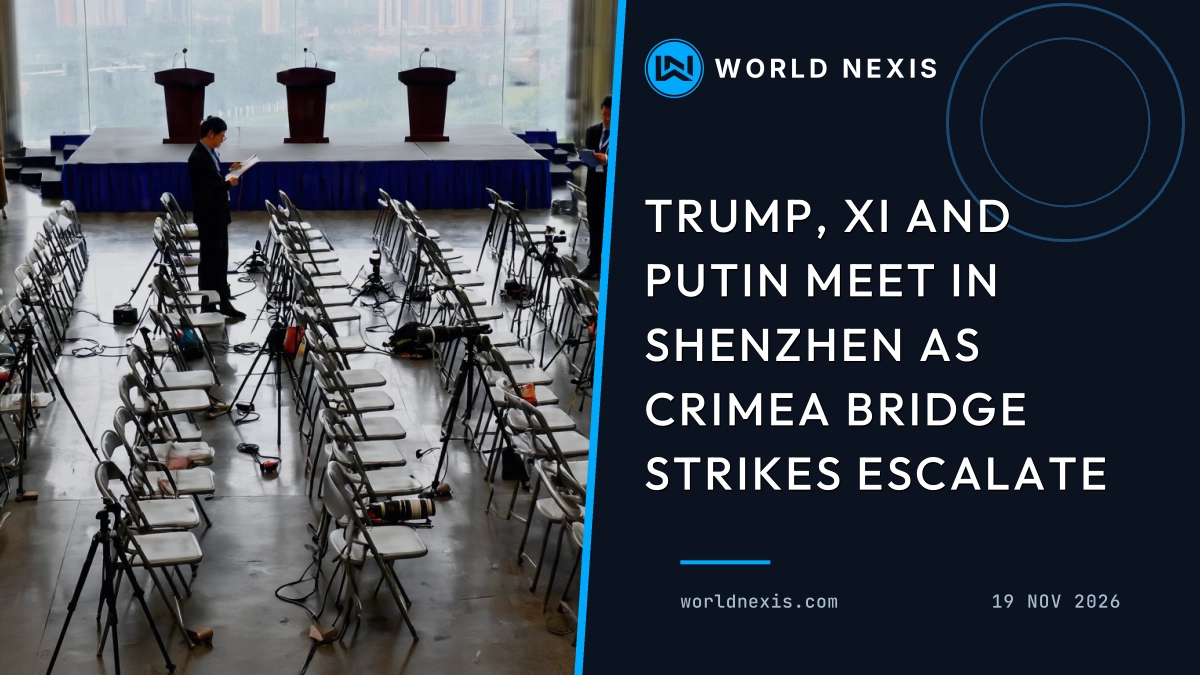
The Trump Xi Putin summit in Shenzhen on Thursday put the leaders of the world’s three largest nuclear powers in one room, with Donald Trump telling the opening session that the three were “really making history”. The meeting ran alongside the Asia-Pacific Economic Cooperation (APEC) gathering in southern China, with Ukraine, Iran, trade and nuclear disarmament on the agenda.
Hours later, Vladimir Putin used a press conference after the talks to warn that Moscow’s answer to Ukraine’s strikes on the Crimean Bridge would be “far more painful” than Kyiv’s attacks. The 12-mile bridge connecting Russia to the occupied peninsula was hit for a third time this week in the early hours of Thursday.
Key points
- Trump, Xi Jinping and Putin held a historic trilateral meeting, with nuclear weapons, Iran and the war in Ukraine on the table.
- Trump said the three countries were “uniquely positioned” to cut nuclear stockpiles, and called the International Criminal Court “out of control”.
- Putin vowed a “far more painful” response to the Crimean Bridge strike, which damaged the structure again on Thursday.
- Xi Jinping said nuclear weapons should be “comprehensively prohibited and completely destroyed”.
What the Trump Xi Putin summit produced
Trump opened the session by saying the United States, Russia and China were “uniquely positioned” to discuss reducing their nuclear stockpiles. He also attacked the International Criminal Court as “out of control”, even though Putin is subject to an arrest warrant issued by the court in 2023.
Putin said the three countries had “many converging interests” in resolving conflicts, including the war in Ukraine, and spoke of a shared responsibility for international peace and security. Xi called for every effort to be made to prevent nuclear war, adding that nuclear weapons should be “comprehensively prohibited and completely destroyed”.
Iran was also on the agenda, alongside trade and the disarmament question that dominated the leaders’ public remarks. None of the three set out how any of those files would be taken forward.
The warmth of the setting sat awkwardly against the fighting on the ground. Putin ordered Russia’s full-scale invasion of Ukraine more than four years ago, and Moscow has regularly targeted Ukrainian civilian infrastructure since, including key bridge crossings over the Dnipro River in Kyiv this week.
Putin’s warning over the Crimean Bridge
Thursday’s Crimean Bridge strike followed a combined missile and drone attack on Tuesday that destroyed its central road section and collapsed part of the double-arched span into the water. Ukraine said the latest attack was carried out with Neptune cruise missiles.
Russia’s transport ministry said nobody was hurt and that specialists were assessing the damage. Train services were suspended but resumed in the afternoon, while car traffic will be prohibited for the foreseeable future because a section of tarmac about 200m (660ft) long was dragged into the sea.
Putin insisted the bridge was used exclusively for civilian purposes, not to move military equipment or petroleum products, a claim Kyiv disputes. Ukraine’s defence ministry said the strikes amounted to “time gained and lives saved”, adding: “The less that reaches the occupiers, the less hits our warriors.”
The bridge was unveiled in 2018, four years after Russia illegally annexed Crimea, and has long been a target because of its role in supplying Russian troops in the occupied south. Moscow has used the peninsula as a military base since 2014, with airbases, troop concentrations, training grounds and artillery stockpiles.
President Volodymyr Zelensky called the earlier strikes an “unprecedented operation” weeks in the making. Kremlin spokesman Dmitry Peskov said the bridge “will be rebuilt, and it will be even better than before”.
Why it matters
The Trump Xi Putin summit matters beyond its choreography because the three men command the world’s largest nuclear arsenals. Any understanding between them, written or implied, shapes the risks hanging over Europe and the energy and food prices that households pay.
For Ukraine, the timing is uncomfortable. A strike on Russian-held territory was answered the same day with a promise of escalation, delivered in front of the two leaders whose support Kyiv depends on. The leaders’ public remarks made no mention of a ceasefire demand.
Analysis
The question I keep coming back to is what Putin gave up in Shenzhen. Having covered conflict and diplomacy for World Nexis News, I watch the sequence rather than the handshakes: a Ukrainian strike closes the central road span of the Crimean Bridge on Tuesday, another follows on Thursday, and by the afternoon Putin is standing beside the American and Chinese presidents describing the three as jointly responsible for world peace.
That is a diplomatic win handed to him at no visible cost, and I think it is the most consequential thing to come out of the summit. Xi’s intervention is the one I would take most seriously, because a call for nuclear weapons to be prohibited and destroyed only matters if talks follow, and nothing in the public statements suggests a framework yet. Trump using the platform to attack the ICC while sitting beside a man the court wants arrested also muddies the accountability picture for Ukraine’s allies.
The strongest counter-argument is that refusing to sit with adversaries has produced nothing but a longer war, and that a channel between the three biggest nuclear powers is better than none. I accept that. But engagement without a ceasefire demand or a concrete nuclear framework is a photograph, not a policy, and on the evidence available I side with those who say Moscow gained more from this room than Washington or Beijing did.
What happens next
Engineers will keep assessing and repairing the Crimean Bridge, with road traffic barred and rail services running again. Moscow has promised retaliation for the strikes but has not said what form it will take, or when.
The APEC summit continues in Shenzhen, and further meetings between the delegations are possible. Trump’s framing of the three powers as “uniquely positioned” on nuclear reductions has not yet been matched by a timetable, a venue or a negotiating team.
What we don’t know yet
It is unclear whether any written commitment on nuclear weapons or on Ukraine emerged from the Shenzhen trilateral talks, or whether the three will meet again in this format. The scale of Russia’s promised response, and whether it targets Ukrainian cities or infrastructure, also remains open.
Related coverage
- Trump Xi summit: historic first three-way talks with Putin
- Trump Xi Putin summit: historic three-way talks in China
- APEC summit: Xi and Putin open historic talks before Trump
Further reading
- Putin vows ‘far more painful’ response to Ukraine’s strikes on Crimean Bridge
- Apec summit live: Trump, Xi and Putin make ‘peace declaration’ at talks
About the author: Marcus Ellington is the International Correspondent at World Nexis News (WNN), covering world affairs. The analysis section reflects the writer’s view.

Marcus Ellington
Marcus Ellington is International Correspondent at World Nexis News, reporting on diplomacy, conflict and the political forces reshaping Europe, the Middle East, Asia and the Americas. Based in London, he focuses on explaining why events unfold as they do, using official statements, diplomatic documents and…



